
By ProHobby™ | Ecological Systems Authority
Koi Herpesvirus is the single most economically and emotionally devastating disease a koi keeper will ever encounter, and understanding why requires understanding a combination of biological facts that, together, make this disease genuinely unlike anything else covered in this site’s disease library. It kills with a speed and completeness that rivals or exceeds the fastest bacterial emergencies covered elsewhere on this site. It is temperature-dependent in a way that makes the same pond dangerously vulnerable in spring and autumn and comparatively safe in the height of summer or the depths of winter. Every fish that survives an outbreak becomes a lifelong carrier capable of triggering new outbreaks in other fish for the rest of its life. And, as with every viral disease covered throughout this library, there is no cure — no antibiotic, no antiparasitic, no antiviral product available to the hobbyist that clears an established infection. This guide covers the full biology behind each of these facts, because understanding the mechanism is what makes the emergency response and, more importantly, the prevention discipline in this guide make sense rather than feeling like an arbitrary set of rules.
Table of Contents
- What Koi Herpesvirus Actually Is
- The Temperature Window — Why the Same Pond Is Safe in Summer and Lethal in Spring
- Symptoms — Recognising KHV Before It Is Too Late
- Why Mortality Rates Are So Catastrophic
- Species Susceptibility — Why Goldfish Confuse the Picture
- The Carrier State — Why Survivors Are Never Safe Again
- Is KHV Treatable? Why the Honest Answer Is No
- Diagnosis — PCR Testing and Why Clinical Suspicion Alone Is Not Enough
- Emergency Response — What to Do During a Suspected Outbreak
- Biosecurity — The Only Real Defence
- Quarantine Protocol Specific to KHV
- The Stress-Trigger Relationship in Carrier Fish
- KHV vs Other Koi Mass Mortality Causes
- India — Notifiable Status, Surveillance and Practical Realities
- Frequently Asked Questions
1. What Koi Herpesvirus Actually Is
Koi Herpesvirus disease is caused by Cyprinid herpesvirus 3 (CyHV-3), a large double-stranded DNA virus belonging to the same broad viral family that includes herpesviruses affecting numerous other vertebrate species, including humans, though CyHV-3 itself is entirely host-specific to cyprinid fish and poses no zoonotic risk whatsoever. The virus was first formally recognised and characterised in the late 1990s, following a series of previously unexplained mass mortality events in koi and common carp populations across multiple countries, and has since been identified as one of the most economically significant pathogens in global carp and koi aquaculture.
Like every herpesvirus family member across every host species it infects, CyHV-3 establishes lifelong latent infection in survivors — a defining viral family characteristic covered in depth in Section 6 — rather than being cleared entirely from a recovered fish’s system the way many bacterial and parasitic infections eventually are following successful treatment or natural immune resolution.
2. The Temperature Window — Why the Same Pond Is Safe in Summer and Lethal in Spring
This is the single most important and most counterintuitive fact about KHV, and the one that most directly shapes both the emergency-response and the seasonal-vigilance recommendations throughout this guide.
CyHV-3 causes clinical disease and mass mortality specifically within a defined temperature range, generally cited as approximately 16 to 28°C, with peak virulence typically in the middle of this range. Outside this window — in water colder than roughly 16°C or warmer than roughly 28°C — the virus becomes clinically much less active, and fish carrying the virus, including fish that would develop severe disease at intermediate temperatures, frequently show minimal or no outward symptoms despite carrying an active viral load.
The practical, genuinely dangerous consequence of this temperature dependency: a pond that has just come through winter cold water with no signs of illness, or a pond currently in the height of summer heat showing no problems, is not thereby confirmed KHV-free — it may simply be outside the temperature window in which the virus produces visible disease. The genuinely highest-risk periods are the transitional seasons, spring and autumn, when pond water passes through the 16–28°C range, frequently coinciding exactly with the periods when new koi are most commonly purchased and introduced, and when existing fish experience the seasonal temperature-change stress that, as established in Section 12, is itself a documented trigger for latent virus reactivation in carrier fish. Aquarium Water Temperature in Indian Summer and the general seasonal pond management principles in Koi Pond Setup in India are directly relevant to understanding when an Indian pond specifically sits within this dangerous temperature window across the year.
3. Symptoms — Recognising KHV Before It Is Too Late
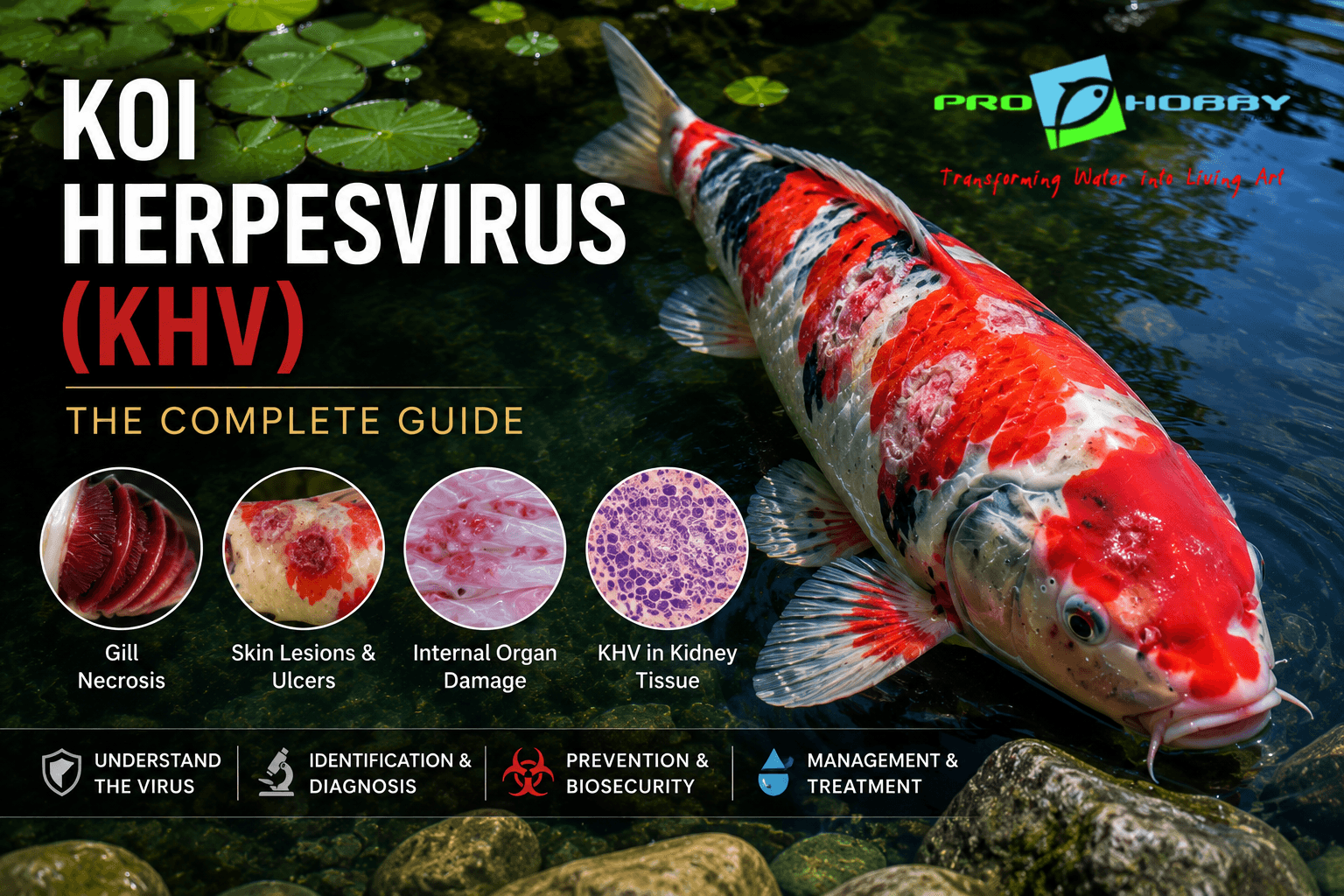
Gill necrosis is the most characteristic and most frequently cited diagnostic sign — patchy white or brown discolouration and tissue death visible on close inspection of gill tissue, often the single most reliable visible indicator available without laboratory testing, and directly responsible for the severe respiratory distress that frequently accompanies active disease.
Excessive mucus production and skin changes — rough, sloughing patches of skin, and excessive or abnormal mucus coating, sometimes with a blotchy or uneven appearance to affected areas.
Sunken eyes — a specific, frequently cited sign in active KHV cases, alongside general lethargy and loss of the normal alert responsiveness expected of healthy koi.
Rapid, laboured respiration — reflecting the direct gill tissue damage described above, and frequently accompanied by fish gathering at water inflow points or areas of higher oxygenation as they attempt to compensate for impaired gas exchange.
Erratic swimming and loss of coordination in more advanced cases, alongside a marked and rapid loss of appetite that frequently precedes visible external symptoms.
The critical timing fact: within the susceptible temperature window established in Section 2, the progression from first visible symptoms to mass mortality can occur within a matter of days — this is not a disease that allows the extended observation and gradual treatment-trial approach appropriate for many chronic conditions covered elsewhere on this site. Any combination of the above symptoms appearing across multiple fish simultaneously, particularly during a seasonal transition period, warrants immediate action following Section 9 rather than a wait-and-observe approach.
4. Why Mortality Rates Are So Catastrophic
KHV outbreaks in susceptible populations at permissive temperature are consistently associated with extremely high mortality rates, frequently cited in the range of 80 to 100 percent of susceptible fish in an affected pond within a period of days to at most a couple of weeks once clinical disease becomes established — a mortality profile that places KHV among the most devastating diseases covered anywhere in this site’s disease library, freshwater or marine.
This catastrophic mortality rate reflects the combination of factors established throughout this guide: a virus to which naive (previously unexposed) koi populations have no pre-existing immunity, a temperature window that frequently coincides with periods of pond community stress and new-fish introduction, direct and severe damage to gill tissue that is immediately life-threatening given fish’s total dependence on functional gill gas exchange, and — critically — the complete absence of any effective treatment covered in Section 7, meaning that once an outbreak begins in susceptible fish at permissive temperature, there is no pharmacological intervention available to arrest its progression once established.
5. Species Susceptibility — Why Goldfish Confuse the Picture
This is a genuinely important and frequently misunderstood point that has real biosecurity implications, particularly for mixed pond systems.
Koi and common carp (Cyprinus carpio) are the primary susceptible species, developing the full clinical disease picture described in Section 3 and experiencing the catastrophic mortality established in Section 4.
Goldfish (Carassius auratus) are generally considered refractory to clinical KHV disease — meaning goldfish typically do not develop the severe symptoms or mortality that koi and common carp experience — but goldfish can still become infected and can serve as carriers capable of transmitting the virus to susceptible koi and carp sharing the same water, without the goldfish themselves ever appearing ill. This makes a mixed koi-and-goldfish pond a genuine, non-obvious biosecurity risk: a hobbyist observing healthy goldfish alongside sick or dying koi may reasonably but incorrectly conclude that whatever is affecting the koi cannot be KHV, since “surely it would affect all the fish equally” — precisely the kind of assumption this species-susceptibility asymmetry undermines.
Grass carp (Ctenopharyngodon idella) show a broadly similar refractory-but-potentially-carrier pattern to goldfish, relevant to any pond system stocking this species alongside koi for vegetation control purposes.
The practical implication for anyone running a mixed pond: the presence of apparently healthy goldfish or grass carp provides no reassurance whatsoever regarding koi health risk, and any suspected KHV situation must be assessed based on the koi and common carp population specifically, regardless of how other species in the same water are presenting.
6. The Carrier State — Why Survivors Are Never Safe Again
This is the herpesvirus-family characteristic that most fundamentally distinguishes KHV from the bacterial and parasitic diseases covered throughout most of this site’s disease library, and it deserves to be understood clearly because it directly shapes the lifelong biosecurity implications of ever having had a KHV-positive fish in a collection.
Fish that survive a KHV outbreak — whether through natural resistance, favourable temperature conditions limiting disease severity during exposure, or simple chance — do not clear the virus from their system the way a fish recovering from most bacterial infections eventually does. The virus establishes latent infection, generally understood to persist within the fish’s nervous tissue in a dormant state, from which it can reactivate under specific trigger conditions covered in Section 12, at which point the recovered fish can shed infectious virus capable of triggering new disease in other susceptible fish, despite the carrier fish itself showing no outward signs of illness during the latent period.
The practical consequence that cannot be overstated: a koi that has survived a confirmed or suspected KHV exposure should be considered a lifelong carrier and a lifelong biosecurity risk to any other koi it is ever introduced to, for the remainder of that fish’s life — not merely during an initial recovery or quarantine period, but permanently. This is fundamentally different from the recovery model most hobbyists are accustomed to from bacterial and parasitic disease, where successful treatment and an appropriate quarantine period is generally understood to render a fish safe to reintroduce.
7. Is KHV Treatable? Why the Honest Answer Is No
No approved, reliably effective antiviral treatment exists for KHV in the hobbyist or general aquaculture context, following the identical fundamental biological limitation established for every other viral condition covered throughout this site, from Lymphocystis to the general principle established in Head and Lateral Line Erosion regarding non-infectious and infectious conditions requiring fundamentally different treatment logic: antibiotics, antiparasitics, and antifungals act on bacterial, parasitic, and fungal cellular machinery respectively, none of which a virus possesses.
Experimental antiviral research specific to CyHV-3 exists in the scientific literature — including, notably, ongoing research into natural compounds such as curcumin as potential replication inhibitors, referenced in recent Indian surveillance literature — but no such approach currently constitutes an approved, reliably available, or standard-of-care treatment accessible to hobbyist or general aquaculture koi keepers. Management during a suspected or confirmed outbreak, covered in Section 9, is accordingly focused on containment, supportive care for less severely affected individuals, and preventing further transmission rather than on any expectation of curing infected fish.
8. Diagnosis — PCR Testing and Why Clinical Suspicion Alone Is Not Enough
Definitive KHV diagnosis requires PCR (polymerase chain reaction) or similar molecular testing to detect viral genetic material directly, generally performed on gill tissue or other samples from affected or exposed fish, and is the diagnostic standard referenced throughout the international scientific and regulatory literature on this disease, including the Indian surveillance research identified in Section 14.
Why clinical symptoms alone are insufficient for a confident diagnosis: the symptom picture described in Section 3 — gill necrosis, excess mucus, lethargy, respiratory distress — overlaps meaningfully with several of the bacterial and parasitic conditions covered elsewhere in this site’s disease library, and confident differentiation, particularly given the severity of the response a genuine KHV outbreak warrants, benefits substantially from molecular confirmation rather than clinical impression alone wherever testing access allows it.
For hobbyists without direct access to PCR testing, the practical approach during a suspected outbreak is to treat the clinical symptom pattern, particularly when appearing rapidly across multiple koi simultaneously during a seasonal transition period, as sufficient grounds for the full emergency and biosecurity response in Sections 9 and 10, while pursuing testing through a veterinary or fisheries diagnostic service where available to confirm or rule out the diagnosis for future management decisions.
9. Emergency Response — What to Do During a Suspected Outbreak
Given the mortality rate and progression speed established in Sections 2 through 4, a suspected KHV outbreak requires immediate, decisive action rather than a gradual, trial-based response.
Isolate any newly symptomatic fish immediately from the general pond population where physically feasible, recognising that in an established pond system this containment is considerably more difficult to achieve fully than in a smaller aquarium hospital-tank context, and that the pond water itself, once an outbreak is underway, should be considered contaminated for the fish remaining in it.
Do not introduce any new fish to the affected system under any circumstances during a suspected or confirmed outbreak, and do not move any fish from the affected system to any other system, given the carrier-state biosecurity implications established in Section 6.
Avoid unnecessary handling and stress of remaining fish, given the stress-trigger relationship with viral reactivation established in Section 12 — handling and net-based movement during an active outbreak risks accelerating disease progression in fish that might otherwise have weathered the exposure with lower severity.
Contact veterinary or fisheries authority support where available, both for diagnostic testing per Section 8 and given the notifiable disease status and associated reporting considerations covered in Section 14.
Prepare for the likelihood of significant loss. Given the mortality rates established in Section 4, realistic expectation-setting during an active outbreak in susceptible fish at permissive temperature is an important part of managing the situation, alongside taking every containment step available to protect any fish and any other systems not yet exposed.
10. Biosecurity — The Only Real Defence
Given the absence of any treatment established in Section 7, KHV management is overwhelmingly a prevention discipline rather than a response discipline, and the biosecurity principles in this section deserve to be treated as non-negotiable standard practice rather than optional extra caution.
Never introduce a new koi to an established pond without a full, dedicated quarantine period, covered in specific detail in Section 11, regardless of how healthy the fish appears at the point of purchase or how reputable the source seems — the carrier state established in Section 6 means an apparently perfectly healthy fish can be carrying latent KHV with zero outward indication.
Dedicated equipment for any quarantine or hospital system — nets, siphons, any tool that contacts water — should never be shared between a quarantine system and an established display pond, given the virus’s capacity to transmit through contaminated water and equipment.
Source new koi specifically from suppliers who can demonstrate their own testing and biosecurity practices, following the general supplier-evaluation framework established in Aquarium Shop Delhi NCR — What a Specialist Looks Like, with particular emphasis, for koi specifically, on asking directly about KHV testing history and quarantine protocols applied to the supplier’s own stock before it ever reaches a buyer.
11. Quarantine Protocol Specific to KHV
Standard aquarium quarantine duration, established generally at 4 weeks throughout this site’s fish and coral disease guides, requires specific extension and modification for KHV given the temperature-dependency established in Section 2.
Quarantine duration should span a genuine temperature exposure within the susceptible 16–28°C range for a period the scientific and veterinary literature on this disease generally regards as sufficient to allow latent infection to become clinically apparent — meaning a quarantine period conducted entirely at a temperature outside this window provides considerably less diagnostic confidence than one that includes genuine exposure to the range in which the virus is most likely to produce visible symptoms in an infected fish.
Where PCR testing access allows, testing new koi during the quarantine period, rather than relying on clinical observation alone, provides considerably greater confidence than symptom-watching given the diagnostic limitations established in Section 8.
Any koi with any history of exposure to a known or suspected KHV-affected system should not be introduced to a new, unaffected collection under any circumstances, regardless of how long ago the exposure occurred or how healthy the fish has appeared since, given the lifelong carrier state established in Section 6 — this is one of the few genuinely absolute rules in this entire guide, reflecting the permanence of the biological risk involved.
12. The Stress-Trigger Relationship in Carrier Fish
Latent KHV infection in a surviving carrier fish is understood to be capable of reactivating under stress conditions, following the same general cortisol-mediated immune suppression pathway established throughout this site’s disease library in The Science of Fish Stress, with the specific and genuinely dangerous consequence that a carrier fish reactivating latent virus becomes capable of shedding infectious virus and triggering new disease in susceptible tank mates, despite having shown no symptoms for months or years since its original exposure.
Known and suspected reactivation triggers include the seasonal temperature transitions established in Section 2 specifically, alongside the general stress factors relevant throughout this site’s disease library — transport, handling, overcrowding, and water quality deterioration — meaning a carrier fish that has been stable and asymptomatic for an extended period is not thereby confirmed safe, and any significant stress event in a pond containing a known or suspected carrier warrants heightened vigilance for the symptom pattern established in Section 3 during the following weeks, particularly if that stress event coincides with the susceptible temperature window.
13. KHV vs Other Koi Mass Mortality Causes
Given the severity of the appropriate response to a genuine KHV outbreak, distinguishing it from other causes of koi mass mortality is a genuinely important diagnostic step rather than an academic distinction.
Acute water quality failure — a sudden ammonia or oxygen crisis, covered throughout Ammonia in Aquariums and Aquarium Dissolved Oxygen — can produce rapid, severe mortality across a pond population that superficially resembles a KHV outbreak in its speed and scale, but lacks the specific gill necrosis and skin change pattern established in Section 3, and is generally distinguishable through direct water parameter testing, which should be a standard first step in any sudden pond mortality event regardless of suspected cause.
Spring Viraemia of Carp (SVC), covered in a dedicated companion article — Spring Viraemia of Carp — Complete Guide — is another notifiable viral disease affecting cyprinid fish with some symptom overlap, including haemorrhagic signs and rapid mortality, but with a distinct causative virus, different specific temperature range, and different specific clinical presentation requiring separate consideration and, where testing access allows, separate molecular confirmation.
Severe parasitic burden from conditions such as Argulus (fish lice) in heavily infested outdoor pond systems can produce significant mortality through combined physical damage and secondary infection, generally distinguishable through direct visual inspection for the parasites themselves rather than requiring molecular testing.
The consistent principle across all of these differentials: any significant unexplained koi mortality event warrants systematic elimination of water quality causes first, given how straightforward and immediate this testing is, before or alongside pursuing the more involved molecular testing required to confirm or rule out KHV and SVC specifically.
14. India — Notifiable Status, Surveillance and Practical Realities
Both KHV and Spring Viraemia of Carp are listed as notifiable diseases by the World Organisation for Animal Health (WOAH), the international body whose disease listings inform national aquatic animal health regulation across member countries including India. Within India specifically, active government surveillance for both diseases is conducted under the National Surveillance Programme for Aquatic Animal Diseases (NSPAAD), implemented by the Department of Fisheries, Ministry of Fisheries, Animal Husbandry and Dairying, and coordinated by ICAR-National Bureau of Fish Genetic Resources — including documented state-level active surveillance programmes, such as a multi-year KHV and SVC molecular surveillance study conducted across major aquaculture zones of Telangana, reflecting genuine, ongoing regulatory and scientific attention to both diseases within the Indian aquaculture sector.
What this means practically for an individual hobbyist koi keeper: while formal reporting obligations are generally structured around commercial aquaculture operations and state fisheries department frameworks rather than individual hobbyist ponds specifically, the existence of active national surveillance underscores that these are diseases taken with genuine seriousness within Indian aquatic animal health policy, and any hobbyist experiencing a suspected KHV or SVC outbreak should consider contacting local veterinary or state fisheries department resources, both for diagnostic support and as part of the broader national disease surveillance effort these programmes represent.
Sourcing implications for Indian koi keepers: given the biosecurity emphasis established throughout this guide, sourcing koi from suppliers with demonstrable quarantine and testing practices is particularly relevant in the Indian market context, where the koi trade includes both domestic breeding operations and imported stock, each carrying its own biosecurity considerations. Koi Fish Care in India and Koi Pond Setup in India cover the broader husbandry context within which KHV biosecurity should be integrated as standard practice rather than an afterthought. Aquarium Shop Delhi NCR — What a Specialist Looks Like covers the supplier evaluation framework directly relevant to sourcing koi with appropriate biosecurity assurance.
Frequently Asked Questions
Can KHV be treated or cured? No. No approved, reliably effective antiviral treatment exists for KHV. Management during a suspected outbreak focuses on containment and supportive measures rather than any expectation of curing infected fish, following the same fundamental limitation that applies to every viral disease covered throughout this site.
Why did my koi survive KHV exposure but I’m told they’re still dangerous? Surviving fish become lifelong carriers. Like other herpesviruses, CyHV-3 establishes latent infection that persists in the fish’s system rather than being cleared, and can reactivate under stress conditions, at which point the carrier fish can shed infectious virus and trigger new disease in other susceptible koi, despite showing no outward symptoms itself. A KHV-exposed koi should never be introduced to a new, unaffected collection at any point in its life.
My goldfish are fine but my koi are dying — can it still be KHV? Yes. Goldfish are generally refractory to clinical KHV disease, meaning they typically do not become visibly ill even when infected, but can still carry and transmit the virus to susceptible koi sharing the same water. Healthy goldfish in a mixed pond provide no reassurance that koi mortality is not KHV-related.
What temperature is KHV most dangerous at? Approximately 16 to 28°C, with peak virulence in the middle of this range. Outside this window, in colder or warmer water, infected fish frequently show minimal or no symptoms despite carrying the virus, making seasonal transition periods — when pond water passes through this range — the periods of highest outbreak risk.
How long should I quarantine new koi to check for KHV? Standard quarantine should specifically include genuine exposure to the 16–28°C susceptible temperature range for a period sufficient to allow latent infection to become clinically apparent, rather than relying on a fixed quarantine duration conducted at a temperature outside this window. PCR testing during quarantine, where accessible, provides considerably greater diagnostic confidence than symptom observation alone.