
By ProHobby™ | Ecological Systems Authority
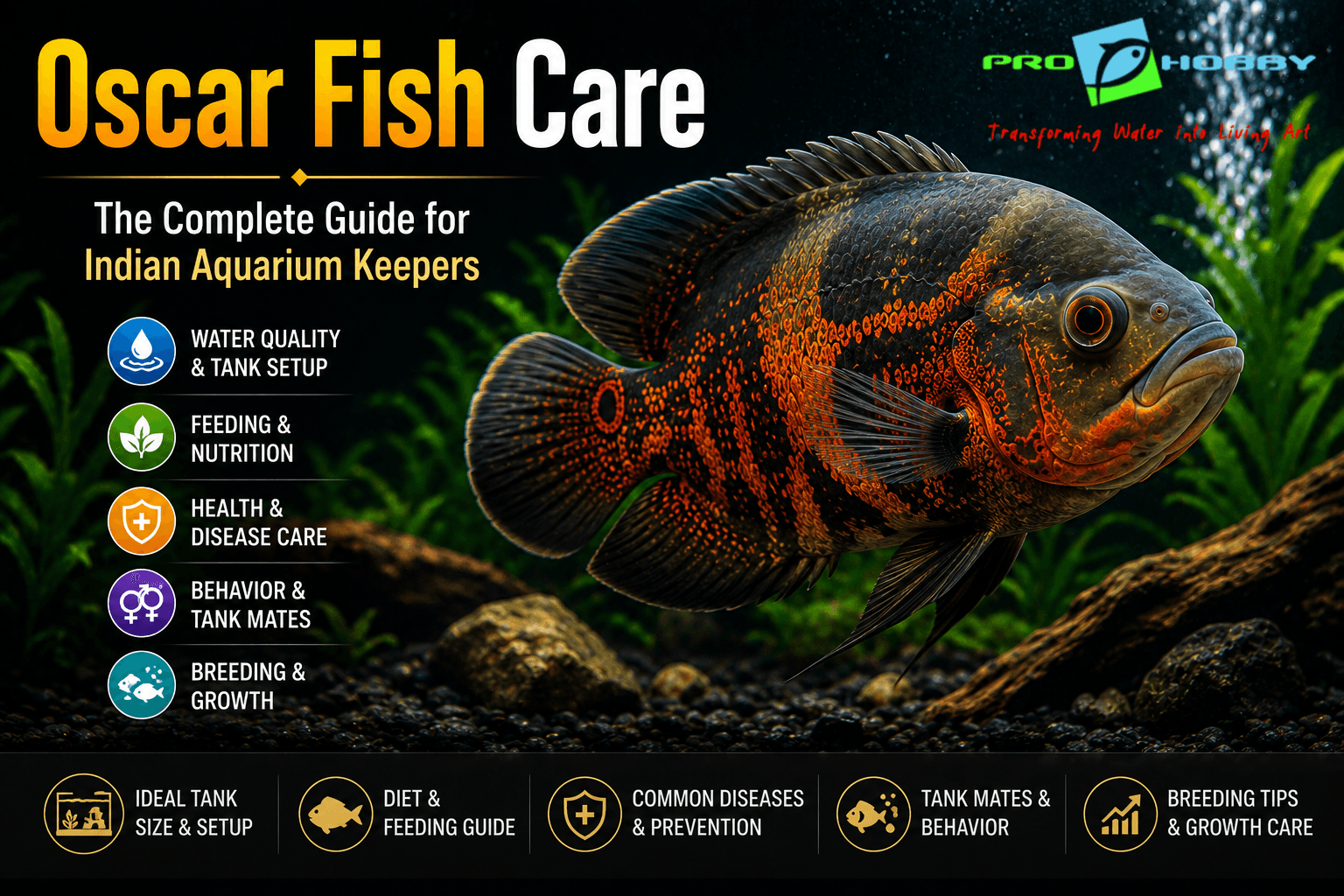
Oscar fish (Astronotus ocellatus) are among the most personality-rich fish in the freshwater hobby — they recognise their owners, rearrange their own tank, and develop individual behavioural quirks that make them genuine companions. They are also among the most demanding in terms of tank size, bioload management, and dietary requirements. The most common oscar care mistake produces one of the most disfiguring diseases in the hobby: Hole in the Head disease. This is not random misfortune. It is a predictable outcome of specific management failures that this guide explains in full.
Natural Habitat
Oscars originate from slow-moving, warm rivers of the Amazon and Orinoco basins. Their natural diet is omnivorous — fish, invertebrates, insects, and substantial plant material and fruit. This mixed diet is critical context for oscar feeding in captivity.
Tank Requirements
Minimum tank size: 200 litres for a single adult oscar. Two oscars require 300–400 litres. Oscars grow to 30–35 cm within 2–3 years.
Growth rate: Juvenile oscars sold at 3–6 cm grow 2–3 cm per month. Purchasing a juvenile without planning for the adult tank is one of the most common failures in oscar keeping.
Filtration: External canister at 8–10× tank volume per hour. Weekly 30–40% water changes. How to Do a Water Change.
Décor: Minimal and secure. Oscars rearrange everything — lightweight objects become projectiles. Large, heavy rocks wedged securely; no small gravel that can be ingested.
Lid: Required — oscars jump, particularly when startled.
Water Parameters
| Parameter | Target Range |
|---|---|
| Temperature | 24–28°C |
| pH | 6.5–7.5 |
| KH | 3–8 dKH |
| GH | 5–12 dGH |
| Ammonia | 0 ppm |
| Nitrite | 0 ppm |
| Nitrate | Below 20 ppm (below 10 ppm to prevent HITH) |
Plants for an Oscar Tank
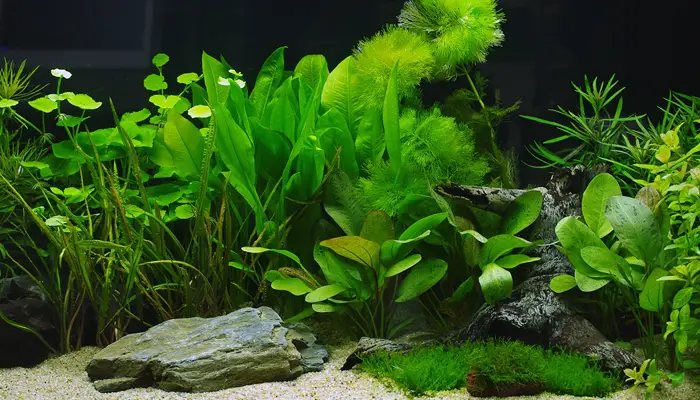
Oscars destroy most aquarium plants through physical disturbance, digging, and grazing. A planted oscar tank requires a specific approach:
Plants that survive oscars:
- Anubias: Large, tough Anubias species (Anubias barteri, A. nana) attached firmly to large rocks or driftwood — oscars rarely eat the leathery leaves and cannot uproot hardscape-attached plants.
- Java fern: Attached to hardscape, mildly bitter taste most cichlids avoid.
- Amazon sword in large pots: Heavy ceramic pots that cannot be uprooted, with large specimens established enough to recover from occasional nibbling.
What doesn’t work: Delicate stem plants, any rooted plants in substrate, fine-leafed plants. The oscar will either eat them or uproot them within hours.
The practical approach for most oscar keepers: focus on hardscape (large rocks, driftwood) with a few Anubias attached, rather than attempting a planted tank. The oscar’s habitat is functionally a large structured environment, not a planted one.
Feeding — The HITH Connection
Diet is one of the two major HITH drivers. Oscars fed primarily on high-protein foods — live feeder fish, beef heart, high-protein carnivore pellets — without adequate vitamin supplementation develop nutritional deficiencies that directly cause HITH.
Correct diet:
- High-quality cichlid pellets with vitamin C supplementation as the primary food
- Frozen or fresh vegetables: blanched peas, cucumber, courgette, spinach
- Occasional protein: prawns, earthworms, frozen mussel, fresh fish pieces
- Avoid: Live feeder fish from unknown sources (parasite risk), beef heart (saturated fat), goldfish feeders (thiaminase)
Remove activated carbon permanently. Continuous use is associated with HITH — it depletes fat-soluble vitamins. Use it only to clear medication after treatment courses.
Feeding frequency: Once or twice daily for juveniles; once daily for adults.
Oscar not eating: First sign of HITH onset, ammonia stress, or internal parasites. Test water parameters immediately — ammonia and nitrate are the key readings. An oscar that has been eating well and suddenly refuses food for 2+ days warrants full water parameter testing and close visual inspection for early HITH pitting.
Male vs Female Oscar
Oscars cannot be reliably sexed by appearance — there are no consistent external differences between males and females. Even experienced oscar keepers cannot sex individuals with confidence. The only reliable method is surgical sexing by a vet or observing actual breeding behaviour between a confirmed pair.
Breeding Oscars
Oscars are open substrate spawners that form monogamous pairs. Breeding in captivity is achievable with a bonded pair in a 300+ litre tank.
Pair formation: Purchase 6–8 juvenile oscars and raise them together — pairs form naturally. Separate all fish except the bonded pair when pairing behaviour (cleaning flat surfaces, displaying to each other) is observed.
Spawning: The pair cleans a flat surface (large smooth rock, slate, bottom of tank), the female deposits 1,000–3,000 eggs in rows, and the male fertilises. Both parents guard the eggs aggressively — remove all other fish.
Fry: Eggs hatch in 2–3 days; fry become free-swimming in 4–5 days. Both parents exhibit strong parental care. Feed fry baby brine shrimp progressing to crushed cichlid pellets.
First-time parents often eat the eggs. Subsequent spawns typically produce better parental care as the pair gains experience.
Colour Change — Reading Your Oscar
Turning dark / black patches: Normal stress response when threatened, startled, or after sudden environmental changes. Also normal during mood changes and displays.
Oscar turning completely dark and staying dark: Sustained stress response — check for water quality issues, incompatible tank mates, or illness.
Pale, washed out colouration: Stress or illness. If combined with reduced appetite — test water parameters immediately.
Reddening of fin edges or body patches: Bacterial infection (haemorrhagic septicaemia) or physical injury. Test water; treat as bacterial fin rot if spreading. Fin Rot — Treatment Guide.
White pits appearing on face: Early HITH — act immediately. Hole in the Head Disease.
Oscar Fish Varieties
Tiger oscar: Wild-type patterning — dark base with orange/red markings. Most robust. Red oscar: Predominantly orange-red. Selectively bred for colour. Albino oscar: White/pink body, red eyes. Slightly more sensitive. Veil tail oscar: Long fins from selective breeding. More prone to fin damage.
Price in India: Juveniles (5–8 cm) ₹150–400. Adults ₹500–2,000+ depending on variety and size.
Common Health Issues
Hole in the Head disease (HITH): The defining oscar disease. Caused by Hexamita/Spironucleus combined with elevated nitrate, vitamin deficiency, and activated carbon. Hole in the Head Disease — Complete Guide.
Ich: Especially after temperature drops. Ich — Treatment Guide.
Bloat: Similar to Malawi bloat — rapid abdominal swelling requiring urgent metronidazole treatment.
Fin rot: From water quality lapses. Fin Rot — Treatment Guide.
All treatment through a hospital tank.
Oscar Fish Lifespan
10–15 years in correct conditions. Most oscar deaths occur in the first 2–3 years from inadequate tank size, water quality failure, or HITH from dietary neglect.
Frequently Asked Questions
What tank size does an oscar fish need? Minimum 200 litres for one adult, 300–400 litres for two. Juveniles grow 2–3 cm per month — purchase the adult tank now.
Why does my oscar have holes in its head? Hole in the Head disease — caused by Hexamita parasites, elevated nitrate, vitamin deficiency, and activated carbon. Remove activated carbon immediately. Increase water changes to bring nitrate below 10 ppm. Improve diet. Treat with metronidazole. Full guide.
Why is my oscar not eating? Test water parameters immediately — loss of appetite is the first visible sign of HITH onset, ammonia stress, or internal disease. Check nitrate specifically. An oscar refusing food for 2+ days requires investigation.
Can oscar fish live with plants? With difficulty. Anubias and Java fern attached to heavy hardscape survive oscar tanks. Rooted or delicate plants are destroyed. Most oscar keepers focus on hardscape rather than planted aquascapes.
How do I sex my oscar fish? You cannot reliably sex oscars by appearance — there are no consistent external differences. The only reliable methods are veterinary surgical sexing or observing confirmed breeding behaviour.