
By ProHobby™ | Ecological Systems Authority
The most common cause of aquarium crashes is not disease, not overfeeding, and not bad livestock. It is cleaning the filter incorrectly.
A filter running in a cycled, stocked aquarium is not a mechanical device that accumulates dirt and needs periodic sterilisation. It is a biological system — the primary housing for the bacterial communities that convert toxic fish waste into safer compounds. When these communities are disrupted, ammonia accumulates. Fish experience gill damage. The tank crashes. And the hobbyist, who cleaned the filter specifically to maintain the tank, has no idea why.
This guide covers the complete protocol for cleaning your aquarium filter effectively — removing debris and blockage that reduce its function — without destroying the biological communities that make it worth having. The guide is universal; a dedicated section at the end covers considerations specific to India and Delhi NCR.
Table of Contents
- Why Filter Bacteria Die When You Clean Wrong — The Biology
- The Four Rules You Cannot Break
- How to Clean Each Filter Type
- How to Clean Each Media Type
- How Often to Clean — Frequency by Media and Filter Type
- Water Change and Filter Clean — The Correct Sequence
- How to Recover If You Have Already Killed the Bacteria
- When to Replace Media Versus Clean It
- Common Filter Cleaning Mistakes and Why Each Is Fatal
- India and Delhi NCR — Specific Considerations
- Frequently Asked Questions
1. Why Filter Bacteria Die When You Clean Wrong — The Biology
The beneficial bacteria in your filter — primarily Nitrosomonas and Nitrospira, the organisms that convert ammonia to nitrite and nitrite to nitrate — do not live in the water. They live in biofilms: structured, multi-layered microbial communities attached to filter media surfaces, developing over weeks and months into the redundant, resilient processing infrastructure that characterises a mature biological filter.
These biofilms are the nitrogen cycle made physical. Without them, ammonia produced continuously by fish metabolism accumulates to toxic levels within hours. With them, ammonia is processed as fast as it is produced. The filter’s value as a biological device comes entirely from the biofilm communities colonising its media — not from the motor, the flow rate, or the housing.
Every cleaning mistake that kills filter bacteria does so through one of two mechanisms:
When a filter crash occurs, ammonia accumulates — and at the elevated pH common in hard water, that ammonia is significantly more toxic than test results suggest. The pH-ammonia toxicity relationship is covered in Aquarium pH — Complete Diagnosis and Fix Guide.
Chemical disruption. Tap water contains disinfectants specifically designed to kill bacteria. Depending on your water supply, these are chlorine (which dissipates slowly with aeration) or chloramine (a chlorine-ammonia compound that is stable, does not dissipate, and is not neutralised by standard dechlorinators). Even a 30-second rinse of filter sponge under tap water exposes bacteria to these disinfectants. The result: 70–90% of active nitrifying bacteria are killed. The tank partially re-cycles with fish inside. The biofilm biology of why this matters so severely is covered in Biofilms — The Invisible Engine of Every Aquarium.
Oxygen deprivation. Nitrifying bacteria are strict aerobes requiring continuous dissolved oxygen — the complete guide to how dissolved oxygen behaves in aquariums, including why filter interruptions are most dangerous in summer, is Aquarium Dissolved Oxygen — Complete Guide. The delivery mechanism is the water flowing through filter media. When filter flow stops — during cleaning or a power interruption — bacteria in deeper media layers begin dying within 2–4 hours from oxygen starvation. Longer gaps produce more extensive losses.
Understanding these two mechanisms explains every rule that follows. Use tank water (no disinfectants), clean one section at a time (never remove the entire community), work quickly (minimise oxygen deprivation), and never clean filter and substrate simultaneously (avoid removing too much biological community at once).
The nitrogen cycle that filter bacteria maintain — and what happens when it is disrupted — is covered in How to Cycle a Fish Tank and the Nutrient Cycles in Nature and Captivity cornerstone. Why fish deaths from ammonia accumulation are so consistently misattributed to disease rather than environmental failure is the subject of Why Most Aquarium Deaths Are Environmental, Not Disease.
2. The Four Rules You Cannot Break
These four rules apply to every filter type, every media type, and every aquarium. Breaking any one risks crashing the tank.
Rule 1: Use only tank water to rinse biological media — never tap water. Collect water removed during a water change and use it to rinse filter sponges and biological media. This water contains no disinfectants. It is already the correct chemistry for the bacteria living in it. It removes accumulated debris without killing any bacteria.
Rule 2: Never clean all filter media at the same time. If your filter contains multiple media types — sponge pad, ceramic rings, filter floss, bio-balls — clean only one type per session and leave everything else undisturbed. If you have multiple sponge layers, clean only one. The goal is to retain enough of the biological community to continue processing ammonia while the cleaned section rebuilds.
Rule 3: Never clean the filter and vacuum the substrate on the same day. Both the filter media and the substrate surface are major biofilm habitats. Disrupting both simultaneously removes too large a proportion of the biological community in a single event. Do your water change and substrate vacuum on one day. Clean filter media at least one week later.
Rule 4: Work quickly and keep media wet throughout. Exposed to air, biological media begins losing bacteria within minutes from desiccation and oxygen deprivation. Have your container of tank water ready before opening the filter. Biological media goes from filter into tank water with no air exposure.
3. How to Clean Each Filter Type
Sponge Filters
The simplest filter to clean safely. The ideal filter for quarantine tanks, breeding tanks, and beginner setups precisely because their single-component design eliminates the risk of accidentally exposing media to tap water through a complex disassembly.
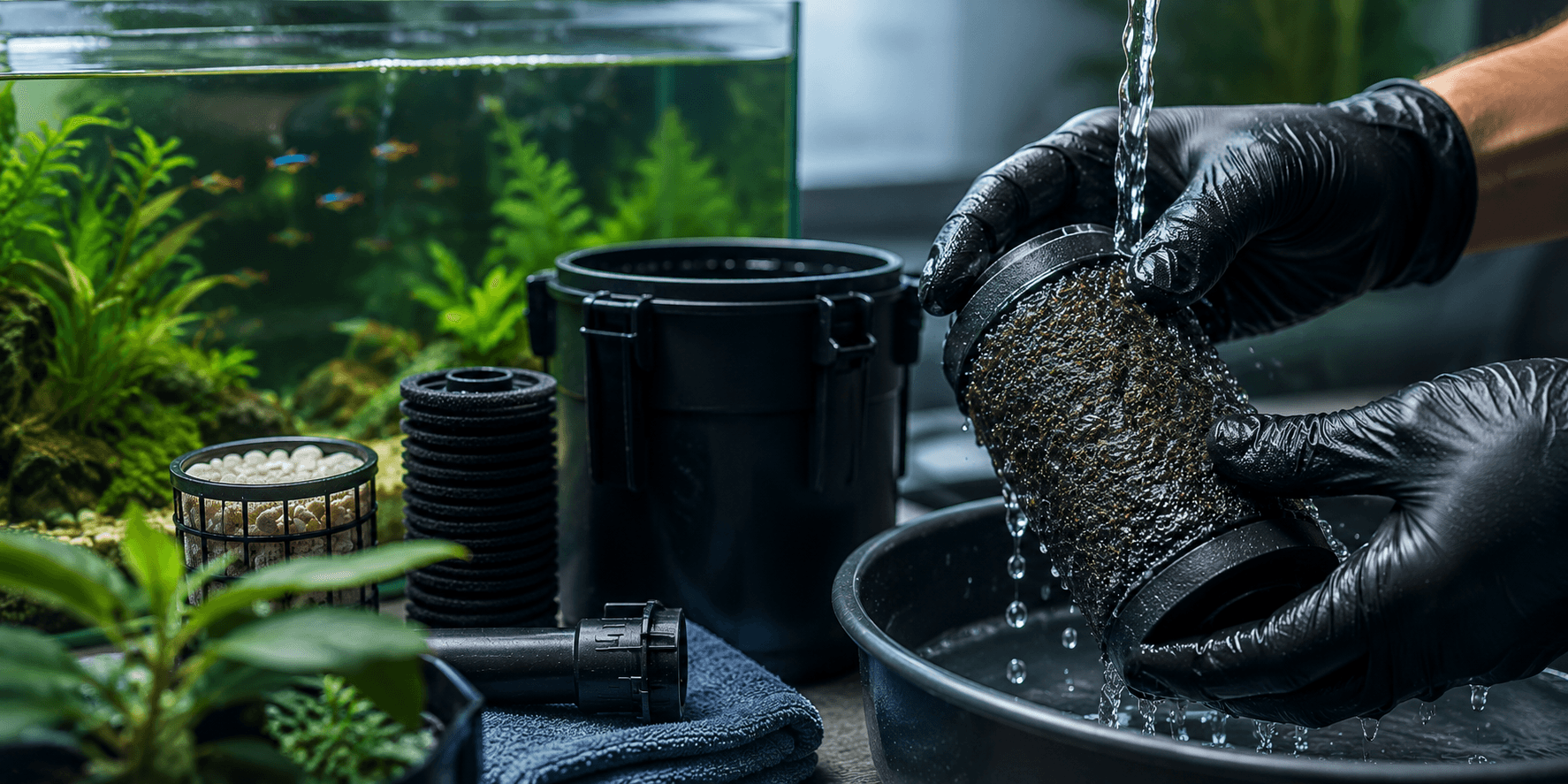
How to clean: Collect 1–2 litres of tank water in a bucket before touching the filter. Remove the sponge. Squeeze it repeatedly in the bucket of tank water until the water runs brown-grey from expelled debris. Replace the bucket water if heavily soiled and repeat. Squeeze the sponge against your hand until most water is removed — retain some moisture; do not wring completely dry. Return the sponge to the filter and reinstall. The entire rinsing process occurs in the bucket of tank water — no tap water contact at any stage.
Hang-On-Back (HOB) Filters
HOB filters typically contain layered media: a mechanical sponge or filter floss at the intake side, followed by biological media (ceramic rings, sponge layers, bio-wheels), and sometimes a chemical media slot.
How to clean: Unplug the filter. Collect tank water in a bucket. Remove and rinse the mechanical intake sponge or floss pad in tank water — this is what accumulates debris fastest and is cleaned most frequently. Leave biological media completely undisturbed unless flow has dropped significantly. If biological media genuinely needs cleaning, rinse only half of it in tank water per session. The impeller and housing may need cleaning with a small brush if flow has decreased — this is mechanical maintenance with minimal biological consequence. Do not clean biological and mechanical media in the same session if both are visibly clogged.
Canister Filters
The largest media volume and most complex to maintain, but their sealed design allows methodical maintenance without exposing media to air unnecessarily.
How to clean: Prepare containers of tank water for each media basket. Close inlet and outlet valves before disconnecting. Open the canister and remove media baskets from mechanical (first, receives raw tank water) to biological (last, receives pre-filtered water). Clean the mechanical media basket — coarse sponge, filter floss — vigorously in tank water. This basket accumulates the most debris and needs the most frequent cleaning. Inspect biological media baskets: if flow has shown no degradation, leave them entirely undisturbed. If biological media needs cleaning due to visible compaction or flow reduction, rinse only the most clogged tray in tank water — leave remaining trays undisturbed. Clean the canister housing interior with a brush to remove accumulated waste from the walls. Reassemble in reverse order. Restart and confirm normal flow.
To determine whether your canister filter’s flow rate is appropriate for your tank volume and stocking, use the Aquarium Water Flow & Filtration Calculator — it calculates required turnover rate based on tank size, stocking level, and system type.
Internal Box Filters
Small submersible units combining mechanical and biological media in a single small housing. Less biological capacity and less tolerance for partial cleaning errors.
How to clean: Remove from tank. Open housing over a container of tank water. Remove and rinse the sponge in tank water. If ceramic rings are present, rinse gently in tank water only if visibly clogged — leave undisturbed otherwise. Do not clean the sponge and ceramic media in the same session.
4. How to Clean Each Media Type
Biological Media — Ceramic Rings, Bio-Balls, Sintered Glass, Lava Rock
The primary biofilm housing. The most conservative cleaning protocol applies here. A media surface that has turned dark brown or grey is densely colonised biofilm — this is the correct, healthy appearance of functioning biological media. Do not clean it based on colour.
When to clean: Only when flow is visibly impaired by blockage or the media appears compacted with detritus. In an established filter running well, biological media may go 6–12 months or longer without needing any cleaning.
How to clean: Gentle agitation and rinsing in tank water only. Ceramic rings: swirl in a container of tank water. Sintered glass (Seachem Matrix and equivalents): gentle rinse and agitation in tank water. Bio-balls: rinse in tank water to remove accumulated waste from the surface. Never scrub, use hot water, bleach, or tap water on biological media.
Replacing biological media: Replace 25–30% maximum at a time, waiting 4 weeks between replacements. The remaining established media maintains biological filtration while the new media colonises. Replacing all biological media at once is equivalent to crashing the nitrogen cycle.
Mechanical Media — Coarse Sponge, Filter Floss, Filter Wool
Mechanical media captures particulate matter before it reaches biological media. It genuinely accumulates debris that reduces flow and degrades function. It needs cleaning. A visibly dark or grey coarse sponge that rinses clean in tank water is functioning correctly — the colour is not the problem.
How to clean: Vigorous squeezing in tank water. Mechanical sponges tolerate more aggressive cleaning than biological media because their function is physical capture, not biological, and their bacterial community is less critical to the nitrogen cycle. Filter floss and filter wool are typically single-use — replace rather than rinse. Coarse sponge can be reused until it physically degrades.
Chemical Media — Activated Carbon, Phosphate Absorbers, Zeolite
Chemical media works by adsorption. It cannot be cleaned once saturated. The only maintenance is replacement on schedule.
Activated carbon saturates within 2–4 weeks of use — replace on schedule regardless of appearance. Saturated carbon may release previously adsorbed compounds back into the water if left too long. Always remove activated carbon before adding any medication to the tank — carbon will adsorb the medication before it reaches therapeutic concentration.
Phosphate absorbers: replace when phosphate testing shows no reduction 48 hours after adding fresh media.
5. How Often to Clean — Frequency by Media and Filter Type
| Media / Component | Typical Cleaning Frequency |
|---|---|
| HOB / canister mechanical sponge | Every 2–6 weeks (stocking-dependent) |
| Sponge filter (primary biological) | Every 4–8 weeks |
| HOB biological media (ceramic rings) | Every 3–6 months, or when flow drops |
| Canister biological media | Every 3–12 months, or when flow drops |
| Filter floss / filter wool | Replace every 1–4 weeks |
| Activated carbon | Replace every 2–4 weeks |
| Impeller and housing | Every 1–3 months |
The correct frequency indicator is flow rate, not a calendar. A filter operating at normal flow with stable water clarity does not need cleaning regardless of the schedule. A filter with visibly reduced flow needs mechanical media cleaning regardless of how recently the last cleaning occurred.
Nitrate accumulates continuously in all stocked tanks — and when filter maintenance disrupts biological processing, nitrate may temporarily spike before recovering. The complete nitrate management guide is Aquarium Nitrate.
Cleaning frequency for mechanical media is directly determined by stocking density — more fish means more waste means faster mechanical media blockage. Use the Aquarium Stocking Calculator to determine the appropriate stocking level for your tank size and filtration capacity. Overstocking is the single most common reason filter mechanical media needs cleaning every week rather than every month.
The complete science of what filter media does at the biological level — why different media types serve different functions and why their maintenance requirements differ so significantly — is in The Truth About Aquarium Filtration. The beginner-level filtration guide covering filter types, media selection, and biological capacity is in Aquarium Filtration — The Backbone of a Healthy Aquarium.
6. Water Change and Filter Clean — The Correct Sequence
The most common timing mistake: cleaning the filter during or immediately after a water change.
This feels efficient — one maintenance session. It is biologically counterproductive. A water change is itself a mild biological event: removing tank water removes some biofilm fragments, bacteria, and biological compounds. Gravel vacuuming during the same water change disturbs substrate biofilm. Cleaning filter media on the same day adds a third simultaneous disruption. The combined removal of biological community from three locations at once can exceed the system’s compensatory capacity.
The correct sequence:
Week A: Water change + gravel vacuum. Do not touch filter media.
Week B (minimum one week later): Clean filter mechanical media only. Do not vacuum substrate. At most a 10–15% water change on filter-cleaning day if genuinely needed — no large water change.
This separation ensures the biological community has at least one week to recover from each disturbance before the next arrives.
Use the Water Change Calculator to determine the appropriate water change volume and frequency for your stocking level and nitrate accumulation rate. The complete step-by-step water change protocol — including dechlorination, temperature matching, and sequencing — is in How to Do a Water Change.
7. How to Recover If You Have Already Killed the Bacteria
If filter media was rinsed in tap water, all media was replaced simultaneously, or the filter was left off for an extended period, the nitrogen cycle may be partially or completely disrupted.
Step 1: Assess the damage Test ammonia and nitrite immediately. Any positive reading confirms biological filtration is compromised.
Before calculating how much dechlorinator or ammonia detoxifier to add, use the Aquarium Volume Calculator to determine your tank’s actual water volume. Most tanks hold significantly less than their labelled capacity once substrate, hardscape, and water level are accounted for — and dosing based on the labelled volume produces underdosing in a smaller actual volume.
Step 2: Immediate stabilisation Add a full-spectrum ammonia detoxifier (such as Seachem Prime or equivalent) dosed for actual tank volume. Note that the nitrification disruption from a filter crash also depletes KH — the buffering mechanism that maintains pH stability. Test KH alongside ammonia during recovery. The complete KH management guide is Aquarium KH — Carbonate Hardness Complete Guide. This temporarily converts ammonia to less toxic ammonium, buying time for biological recovery without acute fish poisoning. Reduce feeding to the absolute minimum — every piece of food adds ammonia. For the complete guide to ammonia toxicity and what it does to fish gill tissue, see Ammonia in Aquariums — Spikes, Poisoning and How to Lower It.
Step 3: Water change If ammonia exceeds 1.0 ppm, perform a 25–30% water change with correctly dechlorinated, temperature-matched water.
Step 4: Biological seeding If another established tank is available, add a used filter sponge from that tank to the damaged filter, or transfer a cup of substrate gravel. Both carry biofilm communities that begin colonising the damaged filter immediately, potentially reducing re-cycling from 4–6 weeks to 1–2 weeks.
Step 5: Monitor to recovery Test ammonia and nitrite daily until both have read zero for 5 consecutive days. The tank is biologically recovered. Fish showing surface gasping, colour loss, or lethargy during this period are likely experiencing ammonia or oxygen stress — see Fish Gasping at the Surface of an Aquarium for the emergency response protocol.
Why this recovery pattern — apparent stability, then crash, then slow recovery — is so consistent and predictable is explained in Why Aquariums Fail — A Systems-Level Diagnosis. The recurring crash pattern when the same cleaning mistake is repeated is covered in My Aquarium Keeps Failing.
8. When to Replace Media Versus Clean It
Replace mechanical media when it physically degrades — tears apart when squeezed, can no longer be rinsed meaningfully clean, loses structural integrity. Replace in stages: half at a time, with two weeks between replacements.
Replace biological media (ceramic rings, sintered glass) when it crumbles or fragments (typically 3–5 years of continuous use), or when calcium scale accumulation has significantly reduced media volume despite descaling. Replace in stages: 25–30% maximum at a time, 4 weeks between replacements.
Do not replace biological media because it is dark or brown. Dark biofilm-covered media is functioning biological media. Its colour is evidence of a healthy community, not a reason for replacement.
Replace activated carbon on schedule every 2–4 weeks. There is no visual indicator of saturation.
Replace sponge filters when the foam physically degrades — cells collapse, foam breaks apart, sponge no longer holds its shape. High-quality aquarium sponge lasts 2–5 years. When replacing an entire sponge filter, run the old sponge alongside the new one for 4–6 weeks before removing it, allowing the new sponge to fully colonise from the established old one.
The role that biological maturity — the long-term development of biofilm communities — plays in system resilience is in The Role of Time in Aquariums. This maturity is what is destroyed by incorrect filter cleaning and takes months to fully rebuild.
9. Common Filter Cleaning Mistakes and Why Each Is Fatal
Rinsing media under tap water The mechanism: disinfectants in tap water (chlorine or chloramine) kill bacteria on contact. The immediate harm: 70–90% of nitrifying bacteria lost within seconds. The visible consequence: ammonia spike 24–72 hours after cleaning, fish showing clamped fins, surface gasping, colour loss. This is consistently misattributed to disease — in reality it is ammonia toxicity from biofiltration loss. Before medicating fish that are unwell after a filter clean, test ammonia. The diagnostic framework for distinguishing ammonia toxicity from genuine disease is in Quarantine vs Medication in Aquariums.
Cleaning all media simultaneously The mechanism: biological community exists across all media and substrate. Removing it from all locations at once leaves nothing to process ammonia during the recovery period. Even if each piece is rinsed correctly in tank water, cleaning all simultaneously removes total community capacity. Stagger cleaning across sessions separated by weeks.
Running hot water through the filter Hot water above 40°C kills nitrifying bacteria directly. Even running hot water through the housing without touching media introduces thermal stress to bacteria exposed to the warm flow. Use cool water and a brush for housing cleaning.
Cleaning the filter immediately before adding new fish Adding new fish increases biological load precisely when biological capacity has been reduced by filter cleaning. The combination produces ammonia accumulation that stresses both new and existing fish. Space filter cleaning and new fish introduction at least one week apart in each direction.
Leaving a cleaned sponge exposed to air A sponge removed from the filter and left on the counter while finishing other tasks loses bacteria from desiccation within minutes. Prepare tank water before opening the filter. The sponge goes from filter into tank water with no air exposure.
Bleaching media to eliminate disease or algae Bleach is a complete sterilant — it kills everything, including all biofilm bacteria. Bleached media is biologically dead and requires 4–6 weeks to recolonise. If bleaching is genuinely necessary, treat the media as a complete filter restart and cycle accordingly. Never bleach and return to a stocked tank the same day.
Stopping medication and immediately cleaning the filter Many medications damage biological filtration. Cleaning the filter immediately after a medication course removes whatever bacteria survived the medication before they have rebuilt. After any antibiotic course, wait at least 3–4 weeks of confirmed stable ammonia readings before performing any filter cleaning.
The systemic perspective on why the failure chain triggered by incorrect filter cleaning propagates so rapidly — and how it connects to the broader question of aquarium stability — is in the Stability and Collapse in Aquarium Ecosystems cornerstone.
10. India and Delhi NCR — Specific Considerations
The following issues are disproportionately relevant to aquarium keepers in India and do not appear in most international guides on filter cleaning.
Chloramine rather than free chlorine
Municipal water supplies across most major Indian cities — including Delhi NCR, Mumbai, Bengaluru, Chennai, and Hyderabad — use chloramine rather than free chlorine as the primary disinfectant. This distinction is critical for filter cleaning.
Free chlorine dissipates with aeration or dechlorination using sodium thiosulfate. Chloramine is chemically stable, does not dissipate, and is not neutralised by basic dechlorinators that only address chlorine. When filter sponges are rinsed in tap water in Indian cities — even briefly, even with a standard dechlorinator added to the bucket — chloramine remains and kills biofilm bacteria.
The only correct approach: use tank water collected during a water change for all biological media rinsing. No tap water should contact biological media at any stage of the cleaning process.
Calcium scale accumulation on filter media
Delhi NCR tap water at TDS 300–600 ppm and GH 6–18 dGH deposits calcium carbonate scale on every surface it contacts continuously — filter media, impeller housings, heater elements, and canister interior walls. Over months, scale accumulation on ceramic media reduces the surface area available for biofilm colonisation. Scale in impeller housings reduces flow rate.
Safe scale removal from filter media: soak calcium-scaled ceramic media in a solution of 1 part white vinegar (5% acetic acid) to 10 parts water for 30–60 minutes. Rinse thoroughly — minimum five complete rinse cycles in fresh water — to remove all vinegar residue before returning media to the tank. Vinegar at any remaining concentration will disrupt pH and stress fish and biofilm bacteria.
Perform vinegar descaling only as a standalone event — treat it as equivalent to a partial media replacement. Leave other filter sections completely undisturbed during descaling. The impeller and impeller well can be safely descaled with dilute vinegar and a small brush with standard care.
Power cut impact on filter bacteria
Delhi NCR power cuts peak in summer precisely when tanks are warmest — meaning lowest dissolved oxygen saturation and highest biological oxygen demand. Nitrifying bacteria in filter media begin dying from oxygen starvation within 2–4 hours when the filter stops. A power cut of 90 minutes in a 32°C tank in May can produce measurable ammonia accumulation by the time power returns.
A battery-powered air pump connected to a sponge filter or airstone provides emergency oxygenation and water movement during power cuts, significantly extending biofilm bacteria survival. This is essential preparation for Indian summer aquarium management, not optional emergency backup. For the complete summer power cut protocol and fish oxygen emergency response, see Fish Gasping at the Surface of an Aquarium and Aquarium Water Temperature in Indian Summer.
Accurate dosing in Indian aquariums
Correct dosing of dechlorinators, ammonia detoxifiers, and medications requires knowing the actual water volume of the tank — not its labelled capacity. Most tanks hold significantly less water than their stated volume once substrate, hardscape, and typical water level are accounted for. Underdosing a chloramine-addressing conditioner because the actual volume is 20% less than labelled leaves residual chloramine to damage biofilm bacteria with every water change.
Use the Aquarium Volume Calculator to calculate actual water volume from your specific tank dimensions and substrate depth. Dose all chemicals to actual volume, not labelled capacity.
The complete Delhi NCR water chemistry profile — TDS ranges by area, seasonal variation, and the full hard water management strategy — is in Hard Water Aquariums in Delhi NCR.
Frequently Asked Questions
Can I use tap water to clean my aquarium filter?
No. Most tap water contains disinfectants — chlorine, chloramine, or both — specifically designed to kill bacteria. Even a brief rinse of filter sponge under tap water destroys the majority of nitrifying bacteria, causing the tank to partially re-cycle with fish inside. Always rinse all biological filter media in tank water removed during a water change. This water contains no disinfectants and is already the correct chemistry for the bacteria living in it.
How do I know when my aquarium filter needs cleaning?
The correct indicator is flow rate, not a calendar date. A filter producing visibly reduced flow — less than approximately 70% of normal output — needs its mechanical media cleaned. Declining water clarity between water changes also indicates mechanical blockage. Do not clean biological media on a fixed schedule — clean it only when flow is impaired. Dark or brown biological media is correctly colonised and functioning. Do not clean it based on appearance alone.
My fish died after I cleaned the filter — what happened?
Almost certainly ammonia poisoning from biological filtration loss. If filter media was rinsed in tap water, all media was cleaned simultaneously, or the filter was cleaned the same day as a large water change, the biological community was sufficiently disrupted that ammonia accumulated to toxic levels. Fish show gill damage, clamped fins, surface gasping, and colour loss from ammonia exposure before dying. This is consistently misattributed to disease. Test ammonia and nitrite immediately — when the nitrogen cycle is disrupted, both accumulate. The complete guide to nitrite toxicity and brown blood disease is Aquarium Nitrite. Test ammonia immediately in any tank where fish seem unwell after filter maintenance.
How often should I clean my aquarium filter?
Mechanical media (coarse sponge, filter pad) typically needs cleaning every 2–6 weeks depending on stocking level. Biological media (ceramic rings, bio-balls) needs cleaning only when flow is impaired — every 3–12 months or longer. Never clean mechanical and biological media in the same session. Use the Aquarium Stocking Calculator to verify your stocking level is appropriate for your filter capacity — overstocking is the most common reason mechanical media needs cleaning every week rather than every month.
Can I boil or use a dishwasher to clean filter media?
No. Boiling sterilises filter media — it kills every bacterium, returning the media to biological zero requiring 4–8 weeks to recolonise. Dishwashers use hot water and detergent residues toxic to fish at trace levels. Both methods produce biologically dead media that must be cycled from scratch before use. Clean filter media only in tank water removed during a water change.
What is the difference between cleaning and replacing filter media?
Cleaning removes accumulated debris from media surfaces while preserving the bacterial biofilm that gives the media its biological function. Cleaned media resumes full function within hours. Replacing installs new media that must be colonised from scratch over 4–8 weeks. Replace biological media only when it physically degrades — not because it looks old or dark. Always replace in stages: 25–30% at a time with 4 weeks between replacements, so remaining established media covers biological processing while new media colonises.
Should I clean the filter on the same day as a water change?
No. A water change disturbs the biological community in small ways — removing tank water, substrate vacuuming, and introducing new water chemistry all represent mild disruptions. Combining this with filter cleaning on the same day compounds the disruptions. Wait at least one week after a water change before cleaning filter media, and vice versa. Separation ensures the biological community recovers from one disturbance before the next arrives.
What happens to filter bacteria during a power cut?
Nitrifying bacteria require continuous oxygen from water flowing through the filter. When the filter stops, bacteria in deeper media layers begin dying from oxygen starvation within 2–4 hours in a warm tank. After power restoration, test ammonia at 12 and 24 hours — any positive reading requires a water change and ammonia detoxifier. A battery-powered air pump connected to an airstone or sponge filter significantly extends bacterial survival time during outages. This is particularly important during summer when tanks are warmest and power supply may be least reliable.