
by ProHobby™ | Ecological Systems Authority
Fish not eating in your aquarium is the second most searched fish health query after “fish keep dying” — and the one with the most varied and most frequently incorrect responses. The reason incorrect responses are common: “fish not eating” is not a single problem. It is a symptom with approximately fifteen distinct causes ranging from completely normal behaviour requiring no intervention, to early signs of serious disease requiring prompt action, to a simple practical problem the hobbyist is not aware of.
The difference between these outcomes is in the pattern — when the refusal started, which fish are affected, what changed recently, and what the feeding behaviour actually looks like when observed carefully. This guide provides the diagnostic framework to identify which cause applies before any intervention is made.
Feeding is where the nutrient cycle of a closed aquatic system begins — every piece of food that enters the tank introduces organic matter that cycles through ammonia, nitrite, nitrate, and waste export. The Nutrient Cycles in Nature and Captivity cornerstone article covers how this input is processed by the ecosystem. When fish stop eating, the nutrient input stops — which changes the biological balance of the system in ways that are secondary to the primary welfare concern but worth understanding. A fish that is genuinely not eating over weeks is a signal the system is not in equilibrium, a concept explored in the Aquarium Stability Is Not Balance cornerstone article.
Table of Contents
- The Four Diagnostic Questions — Ask These Before Doing Anything
- Normal Fasting — When Not Eating Is Not a Problem
- 2a. Post-Purchase Transport Stress
- 2b. Natural Fasting in Predatory Fish
- 2c. Breeding, Spawning, and Mouthbrooding
- 2d. Temperature-Triggered Appetite Reduction
- 2e. Bettas and Labyrinth Fish
- Feeding Behaviour You Are Not Seeing
- 3a. Nocturnal and Crepuscular Feeders
- 3b. Bottom Feeders and Sunken Food
- 3c. Competitive Exclusion at Feeding Time
- Water Quality Suppressing Appetite
- 4a. Sub-Acute Ammonia
- 4b. Sub-Acute Nitrite
- 4c. Temperature Below Species Minimum
- 4d. pH Outside Comfort Zone
- 4e. Low Dissolved Oxygen
- Species-Specific Feeding Requirements Being Unmet
- 5a. Obligate Carnivores Refusing Dry Food
- 5b. Herbivores Needing Plant Matter
- 5c. Food Size Mismatch
- 5d. Live-Food-Conditioned Fish
- Disease-Related Appetite Loss
- 6a. Internal Parasites
- 6b. External Parasites and Gill Disease
- 6c. Bacterial Infection
- 6d. Constipation in Goldfish and Bettas
- 6e. Swim Bladder Affecting Food Access
- 6f. Age and Natural Senescence
- The New Purchase Protocol — Week One
- How to Stimulate a Fish That Refuses to Eat
- When to Escalate — Signs This Is Serious
- India-Specific Considerations
- Frequently Asked Questions
1. The Four Diagnostic Questions — Ask These Before Doing Anything
Before changing food, adjusting parameters, adding medication, or any other intervention, the answers to these four questions narrow the cause to two or three possibilities rather than fifteen.
Question 1: Is it one fish or all fish?
All fish in the tank refusing food simultaneously points directly to an environmental cause — water quality, temperature shock, acute chemistry change, or a major disturbance. Individual fish refusing food while others eat normally points to a species-specific, individual health, or behavioural cause.
Question 2: When did this start — and was there a triggering event?
- Day 1–7 of a new purchase → post-purchase transport stress (almost always)
- Immediate onset after a water change → chemistry shock, temperature shock, or chloramine exposure
- Immediate onset after adding new fish → stress from territorial disruption or introduction of a dominant feeder
- Gradual decline over weeks → age, chronic sub-acute water quality issue, or a food quality problem
- Sudden onset in a fish that was eating normally for months → acute health problem, bullying change, or environmental change
Question 3: Is the fish losing weight, maintaining weight, or unknown?
A fish that “isn’t eating” but maintains body condition is either eating when you are not watching, fasting normally, or has a very recent issue. A fish showing visible weight loss — sunken belly, visible spine, concave muscle along the back — has been in genuine nutritional deficit for weeks and requires urgent investigation.
Question 4: Are there any other symptoms?
Refusal to eat in isolation is less urgent than refusal alongside any of: clamped fins, lethargy, abnormal swimming posture, surface gasping, colour changes, visible lesions, bloating, or faeces changes. Refusal with multiple other symptoms signals disease. Refusal without any other symptoms is more likely normal fasting, behavioural cause, or environmental.
2. Normal Fasting — When Not Eating Is Not a Problem
This is where the majority of hobbyist anxiety about “fish not eating” originates. Most instances of apparent food refusal in the first week of a new purchase, in predatory fish between meals, or in breeding fish during spawning are completely normal behaviour requiring no intervention.
2a. Post-Purchase Transport Stress
The most common cause of apparent food refusal and the one most consistently mishandled. A fish that has been transported — collected, held, shipped, held again at a distributor, shipped again, held at a shop, bagged, and transported home — has been under continuous cortisol-mediated stress for days. Cortisol suppresses appetite directly and predictably.
Normal duration: 2–7 days of food refusal after purchase is typical for most fish. Some species — large cichlids, discus, arowanas, pufferfish — may refuse food for 2–3 weeks after a stressful transport.
The correct response: Leave the fish alone. Dim lighting, minimal disturbance, no attempts to force-feed, no medication, no major parameter adjustments. Offer food every 2–3 days. Remove uneaten food promptly to avoid water quality degradation. Wait.
The wrong response: Daily food attempts with multiple food types, adding vitamins or appetite stimulants, performing a large water change to “refresh” the parameters, adding medication for presumed disease. Each of these adds stress to a fish already managing stress.
In India specifically: Indian fish typically travel through longer supply chains than fish in countries with shorter distribution networks — see Section 10. Post-purchase food refusal lasting 7–10 days is normal for many Indian-sourced fish, and this guideline from international sources underestimates the typical recovery timeline. Patience beyond the standard international “3-day” window is appropriate.
2b. Natural Fasting in Predatory Fish
Ambush predators and large piscivores in the wild eat infrequently — a large meal followed by a multi-day fast is the natural feeding pattern. In captivity, the same instinct operates.
An oscar that consumed a large feeding on Monday and ignores food Tuesday through Thursday is doing exactly what an oscar does. A bichir that ate well two days ago and shows no interest today is following completely normal predatory fasting behaviour. A large cichlid, arowana, pufferfish, or any other predatory fish that fasts for 2–4 days between meals should not be treated as ill unless fasting extends well beyond its normal inter-meal interval and is accompanied by other symptoms.
How to establish normal baseline: Track feeding for a new fish for 30 days. Offer food every other day and record acceptance and refusal. This establishes the individual fish’s normal feeding rhythm, which varies significantly between individuals of the same species.
2c. Breeding, Spawning, and Mouthbrooding
Reproductive behaviour produces some of the longest and most dramatic food refusals in the hobby.
Mouthbrooding fish (many cichlids, some bettas): Female mouthbrooders hold eggs and then fry in their mouths for days to weeks — during which they cannot eat. A mouthbrooding fish appearing to refuse food is not ill; it is performing the most demanding physiological task of its reproductive cycle. Attempting to feed a mouthbrooding female who subsequently swallows her brood is a real risk. Provide a quiet, undisturbed environment. The fast ends when the fish releases fry.
Egg-guarding fish: Both males and females of many substrate-spawning cichlids (angelfish, discus, most South American and West African cichlids) guard eggs aggressively and often refuse food during the guarding period — typically 3–5 days until hatching, sometimes longer.
Post-spawn recovery: After spawning, both parents often show reduced appetite for several days to a week as hormonal profiles return to baseline. This is particularly pronounced in discus, where post-spawn appetite suppression can be significant.
2d. Temperature-Triggered Appetite Reduction
Fish are ectothermic — metabolic rate scales directly with ambient temperature. Below a species’ comfortable temperature range, metabolic rate and therefore appetite drop substantially. This is not a feeding problem; it is physics.
The Indian winter scenario: In unheated rooms during Delhi winters, tank temperatures can drop to 18–20°C. Most tropical fish have comfortable ranges of 24–28°C. At 18°C, the metabolism of a typical tropical fish operates at 40–60% of its rate at 26°C. Appetite is correspondingly reduced. The fish are not ill — they are cold.
The specific Indian scenario in summer: Very hot water (above 32°C) also suppresses appetite. Fish operating in heat-stressed conditions divert physiological resources away from feeding and digestion. Appetite loss in summer heat is an indicator to investigate cooling, not food type.
The solution in both cases: Adjust temperature rather than food. A fish that is eating poorly in cold water that begins eating normally once temperature is restored to the appropriate range was cold, not ill.
2e. Bettas and Labyrinth Fish
Bettas (Betta splendens) are frequently brought in as “not eating” when their behaviour is entirely normal. Bettas are naturally intermittent feeders that fast voluntarily for 1–3 days even in optimal conditions. A betta that refuses food for two days and then eats normally on day three has done exactly what bettas do.
The weekly fast for bettas: Many experienced betta keepers designate one fasting day per week — no food offered, digestion completes, gut remains healthy. This practice is based on the natural feeding pattern of wild bettas, not a manufactured routine.
Distinguish from genuine refusal: A betta that has not eaten for more than 5–7 days, is showing clamped fins, lethargy, or visible deterioration, or is losing weight noticeably, requires investigation. A betta that skipped yesterday’s feeding is almost certainly fine.
3. Feeding Behaviour You Are Not Seeing
A significant proportion of “fish not eating” cases involve fish that are eating perfectly adequately — just not at the moment, in the manner, or in the location the hobbyist is observing.
3a. Nocturnal and Crepuscular Feeders
Many common aquarium species are most active and most willing to feed at night or at dawn and dusk — periods when the hobbyist typically isn’t watching or has turned off the tank light.
Species with nocturnal or crepuscular feeding preference: Most Corydoras catfish feed most actively in the hour before lights-on and the hour after lights-off. Most Loricariid plecos are nocturnal feeders that may barely stir during the day. Many knife fish, many eel species, and most glass catfish (Kryptopterus) are crepuscular. Numerous larger catfish including synodontid species and pimelodid catfish are strongly nocturnal.
How to check: Place sinking food (catfish wafers, sinking pellets, blanched vegetables) in the tank just before lights-off. Return 30 minutes after lights have been off for an hour. The food may be substantially or completely consumed by fish that appeared to show no interest during the day.
3b. Bottom Feeders and Sunken Food
Floating food offered to bottom-dwelling fish may be entirely unavailable to them. Corydoras, loaches, many cichlids, most plecos, and other substrate dwellers cannot effectively access food floating at the surface and may not attempt to do so.
The specific failure mode: Hobbyist offers flake food. Flake floats. After 2 minutes the hobbyist removes uneaten flake (correct practice). The fish “didn’t eat.” The bottom feeders never had an opportunity to access the food. The hobbyist concludes the fish are not eating. The fish are hungry.
The solution: Offer sinking food — sinking pellets, wafers, or gel foods — that reaches the substrate where bottom-dwelling species feed. Observe the substrate directly rather than the surface to assess whether food is being consumed.
3c. Competitive Exclusion at Feeding Time
A fish that is “not eating” may be: being excluded from the feeding area by a more dominant fish; too timid to compete at the surface during the brief feeding window; or actually eating seconds or minutes after the hobbyist leaves the room once the commotion of the feeding event has passed.
The specific scenario: A hobbyist feeds the tank. More assertive species rush to the food immediately. Timid fish retreat. The hobbyist watches for 2–3 minutes, sees the timid fish not eating, removes uneaten food (correct), and concludes the timid fish isn’t eating. The timid fish returns to the feeding area 5 minutes after the hobbyist leaves and consumes what remains on the substrate.
How to check: After offering food, leave the room and observe through the doorway without approaching. Or place a small separate food offering in an area the dominant fish do not regularly occupy and observe whether the “non-eating” fish consumes it.
The species pairing problem: Feeding timid and aggressive feeders together in the same tank requires feeding multiple small amounts at multiple locations simultaneously — not one feeding event at one location that the dominant fish controls.
4. Water Quality Suppressing Appetite
Sub-acute water quality problems — concentrations below the threshold for visible acute distress but above the threshold for normal physiological function — suppress appetite before they produce any other visible symptoms. A fish that stops eating in an established tank without other obvious symptoms frequently has a water quality issue that testing reveals.
4a. Sub-Acute Ammonia
At ammonia concentrations below the threshold for visible gasping or distress behaviour, appetite is typically the first function to be suppressed. A fish experiencing 0.25–0.5 mg/L ammonia continuously is in measurable physiological stress — cortisol-mediated appetite suppression is one of the earliest documented responses to sub-lethal ammonia exposure.
The specific pattern: Fish in an established tank gradually eating less over days to weeks. Parameters appear “fine” on casual testing — but ammonia at 0.25 mg/L is not zero and is not safe for sensitive species. The full mechanism of ammonia toxicity and how it produces this pattern is in Ammonia in Aquariums.
Test correctly: Test ammonia at the same time each day (ammonia typically peaks a few hours after feeding) and use a quality liquid test kit. A reading of 0.25 mg/L is not “practically zero” — it is measurable chronic toxicity for many species.
4b. Sub-Acute Nitrite
Nitrite suppresses appetite through two mechanisms: the physiological stress of haemoglobin compromise and the cortisol response to a threatening environment. At concentrations of 0.5–1.0 mg/L, many fish reduce feeding activity before showing the overt gasping and lethargy of acute nitrite poisoning. The complete mechanism is in Nitrite in Aquariums.
4c. Temperature Below Species Minimum
Covered in Section 2d above in the context of normal fasting behaviour, but temperature suppression is relevant as a chronic water quality issue as well. A tank running 3–5°C below a species’ minimum comfortable temperature produces chronic appetite suppression that is often attributed to other causes — food preference, stress, age — while the actual driver is simple and fixable.
Test: Use a reliable thermometer and verify actual tank temperature (not the heater setpoint). Heaters can malfunction in both directions.
4d. pH Outside Comfort Zone
Each fish species has a pH range within which normal physiological function operates. Outside this range, appetite suppression is an early stress indicator. The pH range on a care sheet represents survival range, not comfort range — a neon tetra at pH 8.0 is in its survival range but not its comfort range, and will show reduced appetite, reduced colour, and reduced immune function long before it shows acute symptoms.
4e. Low Dissolved Oxygen
Appetite suppression is one of the documented responses to mild-to-moderate dissolved oxygen deficiency. Fish prioritise respiratory function — the oxygen they do absorb is directed toward survival processes rather than the metabolic demands of digestion and feeding. A tank with borderline DO (below 5 mg/L) from insufficient surface agitation, warm temperature, or nighttime oxygen depletion in a planted tank may show reduced feeding activity as one of its first signs.
5. Species-Specific Feeding Requirements Being Unmet
Some instances of “fish not eating” are not refusal but genuine inability to recognise or access the food being offered, or genuine incompatibility between the food type and the species’ feeding biology.
5a. Obligate Carnivores Refusing Dry Food
Large predatory fish — arowanas, bichirs, large cichlids, puffer fish, most predatory marine fish — evolved to recognise and respond to live prey movement. A pellet or flake does not trigger the feeding response in the same way that a moving fish, prawn, or worm does. Some individuals will learn to accept prepared foods; others require a systematic transition; a few individuals of some species will never fully accept dry food as a primary diet.
The transition process: Offer live or frozen food that the fish accepts. Gradually introduce prepared food alongside the live/frozen offering. Over days to weeks, reduce the live/frozen proportion while increasing the prepared food proportion. This works for most individuals of most species given adequate time. It fails when the hobbyist introduces prepared food as the only offering immediately — the fish is not being stubborn; it is genuinely not recognising the item as food.
5b. Herbivores Needing Plant Matter
Obligate or near-obligate herbivores — many mbuna cichlids, some pleco species, some marine surgeonfish — have digestive systems calibrated for plant matter. Offering protein-based flake or pellets to an mbuna cichlid produces at best indifferent feeding and at worst digestive problems (bloat is a significant risk in cichlids fed high-protein diets inconsistent with their herbivorous biology). The fish “not eating” is often correctly identifying the food as inappropriate for its biology.
5c. Food Size Mismatch
Fry and juvenile fish cannot consume food larger than approximately one-third of their mouth gape. Standard flake food, which appears fine-textured to human eyes, can be too large for small fish. Large fish may ignore food that is too small to register as worth the effort of feeding. A 2cm juvenile tetra offered adult flake food is physically unable to consume most of it; the floating flake is removed by the hobbyist after two minutes, and the fish appears not to be eating.
5d. Live-Food-Conditioned Fish
Fish that have been fed exclusively live food — bloodworm, tubifex, brine shrimp, small feeder fish — for extended periods may initially refuse frozen or dry alternatives because the lack of movement does not trigger the feeding response. This is especially common with recently imported fish from wholesale facilities that maintained them on live food.
Transition approach: Offer frozen food (thawed to tank temperature) before offering dry. Frozen bloodworm or brine shrimp are structurally similar to the live versions and are usually accepted before pellets or flake. Once frozen food is accepted reliably, begin introducing dry food alongside it.
6. Disease-Related Appetite Loss
When appetite loss is accompanied by other symptoms, or persists beyond the normal fasting periods for the species, disease should be investigated.
6a. Internal Parasites
The counterintuitive case: fish with internal parasites often do not lose appetite — they may eat ravenously while losing weight, because the parasites are consuming a proportion of the nutritional intake. A fish eating well but losing body condition (visible sunken belly, visible spine) more likely has internal parasites than a fish refusing food entirely.
However, severe internal parasite loads can eventually suppress appetite as systemic organ function is compromised. Fish losing weight despite eating is the more diagnostic indicator than refusal to eat for internal parasitism.
6b. External Parasites and Gill Disease
Fish with ich (Ichthyophthirius multifiliis), flukes, velvet, or other external parasites experience chronic irritation and stress that progressively suppresses appetite. The appetite suppression is usually accompanied by other observable symptoms — scratching against surfaces, rapid gill movement, visible spots or dusting on the body, flared opercula. The disease is the primary problem; appetite suppression is a consequence.
For the quarantine and treatment decision framework, see Quarantine vs Medication.
6c. Bacterial Infection
Systemic bacterial infection typically produces multiple symptoms alongside appetite loss — lethargy, abnormal swimming, fin damage, lesions, or bloating. Appetite loss in isolation is rarely the only sign of bacterial infection. When appetite loss is accompanied by any of these signs, bacterial infection should be included in the differential diagnosis and appropriate treatment — after confirming the diagnosis — should be considered.
6d. Constipation in Goldfish and Bettas
A full, impacted digestive system physically prevents a fish from accepting more food. Constipation is particularly common in goldfish (whose compressed round-bodied fancy varieties are anatomically predisposed to digestive issues) and bettas (often overfed high-protein foods with insufficient fibre).
Identifying constipation: A noticeably swollen abdomen, trailing faeces, or no faeces visible over several days in a fish that was previously eating. The fish does not refuse food because it is sick; it refuses food because it physically has no room.
Management: Fast for 2–3 days. Offer a small piece of blanched, shelled pea — the fibre content helps clear digestive impaction in goldfish. For bettas, the fast alone usually resolves mild constipation. Avoid overfeeding high-protein dry foods and alternate with varied food types including plant-based options.
The relationship between swim bladder and constipation in fancy goldfish is covered in Fish Swimming Upside Down: The Complete Guide to Swim Bladder Disorders.
6e. Swim Bladder Affecting Food Access
A fish with buoyancy impairment from swim bladder dysfunction may not be refusing food — it may be unable to reach it. A fish that floats involuntarily cannot easily access sinking food. A fish that sinks cannot access floating food. The fish appears to “not eat” when it is correctly trying to eat but physically cannot reach the food’s location.
Test: Offer food at the depth the fish can reach. Sinking food for a fish stuck at the surface; floating food for a fish stuck at the bottom. If the fish attempts to eat food at the accessible depth, buoyancy rather than appetite is the issue.
6f. Age and Natural Senescence
Old fish eat less. This is physiologically normal and analogous to reduced appetite in elderly animals across species. Reduced appetite in an elderly fish without other symptoms, weight loss, or behaviour change is not disease — it is the natural progression of a long life.
How to identify age-related appetite reduction: The fish is visibly old (faded colour, slower movement, reduced activity, older than expected lifespan for the species). Appetite has declined gradually rather than suddenly. The fish shows interest in food when offered and may eat small amounts. There are no other symptoms. Body condition remains adequate.
The appropriate response: Offer smaller amounts of high-quality, easily digestible food more frequently. Do not force-feed. Accept reduced appetite as appropriate to the fish’s age.
7. The New Purchase Protocol — Week One
Given that post-purchase transport stress is the most common cause of food refusal and the one most frequently mishandled, a specific protocol for the first week of a new fish is worth stating explicitly.
Day 1–3: Do not offer food. The fish is acclimating. Feeding attempts add stress without benefit — the fish’s gut bacteria are themselves adjusting to the new environment and digestion is not a priority biological process in the acute stress period.
Day 3–5: Offer a small amount of appropriate food. If refused, remove after 5 minutes. Do not offer again for 24 hours. Do not switch food types yet. The fish knows what food is — it is choosing not to eat.
Day 5–7: If still not eating, assess the situation against Section 2 and Section 4. Is temperature correct? Is the fish hiding continuously? Are other fish preventing access? Try a different food type if the previous attempts have been a single type — live or frozen food often triggers appetite in a stressed fish that has stopped responding to dry food.
Day 7–14: Persistent refusal beyond day 7 with no improvement requires investigation — checking parameters carefully, assessing for disease symptoms, re-examining the feeding approach. It is not cause for alarm in some species (discus, puffer fish, arowanas commonly take 10–14 days post-purchase), but it warrants investigation rather than continued patience without assessment.
Throughout: Maintain pristine water quality during the first week — the fish’s immune system is already challenged by transport stress and the transition to new water chemistry. The full science of cortisol-mediated stress response and immune suppression is in The Science of Fish Stress. For the complete framework on feeding amounts, frequency, and their relationship to water quality, see How Often to Feed Fish.
8. How to Stimulate a Fish That Refuses to Eat
Once normal fasting, environmental causes, and species-specific requirements have been addressed, these practical techniques can help stimulate appetite in a fish that is genuinely reluctant rather than normally fasting.
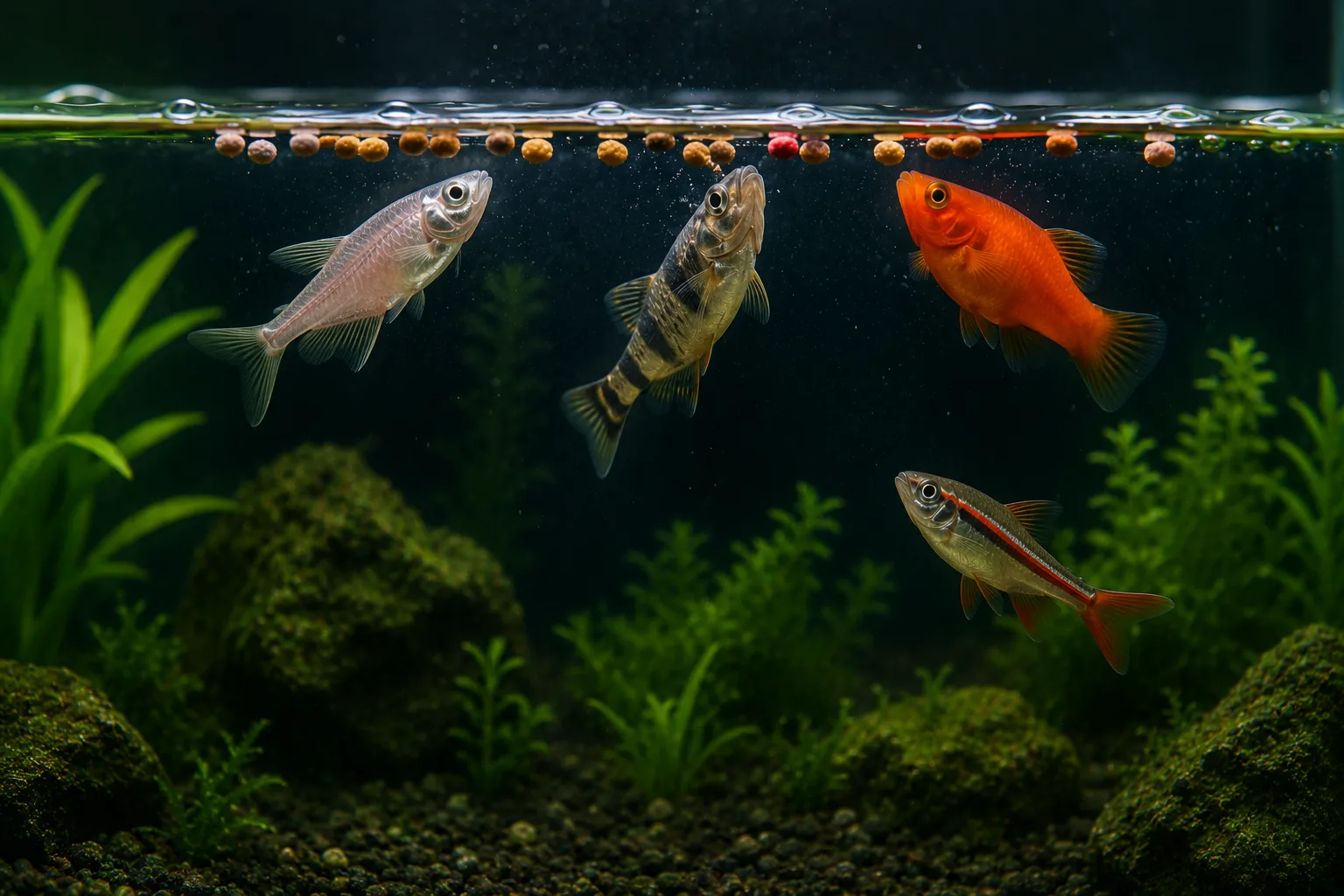
Live food as an appetite trigger: The movement of live food — live brine shrimp, live daphnia, live blackworm, live Tubifex — triggers the feeding response in almost all fish species, including those that have been refusing dry or frozen food. This works because movement is the primary feeding trigger for many fish. Once a fish is eating live food reliably, transitioning to frozen is usually straightforward.
Frozen food as a bridge: Frozen bloodworm, brine shrimp, daphnia, and mysis (for marine fish) thawed to tank temperature are accepted by most reluctant feeders as a bridge between live food and dry food. The texture and smell are closer to live food than pellets or flakes are.
Fasting before offering preferred food: Offering the most appealing food to a fish that has already been fed moderately produces weaker feeding responses than offering it to a fish that has not eaten for 24–36 hours. A fast before introducing a new food type or attempting to trigger appetite in a reluctant fish increases the probability of acceptance.
Feeding at optimal time: Most fish show peak appetite in the first hour of their active period — typically early morning for diurnal species, just after lights-off for nocturnal species. Offering food at these peak appetite windows produces better results than feeding during low-activity periods.
Feeding with the lights off: Timid fish and new purchases often refuse food while lights are bright and people are present. Offering food in subdued lighting or with the room lights off reduces stress and can trigger feeding in fish that otherwise refuse.
Garlic: Garlic extract and garlic-soaked food have anecdotally shown appetite-stimulating effects in fish, particularly saltwater species. The mechanism is not fully understood but garlic contains allicin and other compounds that appear to attract feeding attention. Soaking food briefly in garlic extract or purchasing garlic-infused foods is a low-risk first option for marine fish refusing to eat.
9. When to Escalate — Signs This Is Serious
Most instances of fish not eating resolve within the normal fasting windows described in this guide. The following indicate a situation that requires prompt, active intervention:
Visible weight loss. A fish whose body profile is visibly thinner than before — sunken belly, visible spine or skeletal structure along the back — has been in genuine nutritional deficit for at minimum one to two weeks. This requires immediate identification of cause and appropriate intervention, not watchful waiting.
Refusal to eat beyond 14 days in a fish that is not a known fasting species (predatory fish, mouthbrooding fish) and with no improvement trend. The exact window depends on the species — small fish with high metabolisms deteriorate faster than large fish — but two weeks of genuine total food refusal in a small community fish is a veterinary-level concern.
Food refusal accompanied by other symptoms. Any combination of: clamped fins, surface gasping, erratic or abnormal swimming, visible lesions or ulcers, bloating (particularly with scale lifting — a sign of dropsy), colour changes including darkening or fading. Appetite loss in this context is a disease indicator requiring diagnosis, not a standalone observation.
All fish refusing food after a specific event. All fish in a tank simultaneously refusing food after a water change, the introduction of new fish, a power cut, or any other discrete event indicates an acute environmental problem requiring immediate parameter testing and correction.
Rapid deterioration. A fish visibly deteriorating — posture worsening, equilibrium failing, movement reducing — over 24–48 hours requires emergency assessment regardless of whether it is also not eating. For the complete framework on fish death causes and diagnostics, see Why Do My Aquarium Fish Keep Dying.
10. India-Specific Considerations
Extended post-purchase fasting window. As noted in Section 2a, the Indian aquarium livestock supply chain is longer and more stressful than in countries with shorter distribution networks. Fish reaching Indian shops have typically passed through more transitions — international freight, customs, national distributors, regional distributors — than fish in the UK or Germany where advice timelines are typically calibrated. Post-purchase food refusal lasting 7–14 days is more representative of typical Indian-sourced fish than the 2–5 day window commonly cited in international guides. Do not escalate to medication during this extended window in the absence of other symptoms.
Summer heat suppressing appetite. During peak Indian summer (April–June) when tank temperatures in uncooled rooms reach 30–34°C, appetite suppression is physiological rather than pathological. Fish at temperatures above their comfortable range divert metabolic resources away from digestion. Reduce feeding amounts by 20–30% in summer rather than attempting to maintain normal feeding schedules. The complete thermal management framework is in Aquarium Water Temperature in Indian Summer.
Chloramine and chronic appetite suppression. Delhi and most Indian metro municipal water uses chloramine. Standard dechlorinators release the ammonia component of chloramine with each water change. Chronic low-level ammonia from repeated inadequately dechlorinated water changes produces exactly the sub-acute ammonia appetite suppression described in Section 4a — fish gradually eating less without acute symptoms. If appetite has declined gradually over weeks to months in a tank with regular water changes, test for ammonia after a water change using a full-spectrum dechlorinator-treated sample vs an untreated sample from the tap to identify whether chloramine is the source.
Monsoon and seasonal chemistry shifts. Delhi’s water chemistry shifts between pre-monsoon and monsoon season. Fish adapted to one water chemistry may show temporary reduced appetite when source water shifts across a season — particularly if KH or pH changes noticeably with each water change during the transition period.
11. Frequently Asked Questions
How long can a fish go without eating before it starves? This varies enormously by species, size, and body condition going into the fast. Small fish with high metabolisms — neon tetras, danios, small rasboras — begin showing nutritional stress after 7–10 days without food. Medium-sized community fish — most cichlids, barbs, live-bearers — can fast 2–3 weeks without serious harm. Large predatory fish — oscars, arowanas — can fast several weeks to months between meals in nature. Fry and juveniles deteriorate faster than adults. Body condition at the start of the fast matters significantly — a well-conditioned fish survives a longer fast than a thin one.
My fish is eating but losing weight. What is happening? Eating well while losing weight most commonly indicates internal parasites consuming a portion of the nutritional intake. Other possibilities: the food being offered is nutritionally insufficient for the species (herbivores on protein diet, carnivores on vegetable-based food), the fish has a metabolic condition, or the feeding competition in the tank means the fish appears to eat at feeding time but is not getting adequate nutrition. Assess body condition against species baseline and investigate parasite load if a well-fed fish is losing weight.
My fish ate well for months and suddenly stopped. What changed? Sudden appetite loss in an established fish that was previously eating normally almost always has a triggering cause. Review the 48–72 hours before the refusal began: was there a water change? New fish added? Filter cleaned? Power cut? Parameter test readings changed? Temperature change? Any new chemical addition to the tank (new decoration, new substrate, treatment)? The cause is almost always identifiable from recent events.
Should I try different foods to get a fish to eat? Not immediately. Offering the same food the fish previously accepted (or an appropriate food for the species) is correct for the first 5–7 days. Rapidly switching food types during a stress-related fast adds novelty stress without helping. Once the normal fasting window has passed without improvement, trying live or frozen food as described in Section 8 is appropriate.
My whole tank stopped eating after a water change. What happened? The most likely causes: temperature shock (new water significantly different temperature from tank), chlorine or chloramine in inadequately treated water causing acute gill irritation, a significant chemistry shift (different KH or pH from the tap producing an osmotic stress response), or an accidental contaminant in the water change container. Test parameters immediately. Small partial water change with correctly treated, temperature-matched water is the initial response.
Is it normal for fish to eat less in winter? Yes, for fish in unheated tanks or tanks in rooms that cool significantly in winter. Metabolic rate scales with temperature — fish in 20°C water have meaningfully lower metabolic demand than fish in 26°C water. Appetite reduction in winter in unheated tanks, and appetite recovery in spring when temperatures rise, is physiologically normal. Run the heater at the correct setpoint for the species, verify the actual tank temperature rather than the heater setting, and adjust feeding amounts to match the actual metabolic demand at current temperature.
I’ve tried everything and my fish still won’t eat. What do I do? If genuine refusal persists beyond the species-appropriate fasting window, other symptoms have been ruled out, parameters are confirmed correct, and live food stimulation has been attempted: consult an aquatic veterinarian. In India, aquatic veterinary services are limited but available in major cities. ProHobby provides in-person consultation for challenging cases at our Dwarka outlet. Fish health problems that resist straightforward management at home are diagnosable with appropriate examination — do not continue waiting passively while a fish deteriorates.