
by ProHobby™ | Ecological Systems Authority
Every year, more aquariums fail in the first three months than at any other point in their life. The fish die, the water turns foul, the hobbyist concludes they are not good at this — and they are wrong. The tank failed because it was never cycled, or was cycled incorrectly, or was declared cycled before it actually was. The nitrogen cycle is not a beginner concept to get through quickly before the “real” fishkeeping begins. It is the foundation on which every stable aquatic ecosystem stands, and understanding it at the level of what is actually happening — not just the simplified version that circulates in hobby guides — is what separates tanks that thrive from tanks that repeatedly crash.
This How to Cycle a Fish Tank guide covers the complete science and practice of aquarium cycling: the biology of what is happening inside your filter and substrate, every cycling method with honest trade-offs, what your test readings actually mean and why, system-specific considerations for planted tanks, marine systems, shrimp, and brackish setups, and a comprehensive troubleshooting framework for every failure mode a cycle can produce.
If you are reading this, you have either already setup your tank or considering setting one up soon. Learn how to set up your first fish tank in our step-by-step guide. Also know why aquariums fail in our systems-level diagnosis of aquarium breakdown.
Table of Contents
- What the Nitrogen Cycle Actually Is
- The Organisms Doing the Work — and What Science Actually Says
- Biofilm Ecology: Why Surfaces Matter More Than Water Volume
- Ammonia Speciation: The pH Dependency Most Guides Miss
- What “Cycled” Means — and What It Does Not
- Pre-Cycling Preparation
- 6a. Dechlorination vs Dechloramination
- 6b. Temperature
- 6c. pH and Buffering Capacity
- 6d. Surface Area and Filter Media
- Cycling Methods: A Complete Comparison
- 7a. Fishless Cycling with Pure Ammonia
- 7b. Fishless Cycling with Organic Material
- 7c. Fish-In Cycling
- 7d. Seeded Cycling
- 7e. Bottled Bacteria Products
- The Recommended Method: Fishless Cycling with Pure Ammonia — Step by Step
- Reading the Cycle: Test Kits, Parameters, and What They Mean
- What to Expect Visually During Cycling
- Factors That Control Cycling Speed
- Cycling for Different System Types
- 12a. Freshwater Community Tanks
- 12b. Planted Tanks
- 12c. Shrimp Tanks
- 12d. Brackish Systems
- 12e. Marine and Reef Systems
- After the Cycle: Introducing Fish and the Maturation Period
- Troubleshooting: Every Failure Mode Explained
- Frequently Asked Questions
1. What the Nitrogen Cycle Actually Is
Fish produce waste. Waste decomposes. Decomposition produces ammonia. Ammonia is acutely toxic to fish and invertebrates at very low concentrations. In a natural lake or river, the sheer volume of water dilutes ammonia to harmless levels instantly. In an aquarium, there is no dilution. Without an active biological system to neutralise it, ammonia accumulates until the tank becomes uninhabitable.
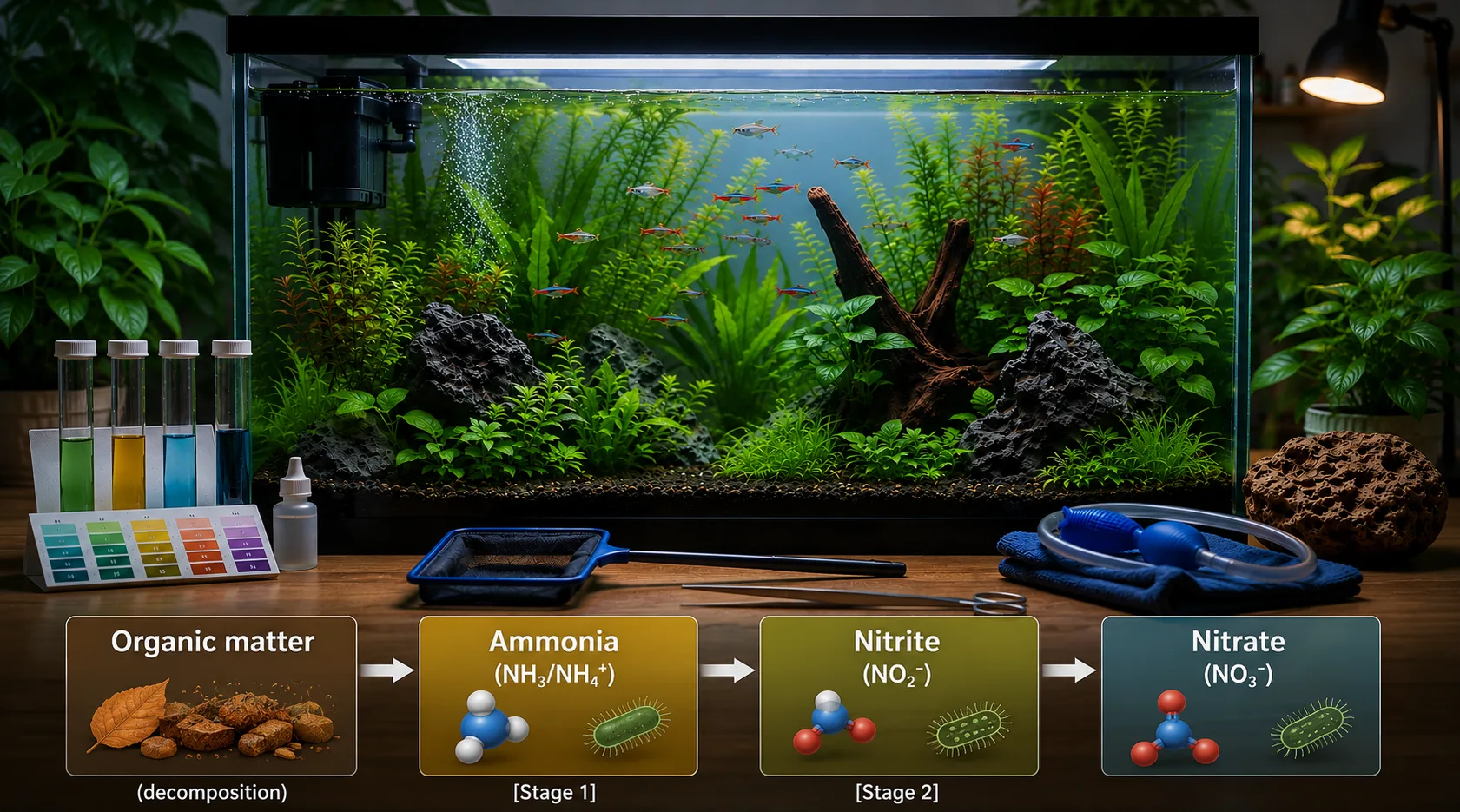
The nitrogen cycle is the biological process that converts ammonia into progressively less harmful compounds through the metabolic activity of specific groups of microorganisms. It proceeds in two primary stages:
Stage One — Ammonia oxidation: Ammonia (NH₃ / NH₄⁺) is converted to nitrite (NO₂⁻). Nitrite is also acutely toxic to fish, though through a different mechanism — it binds haemoglobin and prevents oxygen transport, causing what is sometimes called “brown blood disease.”
Stage Two — Nitrite oxidation: Nitrite (NO₂⁻) is converted to nitrate (NO₃⁻). Nitrate is relatively harmless to most fish at moderate concentrations, though it accumulates over time and is managed through regular partial water changes.
The full pathway:
Organic matter → Ammonia (NH₃/NH₄⁺) → Nitrite (NO₂⁻) → Nitrate (NO₃⁻)
| Source / Process | Conversion | Main Biological Action |
|---|---|---|
| Organic matter | → Ammonia (NH₃/NH₄⁺) | Decomposition |
| Ammonia (NH₃/NH₄⁺) | → Nitrite (NO₂⁻) | Stage 1 |
| Nitrite (NO₂⁻) | → Nitrate (NO₃⁻) | Stage 2 |
In a planted tank, a fourth step partially occurs: aquatic plants consume nitrate (and preferentially ammonia) as a nitrogen source, completing a loop that resembles natural aquatic ecosystems. In a tank with dense plant growth and balanced nutrients, nitrate accumulation is substantially reduced. But no planted tank — however densely planted — fully eliminates the need for the bacterial nitrification cycle, particularly in the early weeks.
Cycling is the process of establishing the microbial populations that drive Stage One and Stage Two before adding livestock. A cycled tank is one where these populations are large enough and stable enough to process the daily ammonia load produced by the planned stocking level.
2. The Organisms Doing the Work — and What Science Actually Says
Most aquarium guides published before approximately 2010 — and many written since, copying older sources — describe the nitrogen cycle as the work of two bacterial genera: Nitrosomonas (Stage One, ammonia oxidation) and Nitrobacter (Stage Two, nitrite oxidation). This is a simplification that has been substantially revised by molecular microbiology research over the past fifteen years.
What current science actually shows:
Nitrosomonas does exist in aquarium biofilms and does oxidise ammonia, but it is not the dominant ammonia oxidiser in most established freshwater aquarium systems. Research using 16S rRNA gene sequencing on aquarium filter biofilms consistently identifies ammonia-oxidising archaea (AOA) — particularly from the phylum Thaumarchaeota — as significant or dominant contributors to Stage One in mature aquarium filters. Archaea are a completely different domain of life from bacteria, and their kinetic properties differ: they are competitive at low ammonia concentrations, which explains in part why established filters are more efficient than new ones at processing trace ammonia.
For Stage Two, the picture is equally more complex than the textbook. Nitrobacter has largely been displaced in aquarium biofilm research by Nitrospira, a genus that outcompetes Nitrobacter under the moderate nitrite concentrations typical of aquarium environments. More significantly, certain strains of Nitrospira have been shown to perform complete ammonia oxidation (comammox) — converting ammonia directly to nitrate in a single organism without requiring a two-stage partnership. This was first confirmed experimentally in 2015 and has since been documented across a wide range of aquatic environments including aquarium filters.
Why does this matter practically?
Understanding that the actual biology is more complex than two bacterial species explains several cycling phenomena that the simplified model cannot account for:
- Why established filters are not just “more bacteria” but qualitatively different microbial communities
- Why filter biofilms from mature tanks are disproportionately more effective than their age would suggest (AOA are slow to colonise but highly efficient once established)
- Why cycling speed is not simply linear with temperature and ammonia concentration
- Why “bottled bacteria” products containing Nitrosomonas and Nitrobacter have inconsistent real-world results — these may not be the dominant organisms in a fully mature system
This does not change the practical steps of cycling a tank, but it does explain the biology behind them and prevents the persistent hobby myth that the nitrogen cycle is a simple, fully understood two-step process.
3. Biofilm Ecology: Why Surfaces Matter More Than Water Volume
The single most important practical insight from aquarium microbiology is this: the organisms that cycle your tank live primarily on surfaces, not in the water column.
Nitrifying bacteria and archaea are biofilm-forming organisms. They colonise and reproduce on solid surfaces — filter media, substrate particles, tank glass, decoration surfaces, plant stems — forming structured microbial communities embedded in a self-produced matrix of polysaccharides and proteins. Free-swimming planktonic nitrifiers exist in the water column but at densities orders of magnitude lower than biofilm communities. The vast majority of your tank’s biological processing capacity resides in the filter media and, to a lesser extent, the substrate.
This has direct implications for aquarium practice:
Filter media is irreplaceable — literally. When you clean filter media by rinsing it in tap water (which contains chlorine or chloramine), you are not just removing debris — you are destroying the biofilm community. A filter rinsed in tap water can lose most of its biological capacity in minutes. Always rinse filter media in tank water or dechlorinated water, and only rinse one section of a multi-stage filter at a time.
Surface area determines biological capacity. Not all filter media is equal. The reason specialist biological media (ceramic rings, sintered glass, plastic biomedia) outperforms simple sponge is surface area: sintered glass media can provide 500–1,500 m² of surface area per litre of media, compared to perhaps 50 m² for a sponge of the same volume. More surface area means more biofilm, means more processing capacity. When you size a filter for a new tank, you are sizing for biological capacity, not just mechanical flow.
Substrate contributes to biological capacity. A fine sand substrate has minimal biological capacity — the interstitial spaces are too small for effective water circulation and biofilm colonisation. A coarse gravel substrate with good flow-through circulation can harbour a significant biofilm community. Deep sand beds (DSB) in marine systems exploit this deliberately, though the biology there is primarily anaerobic denitrification rather than aerobic nitrification.
Seeding works because biofilm can be transferred. When you take a handful of substrate or a piece of filter media from an established tank and add it to a new tank, you are transferring a living biofilm community. This is the most effective way to accelerate cycling because you are adding a pre-assembled functional microbial community rather than waiting for individual colonising organisms to find surfaces, attach, reproduce, and form functional biofilms from scratch.
Know more about Biofilms here.
4. Ammonia Speciation: The pH Dependency Most Guides Miss
This section contains information that is absent from the majority of aquarium cycling guides but is critical for understanding why cycling behaves differently across different tank setups and why certain troubleshooting approaches fail.
Ammonia in water exists in two chemical forms: un-ionised ammonia (NH₃) and ammonium ion (NH₄⁺). Your standard ammonia test kit measures the total of both — it cannot distinguish between them. But they are not equivalent in their effects. NH₃ is acutely toxic. NH₄⁺ is relatively harmless.
The proportion of your total ammonia reading that exists as toxic NH₃ versus harmless NH₄⁺ is controlled almost entirely by pH and temperature. At low pH, the equilibrium strongly favours the harmless NH₄⁺ form. At high pH, the equilibrium shifts toward toxic NH₃.
To quantify this: at pH 7.0 and 25°C, approximately 0.6% of total ammonia exists as toxic NH₃. At pH 8.0 and 25°C, approximately 5.6% exists as NH₃. This means that the same total ammonia reading represents roughly 9–10x greater toxicity at pH 8.0 versus pH 7.0.
For hobbyists in hard-water regions — Delhi NCR, Rajasthan, most of North India, and many other areas globally with limestone-influenced municipal water — tap water commonly runs at pH 7.8–8.4. The Hard Water Aquariums in Delhi NCR guide covers the full implications of this chemistry for tank keeping. A tank reading 1.0 ppm total ammonia at pH 8.2 is presenting approximately the same toxic load as a reading of 8–10 ppm in a soft-water tank at pH 6.8.
Practical implications for cycling:
- If you are cycling a hard-water tank and your fish appear stressed at ammonia readings that seem “low” by the standard advice, pH-adjusted toxicity is a likely explanation
- Fish-in cycling in hard-water tanks is disproportionately dangerous compared to soft-water tanks at the same total ammonia reading
- The nitrifying bacteria themselves are inhibited by very high NH₃ concentrations — which means a high-pH tank being dosed with ammonia for fishless cycling requires smaller doses to avoid inhibiting the bacteria you are trying to grow (covered in Section 11)
- A cycle that completes quickly in a low-pH soft-water tank may take significantly longer in a high-pH hard-water tank partly because of this chemistry
The temperature factor: Temperature interacts with pH in the same direction — higher temperature shifts the equilibrium toward NH₃. A tank running at 28°C with pH 8.0 has meaningfully higher NH₃ toxicity than the same pH at 22°C. This is one of the reasons Indian summer presents compound risk: elevated temperature raises both the rate of fish metabolism (more ammonia production) and the proportion of that ammonia that exists in the toxic NH₃ form. The complete thermal management framework is in Aquarium Water Temperature in Indian Summer.
5. What “Cycled” Means — and What It Does Not
A tank is conventionally described as cycled when it can process an ammonia spike to zero within 24 hours — ammonia added drops to zero, nitrite drops to zero, nitrate accumulates as the only end product. This is the standard test used to confirm a completed cycle.
What “cycled” means:
- Nitrifying biofilm communities of sufficient density exist on filter media and substrate surfaces to process the ammonia load you tested against
- The two-stage conversion pathway is functioning
- Fish at the stocking level tested for can be safely added without acute ammonia or nitrite toxicity
What “cycled” does not mean:
A cycled tank is not a mature tank. This distinction is critical and almost entirely absent from cycling guides. A freshly cycled tank has the minimum viable nitrifying community — enough biofilm to process ammonia without killing fish. But the broader microbial ecology of a healthy, stable aquarium is vastly more complex. A mature aquarium — one that has been running for six months to a year or more — contains:
- A diverse community of heterotrophic bacteria that process organic matter efficiently
- Established protozoan and microinvertebrate communities that feed on bacteria and contribute to nutrient cycling
- Mature biofilm matrices on all surfaces
- Anaerobic zones in substrate deep layers that support partial denitrification
- Stable populations of beneficial fungi and microorganisms on driftwood and plant surfaces
- A microbial community that is resilient to perturbation — individual species die off and are replaced without the system crashing
None of this exists in a freshly cycled tank. A tank in its first three months after completing the cycle is ecologically vulnerable in ways that the ammonia/nitrite/nitrate readings do not reveal. Unexplained fish losses, persistent cloudiness, recurrent algae outbreaks, and parameters that seem to shift without obvious cause are all characteristic of a tank that is cycled but not yet mature. Understanding this distinction — and setting appropriate expectations — prevents a huge amount of hobbyist frustration.
The maturation period of an aquarium continues for 6–18 months. During this time, the microbial community diversifies, stabilises, and becomes increasingly resilient. A two-year-old tank with good husbandry recovers from disruptions that would destabilise a three-month-old tank with identical parameters. For the microbial science of how biofilm communities develop through successional stages, see Microbial Succession in Aquariums. For why patience — not technique — is the primary variable in a tank’s first year, see The Role of Time in Aquariums. And for the broader ecological framework that explains why a cycled tank is not a stable tank — and what stability in a closed aquatic system actually means — the Aquarium Stability Is Not Balance cornerstone article is the reference point.
6. Pre-Cycling Preparation
6a. Dechlorination vs Dechloramination
Municipal water is treated to be safe for human consumption, which means it contains biocidal compounds that are actively harmful to the microorganisms you need to establish during cycling.
Chlorine is the traditional disinfectant. It is relatively unstable and off-gasses from standing water within 24–48 hours in an aerated container. A standard sodium thiosulfate-based dechlorinator neutralises it instantly.
Chloramine is increasingly used by municipal water authorities because it is more stable than chlorine — it does not off-gas and remains effective in distribution pipes for longer. Chloramine is chlorine chemically bonded to ammonia. This creates two problems: first, a simple sodium thiosulfate dechlorinator will break the chlorine-ammonia bond and neutralise the chlorine portion, but the released ammonia remains. For cycling purposes, this released ammonia adds to your ammonia reading, which is manageable but needs to be accounted for. More significantly, standard dechlorinators do not fully neutralise chloramine — you need a product specifically formulated to neutralise both components (products containing sodium thiosulfate combined with a reducing agent, or specifically formulated products like Seachem Prime).
How to determine which your municipal supply uses: Contact your water authority or check their annual water quality report. If your water has a persistent “swimming pool” smell even after sitting overnight, chloramine is likely. If the smell dissipates after 24 hours, it is probably chlorine. This matters because chloramine-treated water used to top up a cycled tank during water changes — treated only with a standard chlorine dechlorinator — will slowly damage biofilm communities over time.
Always use a full-spectrum water conditioner that explicitly states it neutralises chloramine as a baseline practice.
See our complete guide on water chemistry for all aquatic systems.
6b. Temperature
Nitrifying bacteria are mesophilic — they function across a range of temperatures but have an optimal range. In aquarium conditions:
- Below 10°C: nitrification essentially stops
- 10–20°C: cycling proceeds slowly
- 20–30°C: optimal range; cycling is fastest in the upper part of this range
- Above 35°C: nitrification begins to decline; above 40°C it largely ceases
For most freshwater cycling, running the tank at the intended stocking temperature (typically 24–28°C for tropical fish) is appropriate. Do not cycle at lower temperatures thinking to accelerate it “naturally” — run the heater at the intended temperature from the start.
One counterintuitive point: while higher temperature within the optimal range does speed cycling, it also increases ammonia toxicity (as covered in Section 4). For fish-in cycling, this is a relevant trade-off. For fishless cycling, temperature affects only cycling speed.
6c. pH and Buffering Capacity
Nitrifying bacteria require a pH above approximately 6.5 to function effectively. Below pH 6.5, nitrification slows substantially; below pH 6.0, it largely stops. This creates a compounding problem during cycling: the nitrification process itself produces hydrogen ions (it is an acid-generating process), which can lower pH in poorly buffered water. In a tank with low alkalinity (KH below 3–4 dKH), pH can crash during cycling, which stalls the cycle at a point when the cause is not obvious from ammonia and nitrite readings alone.
If your tap water has low alkalinity: Add a small amount of buffering carbonate during cycling. For most freshwater systems, targeting KH of 4–6 dKH provides adequate buffering. Crushed coral or limestone chips added to the filter can provide sustained carbonate buffering.
If your tap water has high alkalinity (common in hard-water regions): pH buffering is not a concern, but the ammonia speciation issue covered in Section 4 requires attention to dosing levels.
6d. Surface Area and Filter Media
Before cycling begins, ensure your filter is loaded with biological media, not just mechanical filtration. A filter stuffed entirely with fine filter wool will cycle, but slowly and with limited long-term capacity. Include ceramic rings, sintered glass, plastic biomedia, or purpose-built biological media. The more biological surface area within the filter, the faster and more robust the cycle.
Run your filter at full flow during cycling — nitrifying biofilms are aerobic and require good oxygenation. Supplement with an airstone if your filter return is not creating strong surface agitation.
7. Cycling Methods: A Complete Comparison
7a. Fishless Cycling with Pure Ammonia
How it works: Pure household ammonia (or purpose-made aquarium ammonia) is dosed into the tank to provide an ammonia source. No fish are present. Bacteria colonise and grow in response to the ammonia.
Advantages:
- No fish are harmed
- Ammonia levels can be precisely controlled and elevated to build a robust bacterial population before any fish are added
- Can be accelerated more aggressively than fish-in cycling
- Tank can be fully seeded and tested before any stocking commitment
Disadvantages:
- Requires pure ammonia with no surfactants or additives — fragrance-free, surfactant-free ammonia only. The shake test: shake the bottle; if it foams and holds bubbles, it contains surfactants and will harm the biofilm. If bubbles dissipate immediately, it is clean
- Requires test kits and regular monitoring
- Takes 3–8 weeks depending on conditions and seeding
- Does not build the full heterotrophic bacterial community that processes fish waste organics — only the nitrifying component
Best for: All freshwater systems where you want to optimise fish welfare. The recommended method for most setups.
7b. Fishless Cycling with Organic Material
How it works: A piece of raw fish, a prawn, fish flakes, or other organic matter is placed in the tank and allowed to decompose, providing ammonia through the decomposition process.
Advantages:
- No special ammonia source required
- Also builds some of the heterotrophic bacterial community (decomposers), not just nitrifiers
- Passive — no daily dosing
Disadvantages:
- Ammonia levels are completely uncontrolled — can spike to very high concentrations that inhibit bacterial growth
- The decomposing material creates foul odour and visual cloudiness
- End-point is less clear — removing the organic source is imprecise
- Higher risk of establishing harmful bacterial species or nuisance organisms
- Produces a more variable timeline
Best for: Hobbyists without access to pure ammonia who cannot do fish-in cycling.
7c. Fish-In Cycling
How it works: Hardy fish are stocked at low density and the cycle proceeds in their presence. Ammonia is managed through frequent partial water changes to keep it below toxic thresholds.
Advantages:
- No special equipment or chemicals required
- The cycle is built around the actual fish being kept — the bacterial community is tuned to the specific waste profile of those species
- Also builds the heterotrophic community alongside the nitrifying community
Disadvantages:
- Fish are exposed to ammonia and nitrite throughout the process — even carefully managed fish-in cycling causes physiological stress and immune suppression
- Requires daily or twice-daily monitoring and frequent water changes
- A mistake in monitoring can be lethal
- Significantly more management-intensive than fishless cycling
- Ethically questionable when fishless cycling is an available alternative
Safer fish-in cycling if you choose this method:
- Start with no more than 25–30% of the intended final stocking
- Test ammonia and nitrite every day without exception
- Perform a 30–50% water change any time total ammonia exceeds 0.5 ppm or nitrite exceeds 0.25 ppm
- Use a water conditioner that temporarily detoxifies ammonia and nitrite (such as Seachem Prime) — this buys time between monitoring and water changes but does not replace them
- Do not add more fish until the cycle is complete
Best for: Situations where fish have already been purchased before the cycle was understood, or where fishless cycling materials are genuinely unavailable.
7d. Seeded Cycling
How it works: Established biological material from a running, healthy tank is transferred to the new tank. This can be filter media, substrate, a sponge filter that has been running in an established tank, or even a significant volume of tank water (though water carries far fewer bacteria than surfaces).
Advantages:
- The fastest method by far — a heavily seeded tank with established media can become functional within days rather than weeks
- Transfers a mature, diverse biofilm community rather than starting from scratch
- Reliable and predictable if the source tank is genuinely healthy
Disadvantages:
- Requires access to a trusted established tank — the source tank must be free of disease, parasites, and pest organisms
- The transferred media must not be allowed to dry out or be exposed to tap water before being introduced
- A smaller amount of seed media (e.g., a handful of substrate) from a healthy tank still accelerates cycling but does not eliminate it — it shortcuts rather than replaces the cycle
Best for: Hobbyists who have an established tank or know someone who does. In combination with ammonia dosing, this is the fastest reliable method.
7e. Bottled Bacteria Products
How it works: Commercially produced products claim to contain live nitrifying bacteria in suspension — adding them to a new tank is marketed as providing an “instant cycle.”
Reality: The effectiveness of bottled bacteria products is genuinely variable, and the variation is explained by the microbiology. Products containing Nitrosomonas and Nitrobacter — the textbook bacteria — have performed inconsistently in independent testing because, as covered in Section 2, these may not be the dominant organisms in a mature aquarium system. Products containing more ecologically accurate bacterial communities, or heterotrophic bacteria alongside nitrifiers, tend to perform better.
Even the best bottled bacteria products reliably do not provide a “complete instant cycle.” They more accurately function as seed accelerants — adding a starting population that reduces cycling time compared to starting from nothing. A tank using a good bottled bacteria product alongside ammonia dosing may cycle in 2–3 weeks rather than 4–6 weeks.
Best for: Accelerating a fishless or fish-in cycle when no established seed media is available. Do not use as a replacement for understanding the cycle. Check the expiry date — shelf life matters and old products may contain largely dead organisms.
8. The ProHobby™ Recommended Method: Fishless Cycling with Pure Ammonia — Step by Step
This is the method that provides the most control, causes no animal harm, and produces a robust result within a predictable timeframe.
What you need:
- Pure ammonia solution, fragrance-free and surfactant-free (do the shake test described above). Concentrations vary — 10% ammonia solution is common; know your concentration
- A liquid test kit for ammonia, nitrite, and nitrate. Strip tests are insufficiently accurate for cycling. API Master Test Kit is widely available and reliable
- A thermometer
- A heater set to the intended tank temperature
- Full biological filter media installed and running
- Dechlorinator (chloramine-safe)
Step 1 — Set up the tank fully. Fill with dechlorinated water. Run the filter. Set the heater to the intended temperature. Do not add fish. Do not add live plants yet if you are doing a basic freshwater cycle — plants are a beneficial complication covered in Section 12b. Allow the tank to run for 24 hours and confirm temperature stability.
Step 2 — Establish a baseline dose. The target starting ammonia level is 2–4 ppm of total ammonia. This is high enough to provide a substantial food source for colonising bacteria but not so high as to be inhibitory. Dose ammonia and test after 30 minutes. Adjust and test again. Note the volume of ammonia that achieves your target in your specific tank — you will repeat this dose throughout.
Why not higher? Ammonia concentrations above 4–6 ppm begin to inhibit nitrifying bacteria directly. Many stalled cycles that hobbyists attribute to “wrong temperature” or “bad products” are actually caused by over-dosing ammonia, which creates a concentration toxic to the organisms it is supposed to feed. This is the inhibitory concentration effect, and it is one of the most underdiagnosed problems in cycling.
Step 3 — Monitor daily. Test ammonia and nitrite every day at the same time. Record the readings. For the first one to two weeks, you will likely see only ammonia with no nitrite — Stage One bacteria have not yet colonised in sufficient numbers to produce measurable nitrite. This is normal. Do not redose ammonia if it is still reading above 1 ppm.
Step 4 — Recognise Stage One completion. You will see nitrite begin to rise as ammonia starts to drop. This typically occurs between Day 7 and Day 21 depending on temperature, seeding, and water chemistry. When ammonia begins to fall, top it back up to 2 ppm to maintain the bacterial food source. When ammonia consistently processes to near-zero within 24 hours, Stage One is functionally complete.
Step 5 — Monitor through Stage Two. Nitrite will now rise, potentially to very high levels (10+ ppm on the test scale). This is normal — Stage Two bacteria are slower to establish than Stage One bacteria, and nitrite accumulates while their population builds. Do not panic at high nitrite readings. Do not perform a water change — you need the nitrite to feed Stage Two bacteria. Test nitrate: when it begins to appear, Stage Two bacteria are active.
Step 6 — Confirm the cycle is complete. The cycle is complete when, within 24 hours of dosing 2–4 ppm of ammonia: ammonia reads zero, nitrite reads zero, and nitrate has increased. Perform this test twice on consecutive days to confirm it is not a single-day anomaly.
Step 7 — Prepare for fish. Perform a 50% water change to reduce nitrate accumulated during cycling. Dose dechlorinator. Add fish at no more than 50% of the total intended stocking on the first introduction — the bacterial population is sized for the ammonia dose you were adding, and a full fish load immediately may temporarily exceed its capacity. Test ammonia and nitrite daily for the first week after stocking.
Typical timeline:
- Seeded tank with bottled bacteria: 2–3 weeks
- Unseeded tank at 25–28°C: 4–6 weeks
- Unseeded tank at lower temperature: 6–10 weeks
9. Reading the Cycle: Test Kits, Parameters, and What They Mean
Liquid test kits vs test strips: Use liquid test kits. Test strips are a false economy — their margin of error is too wide to provide useful information during cycling, where the difference between 0.25 ppm and 0.5 ppm of nitrite can be meaningful. The API Freshwater Master Test Kit covers ammonia, nitrite, nitrate, and pH and is the baseline minimum for cycling.
Ammonia: Test twice daily if doing fish-in cycling; daily for fishless. Your target during fishless cycling is to maintain 2–4 ppm as a food source. In fish-in cycling, do a water change the moment it exceeds 0.5 ppm.
Nitrite: Test daily. No action is needed during fishless cycling regardless of how high nitrite goes — the bacteria need it. In fish-in cycling, do a water change if nitrite exceeds 0.25 ppm. The salt treatment (adding 1 tablespoon non-iodised salt per 10 litres) partially mitigates nitrite toxicity by competing for gill uptake — a temporary supportive measure for fish-in cycling only, and only in freshwater tanks.
Nitrate: Test weekly during cycling. You are looking for nitrate to appear, which confirms Stage Two is active. The actual level does not matter during cycling.
pH: Test at the start and once or twice during cycling. If pH drops below 6.8, the cycle will stall. Investigate buffering capacity and add carbonate if necessary.
What readings look like across the cycle:
| Phase | Ammonia | Nitrite | Nitrate |
|---|---|---|---|
| Week 1 (unseeded) | Rising or stable | Zero | Zero |
| Week 2–3 | Starting to fall | Rising | Zero or trace |
| Week 3–4 | Near zero | Peaked, starting to fall | Rising |
| Week 4–6 | Zero (within 24hr of dose) | Zero | Accumulating |
| Cycled | Zero (24hr) | Zero (24hr) | Positive |
10. What to Expect Visually During Cycling
A cycling tank does not look like a healthy established tank. Understanding what is normal prevents unnecessary intervention.
Bacterial bloom — cloudy white water: At some point during cycling, typically in the first two to three weeks, the water may turn milky white or opaque. This is a heterotrophic bacterial bloom — free-swimming decomposer bacteria proliferating in the water column in response to the available organic material. It is harmless and will clear on its own, typically within a few days, as the microbial community self-regulates. Do not perform a large water change to clear it — this disrupts the process. Surface agitation and good filtration will help it resolve.
Diatom bloom — brown coating on surfaces: A brown, silky coating on glass, substrate, and decorations is diatoms — single-celled algae that exploit the elevated silicate concentrations in new tank water. Diatoms are one of the definitive visual signatures of a new tank and reliably disappear on their own within four to eight weeks as silicates are consumed and the broader system matures. They will not harm fish. Snails, plecos, and otocinclus eat them readily.
Biofilm on surfaces: A thin, often slightly transparent or grey-brown coating may appear on hard surfaces in the tank. This is biofilm — your nitrogen cycle, visible. Do not scrub it off. These are the living communities you are trying to establish.
Ammonia-stressed appearance in fish-in cycling: In fish-in cycling, watch for clamped fins, gasping at the surface, sitting at the bottom, rapid gill movement, and loss of colour — all signs of ammonia or nitrite stress requiring immediate water change.
11. Factors That Control Cycling Speed
Temperature: The most consistent accelerant. Each 10°C increase roughly doubles biological reaction rates within the viable range. Cycling at 28°C versus 22°C can halve the time required.
Seeding: The most impactful single action. A large amount of established filter media can compress a 6-week cycle into a matter of days. Even a small amount of established substrate reduces cycling time meaningfully.
Ammonia concentration: There is an optimal range, not a “more is better” relationship. 2–4 ppm is the sweet spot. Above 5–6 ppm, ammonia begins to inhibit the bacteria you are feeding. Above 8–10 ppm, bacterial growth is significantly suppressed. Stalled cycles caused by over-dosing are common and misdiagnosed.
Oxygen: Nitrifying bacteria are strict aerobes. Dissolved oxygen must be high throughout cycling — ensure strong surface agitation. A supplementary airstone during cycling is beneficial in any tank.
pH: Must remain above 6.5, ideally 7.0–8.0. Below 6.5, nitrification slows dramatically. If pH crashes, the cycle stalls.
Absence of biocides: Chlorine, chloramine, antibiotics, and many plant-based treatments kill nitrifying bacteria. Never add any treatment or medication to a cycling tank. Never add untreated tap water.
Light: Has no direct effect on nitrifying bacteria. Lighting schedule during cycling is irrelevant to cycling speed, though it affects algae growth on surfaces.
12. Cycling for Different System Types
12a. Freshwater Community Tanks
The standard method described above applies. No significant modifications needed. Target 2–4 ppm ammonia, maintain temperature at the intended stocking temperature, confirm cycle with the 24-hour test.
12b. Planted Tanks
Planted tanks introduce beneficial complications to cycling. Aquatic plants consume ammonia directly and preferentially — often faster than bacteria oxidise it. In a densely planted tank with good lighting, plants may process ammonia so efficiently that bacterial populations never build to the levels needed for an unplanted system.
This sounds like a problem but is actually an advantage: plants are far better nitrogen processors than bacteria in terms of the completeness of nutrient removal (they sequester it into biomass rather than leaving it as nitrate). A heavily planted tank with healthy, actively growing plants in good light with CO₂ may achieve functional ammonia control through plants alone during the first weeks, with bacterial communities supplementing.
Practical guidance for planted tank cycling:
- Run the full lighting photoperiod during cycling — plants need light to process ammonia
- If using CO₂ injection, run it from the start — CO₂-limited plants consume nutrients sluggishly
- Still establish a bacterial cycle — plants die back, get trimmed, or slow in winter; the bacterial community provides resilience
- Fishless cycling with ammonia works but may take longer because plants compete for the ammonia — this is normal and beneficial
- The “ugly phase” with diatoms is typically more severe in planted tanks due to elevated silicate release from new substrate
12c. Shrimp Tanks
Shrimp — particularly Caridina and Neocaridina species — are significantly more sensitive to ammonia and nitrite than most fish. They are also sensitive to cycling-related parameter swings. Two adjustments are important:
Lower ammonia dosing target: Cycle to a lower ammonia level — 1–2 ppm rather than 2–4 ppm — to build a bacterial community calibrated to the lower ammonia load that a shrimp-only tank produces. A cycle built on 4 ppm ammonia may overreact to the trace ammonia from a low-density shrimp colony and allow the population to crash from starvation.
Extended maturation before stocking: Do not add shrimp to a freshly cycled tank. Shrimp are particularly sensitive to the parameter instability of a newly cycled but not yet mature tank. Allow at least 4–6 weeks of running after the cycle completes — with some small fish or feeding to maintain the bacterial population — before introducing shrimp. A 3–6 month old established tank is the ideal shrimp environment.
12d. Brackish Systems
Brackish cycling follows the same principles as freshwater but with the salinity variable added. Nitrifying bacteria are present across the full salinity range from fresh to full marine, but the species composition shifts. The bacteria that dominate in a freshwater system are not the same as those in a marine system, and brackish is a transitional zone.
Cycle a brackish tank at the intended salinity — do not cycle at freshwater salinity and then increase salt. The bacterial community needs to be established at the conditions it will operate in.
Brackish systems tend to cycle somewhat faster than equivalent marine systems and at comparable speeds to freshwater when run at the intended temperature and salinity.
12e. Marine and Reef Systems
Marine cycling is the most complex and longest of any aquarium system type. Several factors distinguish it from freshwater:
Live rock as biological seed: Traditional marine cycling used live rock — porous limestone rock colonised by diverse marine microorganisms from ocean collection sites — as the primary biological seed. The die-off of organisms transported on the rock provided an initial ammonia source while the surviving and colonising bacteria established. With the increasing use of “dry” (cured) rock or synthetic rock for ecological and ethical reasons, the cycling process is now more similar to freshwater fishless cycling but slower.
Timeline: Marine systems cycle more slowly than freshwater — 6–12 weeks is typical for an unseeded system. Marine-specific bottled bacteria products (containing halotolerant nitrifying bacteria) are more consistent in their effectiveness than freshwater equivalents.
Reef systems: Coral and invertebrate sensitivity requires that a reef system is not just cycled but well-matured before sensitive livestock is introduced. ProHobby™ recommends running a system for 3–6 months preferably fishless or with only hardy fish and beginner corals before introducing sensitive species.
Denitrification: Marine systems — particularly reef systems — benefit from and often incorporate active denitrification (conversion of nitrate to nitrogen gas) through deep sand beds, refugiums with macroalgae, or specialized biological media. This is a fourth stage beyond the standard nitrogen cycle and is specific to marine systems where nitrate accumulation is a significant concern for coral health.
13. After the Cycle: Introducing Fish and the Maturation Period
Introducing fish after cycling:
- Perform a 50% water change immediately before first stocking to reduce accumulated nitrate
- Stock at no more than 50% of intended final stocking on the first introduction — the biological rationale for this and the full framework for calculating your tank’s sustainable capacity is in Carrying Capacity in Aquariums
- Test ammonia and nitrite daily for the first week — a newly cycled tank sometimes shows a brief ammonia spike as the bacterial community adjusts from ammonia dosing to actual fish waste
- Add subsequent fish in stages over the following weeks, with testing between additions
- Do not add all fish at once even if the cycle appears robust
The maturation period:
For the first three to six months after a tank cycles, maintain heightened attention to parameters and take the following as normal rather than alarming:
- Occasional minor ammonia or nitrite spikes that resolve within 24–48 hours without intervention
- Water clarity fluctuations — bacterial blooms, occasional cloudiness
- Algae progression: diatoms (brown) typically peak in the first 4–8 weeks then decline, giving way to green spot algae, and eventually reaching an algae equilibrium as the tank matures
- Fish behaviour that seems slightly stressed relative to how the same species behaves in an established tank
Do not significantly change filtration, substrate, or stocking during the maturation period without testing before and after. The system is still building ecological resilience.
After 6–12 months, a well-managed tank achieves the ecological stability that experienced hobbyists associate with a “settled” system — characterised by stable parameters, predictable algae levels, efficient waste processing, and resilience to minor disruptions. The Role of Time in Aquariums covers this maturation arc in full.
The next questions after cycling are what fish to keep and how many. Best Community Fish for Beginners covers species selection around your actual tap water chemistry, and How Many Fish Can an Aquarium Support provides the four-constraint framework for calculating carrying capacity before stocking.
14. Troubleshooting: Every Failure Mode Explained
Cycle stalls at ammonia — nitrite never appears
Likely causes:
- Temperature below optimal — check heater function
- pH below 6.5 — the cycle cannot proceed; test pH and buffer if necessary
- Ammonia concentration too high (inhibitory) — if dosing above 4–5 ppm, reduce to 2 ppm and retest in 48 hours
- Chlorine or chloramine in the water — verify dechlorinator is appropriate for your water supply
- Antibiotic, medication, or plant treatment added to the tank — these kill nitrifying bacteria; cease treatment and restart
Cycle stalls at nitrite — nitrite will not drop
This is the most common stall point. Stage Two bacteria are slower to establish than Stage One bacteria. A high nitrite reading that persists for two to three weeks is frustrating but normal in an unseeded system.
If stalling exceeds three weeks:
- Test pH — Stage Two bacteria are more sensitive to low pH than Stage One; if pH has dropped during Stage One, buffer and retest
- Confirm oxygen levels are adequate — increase surface agitation
- Consider adding a small amount of seed material from an established tank
- Check ammonia is still being provided as a food source — if ammonia has gone to zero and not been redosed, Stage One bacteria lack food and may have declined
Nitrite never drops, ammonia never drops: Points to a complete blockage — most likely pH crash or ongoing biocide exposure.
pH crash during cycling
Cycling is acid-generating. In a low-alkalinity tank, pH can drop from 7.5 to below 6.0 within two to three weeks, stalling the cycle completely. If pH tests show a progressive decline:
- Add crushed coral or aragonite to the filter or a mesh bag in the tank — these dissolve slowly and provide carbonate buffering
- Alternatively, use a commercial pH buffer product calibrated for your target range
- Retest ammonia and nitrite after pH stabilises — the cycle will resume
Cycle crashes after completion
A completed cycle that subsequently fails — ammonia or nitrite reappear in a previously cycled tank — is almost always caused by one of the following:
- Filter cleaning in tap water — the most common cause. The biofilm was killed. Seed the filter again and re-cycle
- Antibiotic medication — kills nitrifying bacteria as a side effect. Always remove biological media to a separate running container during antibiotic treatment
- Extended power cut — nitrifying bacteria are aerobic; a long power outage without oxygen can crash a filter’s biological capacity. After extended outages, feed minimally and test daily for several days
- Sudden temperature crash or spike — extreme temperatures kill biofilm communities
Nitrite drops but ammonia never truly zeros
This pattern — nitrite reaching zero while ammonia stays at a low positive reading — sometimes indicates the test kit is reading false positives from certain water conditioners (Seachem Prime temporarily interferes with some ammonia test readings). Test with a second kit or use a different test method. If ammonia reads low but consistent, stock conservatively and monitor.
15. Frequently Asked Questions
How long does cycling take? 4–6 weeks for an unseeded freshwater tank at optimal temperature. 2–3 weeks with good seeding. Up to 12-24 weeks for marine systems. Up to 12 weeks in suboptimal temperature or pH conditions.
Can I cycle with fish food instead of pure ammonia? Yes — decomposing fish food provides ammonia. The method is less controlled but works. Add a small pinch of flakes daily and test ammonia to ensure it stays below 4 ppm.
Do I need to do water changes during fishless cycling? No, and you should not — except if ammonia or nitrite builds to very high levels (above 8 ppm), which indicates over-dosing. Water changes during fishless cycling remove the substrate (nitrite) that Stage Two bacteria need.
Can I add plants during cycling? Yes, and it is beneficial. Hardy plants like Anubias, Java Fern, Vallisneria, and Hornwort can tolerate the parameter swings of a cycling tank and will actively help process ammonia. Tissue culture plants (sold in sealed cups) add no pest organisms. Avoid expensive or delicate species until after the cycle.
Will a cycled filter media from a friend’s tank instantly cycle my new tank? Substantial seeding with filter media from an established, disease-free tank can compress cycling to days rather than weeks — not truly instant, but very fast. The transferred media must not dry out or be exposed to tap water, and must be introduced immediately. The source tank must be confirmed free of disease and unwanted organisms.
Should I turn off the filter at night during cycling? No. The filter must run continuously. Nitrifying biofilms require constant oxygenated water flow. Interrupting flow, even overnight, deprives the biofilm of oxygen and can damage the community.
My ammonia reads zero but I never saw nitrite — did I skip the cycle? If ammonia reads zero without ever seeing nitrite, and nitrate has not appeared, most likely the ammonia source was exhausted without bacterial colonisation occurring, or the test kit is unreliable. Dose ammonia and monitor closely for 48 hours. If ammonia consistently drops to zero within 24 hours and nitrate is rising, the cycle may be complete — possibly accelerated by plants or seed material. Confirm with the 24-hour test before stocking.
How do I maintain the cycle if I am delaying stocking? Dose 1–2 ppm ammonia every few days to maintain the bacterial population. Without a food source, nitrifying bacteria decline. A cycled tank left unfed for more than 1–2 weeks will lose biological capacity.
Is a cycled tank safe for shrimp? A cycled tank is minimally safe for shrimp — far safer than an uncycled tank. But shrimp fare considerably better in a mature tank. Wait at least 4–6 weeks after cycle completion, run the tank with some hardy fish or regular ammonia dosing during that time, and test parameters thoroughly before introducing shrimp.
Does the nitrogen cycle ever “turn off” in an established tank? No, but it can be disrupted. Any event that damages biofilm communities — antibiotic treatment, filter cleaning in tap water, major substrate disturbance — can partially or fully crash the cycle. This is why newly established tanks require more careful management than mature systems: the bacterial community is thinner and less resilient. If fish losses are occurring despite a completed cycle, Why Do My Aquarium Fish Keep Dying provides a stage-by-stage diagnostic framework starting from the biology covered in this guide.