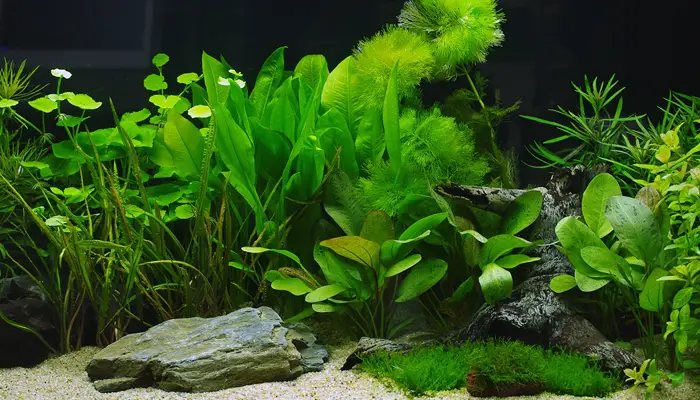

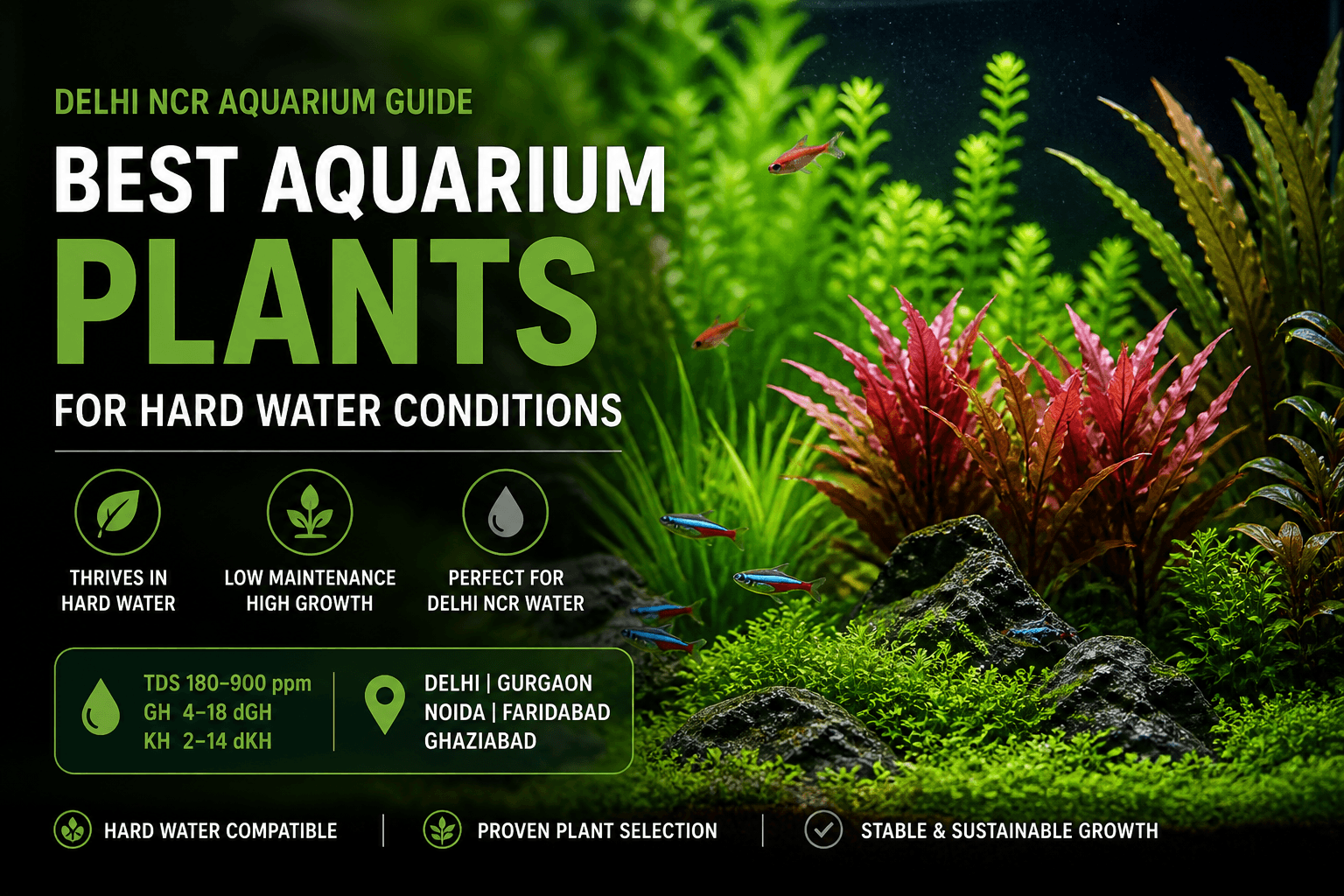
Aquarium plants in Delhi NCR water conditions are defined by mineral content, not technique. Across Delhi, Gurgaon, Noida, Faridabad, and Ghaziabad, aquarium plants Delhi NCR water compatibility depends on TDS, GH, and KH variation, which determines which species grow reliably and which fail.
In Delhi NCR water conditions, hardy plants such as Anubias, Java Fern, Vallisneria, Cryptocoryne, and Hygrophila grow reliably across most setups. Plants that require stable CO₂ and low buffering, including carpeting and sensitive species, require reduced KH and TDS, typically achieved through controlled systems or RO blending. Plant success depends on selecting species that match water conditions rather than attempting to adjust water for every plant.
ProHobby Plant Compatibility Model
| Water Condition | Plant Response | Outcome |
|---|---|---|
| TDS ≤ 300 ppm, KH ≤ 5 | High adaptability | Broad plant range |
| TDS 300–600 ppm, KH 4–10 | Selective growth | Stable with limits |
| TDS ≥ 600 ppm, KH ≥ 8 | Restricted growth | Only hardy species |
Plant performance declines as mineral load and buffering increase. Growth limitations are chemical, not procedural.
Plant Compatibility Matrix (Delhi NCR)
| Plant Type | Examples | Low Mineral | Mixed Water | High Mineral |
|---|---|---|---|---|
| Epiphytes | Anubias, Java Fern | Excellent | Excellent | Excellent |
| Hardy Rooted | Vallisneria, Cryptocoryne | Excellent | Good | Moderate |
| Stem Plants | Hygrophila, Bacopa | Excellent | Good | Limited |
| Carpeting | Monte Carlo, HC | Good | Poor | Fail |
| Sensitive | Tonina, Syngonanthus | Moderate | Fail | Fail |
This matrix reflects actual performance across Delhi NCR, including Gurgaon and Noida, where higher groundwater influence often increases hardness.
System Logic
When TDS exceeds 600 ppm and GH exceeds 10 dGH, plant selection becomes restricted to hardy species. When KH exceeds 8 dKH, buffering reduces CO₂ effectiveness, limiting growth of demanding plants. When TDS remains below 300 ppm and KH below 5 dKH, most plant categories become viable without modification.
Plant failure under unsuitable conditions cannot be corrected through fertilizers, lighting, or CO₂ alone. Choosing the right aquarium plants Delhi NCR water systems support is the most important step in building a stable planted tank.
Growth Behavior by Plant Category
Epiphytes remain stable because they absorb nutrients directly from the water column and tolerate wide parameter ranges. Hardy rooted plants adapt to mineral variation but may show slower growth under higher hardness. Stem plants perform well in moderate conditions but lose consistency as mineral concentration increases. Carpeting plants depend heavily on stable CO₂ and low KH and therefore struggle in untreated Delhi NCR tap water. Sensitive plants require controlled environments and fail under high mineral load.
CO₂ Dependence and Water Interaction
Plant growth is directly linked to carbon availability. In high KH environments common across Delhi NCR, buffering reduces CO₂ efficiency. This makes high-demand plants difficult to maintain without modifying water chemistry.
For a deeper understanding of carbon behavior in high buffering systems, see our guide on CO₂ in high KH aquarium conditions.
Substrate and Water Interaction
In low mineral systems, substrate contributes significantly to nutrient availability and buffering. In high mineral conditions common in Gurgaon and Faridabad, water chemistry dominates and reduces substrate influence.
For deeper understanding, refer to our aquarium substrate strategy guide.
Failure Patterns in Plant Selection
Planting incompatible species leads to predictable outcomes. Carpeting plants fail to establish. Sensitive plants melt or stagnate. Stem plants become inconsistent. These failures are direct consequences of water chemistry mismatch.
These patterns connect to broader system instability explained in our Why Aquariums Fail systems diagnosis.
Practical Selection Framework
Plant selection should begin with water testing. When water chemistry is known, compatible species can be selected without unnecessary modification. Attempting to force incompatible plants leads to repeated instability.
For a complete system-level understanding, refer to our Hard Water Aquariums in Delhi NCR guide and RO Water Decision Framework.
Water chemistry varies across Delhi NCR locations. Gurgaon and Faridabad often show higher TDS due to groundwater influence. Noida and parts of Delhi may show moderate ranges depending on municipal supply. These variations directly influence plant compatibility and must be considered before selection. Hobbyists facing consistent plant melt should also see Why Aquarium Plants Melt After Planting (And What It Really Means).
Frequently Asked Questions
What are the best aquarium plants for Delhi NCR water?
Anubias, Java Fern, Vallisneria, Cryptocoryne, and Hygrophila grow reliably across Delhi NCR conditions. Also see 12 Best Low-Light Aquarium Plants for Beginners (No CO₂ Needed!) and Top 7 Low Light Aquarium Plants That Thrive in Delhi Homes.
Can I grow carpeting plants in Gurgaon or Noida tap water?
Only under controlled conditions with reduced KH and stable CO₂.
Why do aquarium plants fail in Delhi water?
High TDS, GH, and KH create conditions unsuitable for sensitive species.
Do I need CO₂ for aquarium plants in Delhi NCR?
Only for high-demand plants requiring stable carbon availability.
Is RO required for aquarium plants in Delhi NCR?
Only when water parameters exceed plant tolerance or when growing sensitive species.
Does water differ across Delhi NCR cities like Gurgaon and Noida?
Yes, water chemistry varies across Delhi, Gurgaon, Noida, Faridabad, and Ghaziabad, affecting plant compatibility.
Closing Principle
Aquarium plants do not adapt equally to all conditions. In Delhi NCR, stability is achieved by selecting plants that match water chemistry rather than attempting to modify water for every species.