
By ProHobby™ | Ecological Systems Authority
Turtles are kept in India in conditions that would not be recognisable to the animals. A red-eared slider on a 25 cm plastic plate with a small palm tree, a few centimetres of water, and no basking lamp is one of the most common setups sold at Indian pet markets — and it is inadequate in every respect. Turtles are long-lived reptiles with specific ultraviolet light requirements, basking requirements, filtration demands, and dietary needs completely different from fish. A turtle in a correct setup lives 20–40 years. A turtle in a plate setup lives 1–3 years, usually dying from metabolic bone disease, shell rot, or respiratory infection.
The legal landscape must be addressed first.
Legal Status of Turtles in India — Read This First
Most turtle species native to India are listed under Schedule I or Schedule IV of the Wildlife Protection Act (WPA) 1972, making capture, sale, and possession illegal without specific permits.
Protected native species commonly sold illegally:
- Indian star tortoise (Geochelone elegans): Schedule IV, WPA 1972. Illegal without captive breeding certificate. Despite this, widely sold at Indian markets — almost all originate from illegal wild capture.
- Indian tent turtle (Pangshura tentoria): Schedule I. Highest protection. Illegal to keep.
- Indian roofed turtle (Pangshura tecta): Schedule I. Illegal to keep.
- Indian flapshell turtle (Lissemys punctata): Schedule I. Illegal to keep.
Legal exotic species available in India:
- Red-eared slider (Trachemys scripta elegans): North American species, widely captive-bred globally. Legal when sourced from registered captive breeders. The most commonly kept aquatic turtle in India and the primary focus of this guide.
- Yellow-bellied slider (Trachemys scripta scripta): Similar care requirements. Legal when captive-bred.
- Painted turtle (Chrysemys picta): Legal when captive-bred.
Always request documentation of captive breeding. An undocumented turtle sold by a roadside vendor is almost certainly a protected species taken from the wild. Possession of Schedule I or IV species without documentation carries criminal penalties under the WPA.
The Fundamental Requirement — Land AND Water
Aquatic turtles are semi-aquatic reptiles that divide time between water (swimming, feeding, thermoregulation) and dry land (basking, UV exposure, warming). A correct enclosure provides both environments. A tank of water without dry land is half the habitat.
This single point explains most Indian turtle failures. A turtle without adequate dry basking area develops metabolic bone disease, shell deformities, and respiratory infections regardless of water quality.
Tank Size Requirements
Red-eared sliders grow to 20–30 cm over 5–10 years. The juvenile sold at 5–8 cm in Indian markets will become a large, powerful animal within 2–3 years.
The 10-litre-per-centimetre rule: 10 litres of water per centimetre of shell length. A 20 cm turtle requires 200 litres of water volume. A 5 cm juvenile needs 50 litres now and 200 litres within 2–3 years.
Enclosure dimensions: Length at least 5× shell length, width at least 3×. A 20 cm turtle needs a tank minimum 100 cm long and 60 cm wide.
Basking Area Design
Requirements:
- Completely dry surface — turtles bask to dry their shells entirely
- Large enough for the turtle to turn and lie fully extended
- Easily accessible via ramp at shallow angle with grip surface
- Positioned under the basking heat lamp and UVB tube
Land-to-water ratio: Approximately 25–30% land, 70–75% water.
Basking temperature: 30–35°C under the lamp. Water temperature: 24–28°C. This differential drives thermoregulation — the turtle moves between environments to regulate body temperature precisely.
UVB Lighting — The Most Critical and Most Neglected Requirement
Without UVB radiation, turtles cannot synthesise vitamin D3, which is essential for calcium metabolism. The consequences of UVB deficiency:
- Metabolic Bone Disease (MBD): Bones and shell become soft and deformed. The turtle cannot metabolise calcium regardless of how much is in the diet.
- Shell deformities: Pyramiding, softening, abnormal growth.
- Immune suppression and increased disease susceptibility.
Standard aquarium lighting provides no UVB. LED lighting, fluorescent tubes, and household lighting emit no meaningful UVB. Only reptile-specific UVB tubes (rated UVB 5.0 or 10.0) work.
Key points:
- UVB tubes degrade over time — replace every 6–12 months even if still emitting visible light
- The tube must be within 30–45 cm of the basking area
- Window glass and plastic filter out UVB — a turtle basking near a glass window receives minimal UVB benefit
- UVB tubes are available from specialist reptile suppliers in major Indian cities and online
Turtle Aquarium Plants
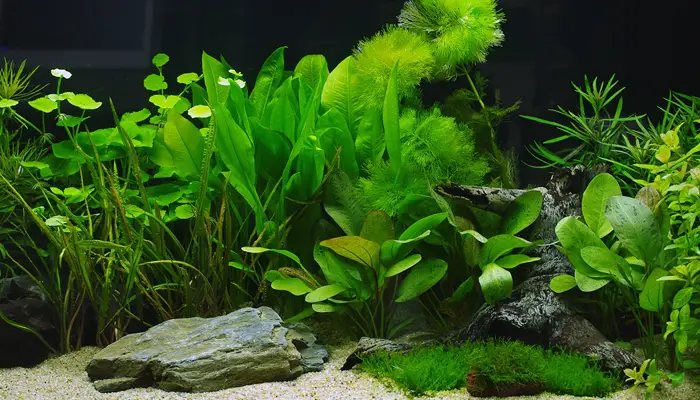
Aquatic plants can be kept in turtle tanks but require specific selection — turtles eat most soft-leafed aquatic plants rapidly and disturb substrate planting.
Plants that can survive in turtle tanks:
- Anubias (attached to hardscape): Leathery leaves turtles find unpalatable, attached to rocks or driftwood so they cannot be uprooted. Large Anubias barteri or Anubias coffeefolia on heavy rocks is the most turtle-proof plant option.
- Java fern (attached to hardscape): Mildly bitter taste that turtles tend to avoid. Must be attached to hardscape to prevent uprooting.
- Water hyacinth and water lettuce (floating): Floating plants in the water area provide shade, improve water quality through nitrate absorption, and are regularly grazed by turtles — which is acceptable as they grow quickly. Stock heavily and allow grazing.
- Hornwort (floating): Fast-growing, efficient at nitrate removal, partially grazed but regenerates faster than turtles eat it in most cases.
- Duckweed: Fast-growing surface cover, excellent water quality improvement. Turtles graze it but cannot eliminate it in a well-lit tank.
Benefits of plants in turtle tanks:
- Absorb nitrate and ammonia between filter cycles
- Reduce light penetration, reducing algae growth on glass
- Provide additional cover for water depth areas
- Grazing on appropriate plants provides nutritional benefit
What turtles will destroy: Amazon swords, cryptocoryne, stem plants, and any soft-leafed plant in substrate. These are consumed or uprooted immediately.
Practical approach: Focus on floating plants (water lettuce, hornwort, duckweed) for water quality and grazing value, with Anubias or Java fern attached to heavy hardscape for structural planting.
Filtration
Turtles produce substantially more waste than fish of equivalent size — their feeding behaviour, protein-rich waste, and messy eating habits create biological loads that overwhelm typical aquarium filtration.
Requirements:
- Canister filter rated for 2–3× the tank volume (200-litre turtle tank needs a filter rated 400–600 litres)
- Biological, mechanical, and chemical filtration
- Weekly 25–30% water changes regardless of water clarity
Turtle tank smell: The characteristic smell of turtle tanks is almost entirely a filtration and water change failure. A correctly filtered turtle tank with regular water changes should not produce significant odour. If the tank smells strongly, the filter is undersized, water changes are overdue, or organic waste (uneaten food, dead plants) is accumulating. How to Clean an Aquarium Filter Without Killing Bacteria.
Water Parameters
| Parameter | Target Range |
|---|---|
| Temperature | 24–28°C |
| pH | 7.0–8.0 |
| Ammonia | 0 ppm |
| Nitrite | 0 ppm |
| Nitrate | Below 40 ppm |
Water depth at least 1.5× the turtle’s shell length. Ammonia and nitrite testing weekly is standard maintenance.
Substrate
Bare bottom: The easiest to maintain for turtle tanks. No substrate trapping waste, easy weekly cleaning, no risk of ingestion injuries.
Large smooth river stones: 5–10 cm diameter stones too large to be accidentally ingested. Some keepers prefer this for aesthetics. Requires thorough weekly cleaning as waste accumulates between stones.
Fine sand (2–3 cm depth): Turtles dig and disturb fine sand but it can work. Regular siphoning essential. The main risk is impaction if the turtle ingests significant quantities — use smooth, fine-grade aquarium sand only.
Avoid: Small gravel or pebbles that can be accidentally ingested, causing intestinal impaction.
Feeding
Red-eared sliders are omnivores with age-dependent dietary ratios.
Juvenile diet (under 2 years): 70% protein (aquatic turtle pellets, bloodworm, earthworms, small fish, shrimp), 30% vegetation (leafy greens, aquatic plants).
Adult diet: Reverses — 70% vegetation, 30% protein. Adults on high-protein diets develop kidney disease and obesity.
Calcium supplementation: Cuttlebone placed in the tank for the turtle to gnaw. Calcium powder dusted on food.
Feeding frequency: Juveniles daily; adults every other day. Feed in a separate container if possible — this dramatically reduces water quality degradation from feeding activity, which is the primary cause of rapid water quality deterioration between water changes.
Baby Turtle Care in India
Baby turtles (under 5 cm shell length) have specific additional requirements:
Shallow water depth: Water depth equal to turtle shell length — deep enough to swim but the turtle can touch bottom and reach the surface. Baby turtles drown in deep water if they cannot find footing easily.
Temperature: Baby turtles require water temperature at the higher end of the range (26–28°C) and basking temperature 32–35°C. They thermoregulate less efficiently than adults and are more sensitive to temperature drops.
Feeding frequency: Baby turtles should be fed daily — they are growing rapidly and need consistent nutrition.
UVB: Even more critical for babies than adults, as metabolic bone disease develops faster in growing turtles deprived of UVB.
Separate from adult turtles: Adult red-eared sliders are aggressive toward small turtles and will injure or kill them.
Keeping Two Turtles Together
Two red-eared sliders can coexist in adequately sized enclosures, but the species has territorial tendencies that require management:
- Two females: generally compatible in a large tank
- Two males: more aggressive — require very large tank with multiple basking spots
- Male and female: male harasses female with constant mating attempts — use large tank and monitor female for stress
Minimum tank size increases proportionally: two adult turtles require 400+ litres of water volume and two separate, adequately sized basking areas. If one turtle is consistently preventing the other from basking, separation is necessary.
Do Turtles Hibernate in India?
Red-eared sliders naturally brumate (reptile equivalent of hibernation) in cold winters in their native North American range. In Indian conditions — even Delhi NCR winters — temperatures rarely drop low enough to trigger natural brumation. Indoor-kept red-eared sliders with maintained water temperature (24–28°C) do not hibernate and should not be induced to do so. Continue feeding and maintaining water temperature year-round.
How Long Can a Turtle Stay Out of Water?
Red-eared sliders can be out of water for several hours without harm, provided they remain in a warm, safe environment. This is relevant for handling and health checks — brief periods out of water for inspection are fine.
Dry docking (keeping a turtle out of water for extended periods, typically 1–2 hours daily) is sometimes used as a treatment for shell rot — it denies the bacteria and fungi moisture while allowing the shell to air out. Dry docking for longer periods requires veterinary guidance.
Common Health Issues
Shell rot (ulcerative shell disease): Soft spots, discolouration, and pitting from bacterial or fungal infection. Caused by poor water quality and insufficient drying during basking. Treatment: dry docking, antifungal/antibacterial treatment to affected areas, improved water quality, veterinary consultation for severe cases.
Respiratory infection: Wheezing, mucus, open-mouth breathing, listing to one side when swimming. Caused by cold, damp conditions without adequate basking. Requires veterinary antibiotic treatment.
Metabolic Bone Disease: Soft shell, deformed limbs from UVB deficiency. Prevention is the only realistic approach — established MBD produces permanent deformity. Hospital Tank protocol concepts apply to turtle quarantine and treatment.
Swollen eyes: Vitamin A deficiency. Supplement and improve dietary variety.
Red-Eared Slider Lifespan
20–40 years in correct conditions. Most red-eared sliders in Indian plate setups live 1–3 years. A turtle purchased at a roadside stall for a child who loses interest within months, transferred to a larger setup, and maintained properly can live longer than the child’s entire school career.
Frequently Asked Questions
What size tank does a red-eared slider need? 10 litres of water per centimetre of shell length — approximately 200–250 litres for a full-grown adult of 20–25 cm. The plate setups sold at Indian markets are inadequate from day one.
Is Indian star tortoise legal to keep in India? No without captive breeding documentation. Indian star tortoises are Schedule IV under WPA 1972. Most sold at Indian markets are wild-caught, which is illegal. Red-eared sliders from captive breeders are the legal aquatic turtle option.
Does my turtle need UVB lighting? Absolutely yes. Without UVB, turtles cannot synthesise vitamin D3, causing metabolic bone disease regardless of dietary calcium. Only reptile-specific UVB fluorescent tubes work — replace every 6–12 months.
Can I put plants in my turtle tank? Yes — select tough plants. Anubias and Java fern attached to hardscape, floating plants (water lettuce, hornwort, duckweed), and water hyacinth work well. Plants improve water quality through nitrate absorption. Soft-leafed rooted plants are eaten immediately.
Why does my turtle tank smell? Filtration failure and insufficient water changes. Correctly filtered turtle tanks with weekly 25–30% water changes and regular feeding in a separate container do not produce significant odour. Undersize filtration, overdue water changes, or uneaten food accumulation cause smell.
How often should I change water in a turtle tank? 25–30% weekly minimum. Monthly substrate cleaning and filter maintenance (without killing biological media) complete the routine.