
By ProHobby™
The living room — the drawing room, hall, or baithak — is the right room for a vastu aquarium. Both vastu shastra and feng shui agree on this without reservation. It is the social heart of the home, where family gathers and guests arrive, where the dominant energetic pulse of the household concentrates and radiates outward.
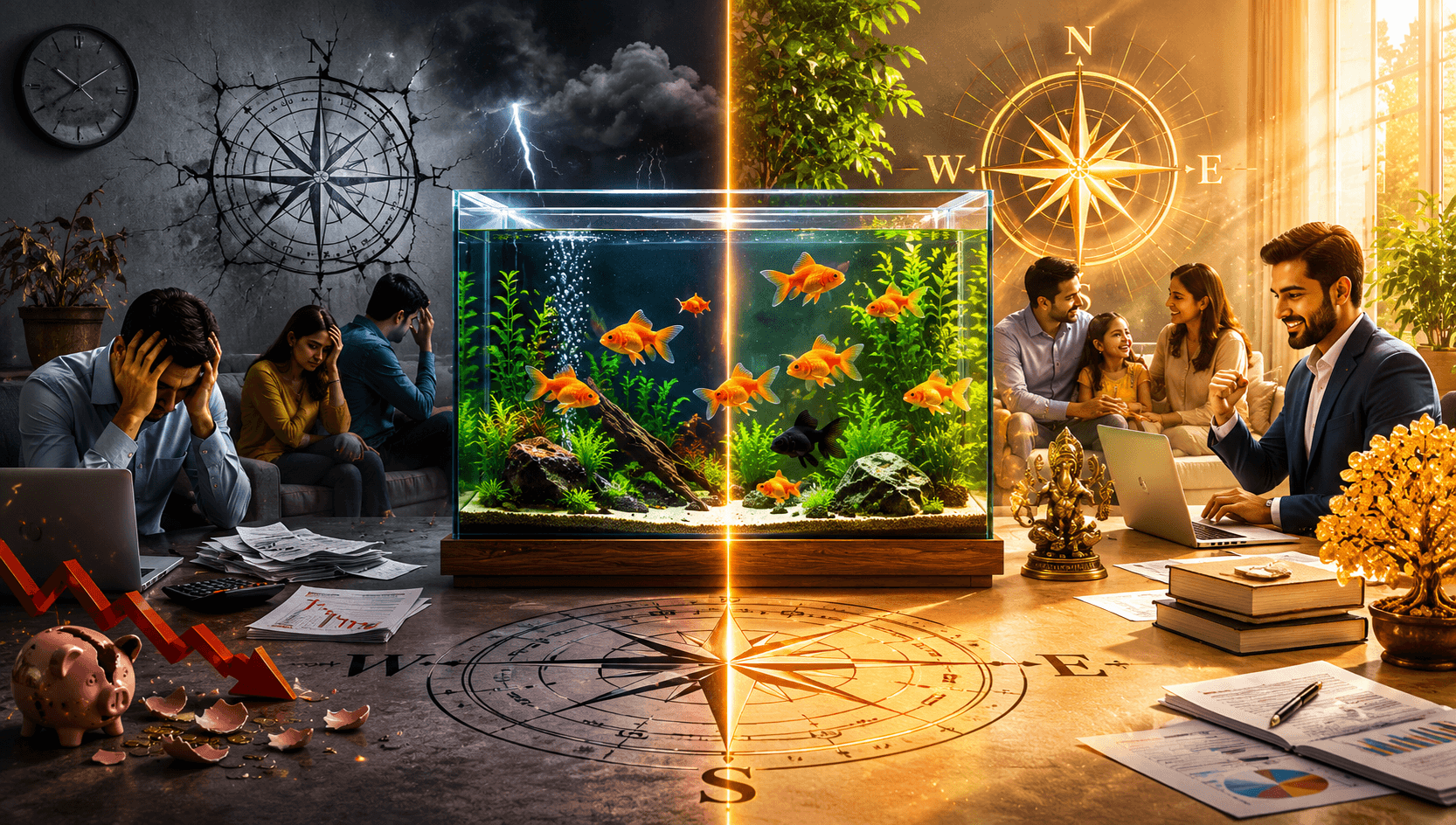
Whether your aquarium is in the right position within that room is a different question entirely. And getting that position wrong does not mean the aquarium is doing nothing. It means the aquarium is doing the opposite of what was intended — in the primary social space of your home, affecting everyone who lives there and everyone who visits.
Why the Living Room Is the Right Room
The living room earns its status for specific reasons.
It is the space of maximum energy exchange. Every visitor to the home passes through the living room first, carrying whatever energetic intentions they bring with them — genuine goodwill, indifference, competitive jealousy, or active ill-will. An aquarium positioned correctly in the living room absorbs all of this incoming energy before it propagates through the household’s private spaces. It is the home’s first and most powerful energetic filter.
It is the most open, most visible, and most occupied common space. A tank in a back bedroom affects one person’s energy. A tank in the living room affects every person in the household every day — and every guest who enters.
Visibility is part of the vastu function. In both traditions, what you can see continuously affects your energy field. The living, moving system of a well-maintained aquarium — active fish, warm lighting, growing plants — creates a sustained positive sensory environment in the space where the family lives.
Why Position Within the Room Matters More Than Most People Realise
The auspicious compass directions for an aquarium are well-documented in both vastu and feng shui. The directions where the water element amplifies prosperity, health, and positive energy are specific and consistent across both sciences.
The directions where the water element creates elemental conflict — where placing water generates financial stress, domestic discord, health deterioration, or relationship breakdown — are equally specific.
What most guides do not tell you is this: identifying which wall in your specific living room corresponds to which compass direction is not straightforward, and getting it wrong is extremely common.
In Indian apartment buildings, the internal compass orientation of individual living rooms varies enormously — by floor, by wing, by the position of the unit within the building. The direction the building entrance faces has almost no reliable relationship to the direction your living room faces. A north-facing building entrance does not mean your living room’s long wall faces North.
The only reliable method is a compass measurement from the geometric centre of your specific room. Without this measurement, every assumption about which wall is which direction has a meaningful probability of being wrong.
ProHobby™ begins every consultation with this measurement. Not because it is complicated — it takes two minutes. Because the entire prescription depends on it, and the consequences of getting it wrong are not minor. Book a measurement and assessment →
The Walls — What Each Direction Does
Each compass direction in a living room carries a specific elemental energy in vastu and corresponds to a specific life area in feng shui. Some directions are powerfully auspicious for an aquarium. Others create elemental conflicts whose consequences are documented consistently in assessed properties.
The auspicious directions amplify the water element into prosperity, health, and career energy. The inauspicious directions create conflicts that manifest as financial stress, domestic arguments, or health deterioration — building gradually, attributed to everything except the tank on the wrong wall.
The most damaging placement we encounter in assessed homes is consistently the South-West. An aquarium here is placing water in the earth stability zone — the direction vastu associates with ancestral karma, structural grounding, and household foundation. Water erodes earth. The documented consequences of South-West aquarium placement include financial instability, serious illness, relationship breakdown, and a general deterioration of household circumstances that families typically attribute to external causes for years before the assessment identifies the source.
It is not a neutral mistake. It is an active vastu dosha — and an extremely common one, because the South-West is often the most visually prominent wall in an Indian living room.
The specific direction your tank should occupy depends on the compass orientation of your room, the specific vastu doshas present in your home, and what the dual-system assessment determines about your space. This is a ProHobby™ consultation output.
The Staircase — A Specific and Serious Warning
Under-staircase placement deserves its own section because it is one of the most common mistakes in Indian homes, and because the consequences are among the most consistently negative we document in assessed properties.
The enclosed space beneath a staircase appears practical — it is defined, it accommodates a tank cabinet, and it makes use of space that is otherwise difficult to furnish. Both vastu and feng shui identify this space as energetically compromised. In vastu, it carries suppressed, downward-flowing energy — the energy that has been walked over and compressed downward continuously. In feng shui, it concentrates sha chi (negative energy) at its lowest point and radiates it into the room.
An aquarium here does not correct these conditions. It introduces the water element into the most energetically problematic area of the home, where water absorbs and amplifies the existing stagnant negative energy rather than generating positive prana.
Families with under-staircase aquariums describe a characteristic stagnation across their circumstances — financial, professional, and social — that resists explanation and effort. The aquarium is rarely identified as the source. We identify it regularly.
Under-staircase placement should be avoided. Whether specific conditions in your space change this assessment is not something a generic guide can determine. It is a ProHobby™ consultation question. Book an assessment →
The Height, the Sofa, and the Television
Height: The aquarium’s energy interacts most effectively with the household when it sits at approximately the level where people spend most of their time — seated. A tank at floor level dissipates its energy downward. A tank mounted at ceiling height is energetically disconnected from the room’s occupants. At or slightly above seated eye level is the effective zone.
Relative to the sofa: The aquarium should be visible from the main seating area. Visibility is part of the vastu function — what you see continuously affects your energy field. An aquarium placed behind the sofa, invisible from where the family actually sits, is energetically isolated from the people it is meant to serve.
Relative to the television: Maintain meaningful distance between the television and the aquarium. The electromagnetic field from large screens stresses fish. Stressed fish generate negative energy. The TV and aquarium can coexist in a well-designed living room — they simply should not be immediately adjacent.
What a Correctly Positioned Living Room Aquarium Does
When the position is correct — verified by compass, matched to the vastu diagnosis of the specific space, sized appropriately for the room — a living room aquarium does things no other single household object can do.
It introduces all five Pancha Bhuta elements into the primary social space of the home simultaneously. It generates living prana continuously, 24 hours a day, without requiring any ongoing action from the family beyond maintenance. It absorbs the negative energy of every visitor before it can propagate through the home. It counterbalances structural vastu doshas that the building itself contains and that cannot be corrected without demolition.
It does all of this visibly, beautifully, and without disrupting the life of the household in any way.
But only when it is in the right position. And only when that position was determined by assessment, not assumption. Book a ProHobby™ assessment →
Frequently Asked Questions
Is the living room the best room for a vastu aquarium? Yes — both vastu shastra and feng shui agree without reservation. The living room is the home’s primary social and energetic space, making it the highest-impact position for an aquarium.
Can I place an aquarium under the staircase as per vastu? Generally not. Under-staircase placement is associated with amplified stagnant negative energy in both vastu and feng shui. Whether specific conditions in your space change this assessment requires professional evaluation.
How do I know which wall is correct for my living room? A compass measurement from the geometric centre of your specific room. Do not assume from the building’s facing direction — individual flat orientations vary significantly from building orientation. ProHobby™ takes this measurement as the first step of every consultation.
Does a rented flat affect the vastu effectiveness? No. Vastu operates on the occupant’s energy within the space. Legal ownership is irrelevant to the energetic function.
My aquarium is already placed — how do I know if it is in the right position? Book a ProHobby™ assessment. We identify whether your current placement is serving the household or working against it — and what the correct position for your specific space is.
Related Reading
- Why Bad Vastu Is Costing You More Than You Think →
- Aquarium Vastu Shastra & Feng Shui: The Complete Guide →
- Best Fish for Vastu Aquarium →
- Office Aquarium Vastu & Feng Shui →
- Aquarium in Bedroom as Per Vastu →
- Custom Aquarium Setups by ProHobby™ →
ProHobby™ — Delhi NCR’s dual-science vastu and feng shui aquarium consultants. WhatsApp: +91 81303 16186 · Book a Consultation →