
Stability, Energy Partitioning and Emergent Behaviour at the Boundaries of Water, Air and Substrate
Cornerstone Reference Article | ProHobby™ Hybrid Ecological Systems Framework
by ProHobby™ | Ecological Systems Authority
INTRODUCTION
A hybrid aquarium ecosystem combines aquatic and terrestrial habitat processes to create stable ecological systems such as paludariums and ripariums.
Understanding Interface Ecosystems
Most ecological thinking begins by dividing the natural world into distinct environments — rivers, forests, wetlands, reefs. Yet in reality, biological complexity often reaches its highest expression not within these environments, but at their boundaries. Transitional landscapes such as river margins, floodplains, mangrove belts and marshes function through the interaction of multiple physical regimes rather than through the stability of any single one.
Hybrid ecosystems replicate this boundary condition at controlled scales. They operate simultaneously as aquatic, terrestrial and atmospheric systems, governed by gradients of moisture, temperature, oxygen availability and nutrient mobility. Their stability emerges from the negotiation between these gradients rather than from the maintenance of uniform conditions.
This article examines hybrid ecosystems as integrated ecological systems, exploring how hydrology, thermodynamics, microbial energetics, substrate mechanics and biological behaviour interact across environmental interfaces. The objective is not to provide construction guidance, but to develop a conceptual framework through which such systems can be understood, evaluated and designed with long-term ecological coherence.
PART 1
Conceptual Foundations
Boundaries as Ecological Engines
Ecological systems are often described in terms of the environments they contain: forests, rivers, coral reefs, grasslands. Yet in many cases, the most biologically productive and structurally complex regions of the natural world are not these environments themselves, but the zones where they meet. Riverbanks, tidal marshes, mangrove forests, floodplains and seasonal wetlands all exist as gradients rather than discrete habitats. They are defined less by uniform conditions than by the continual negotiation between contrasting physical regimes.
In such places, water does not merely occupy space; it migrates, recedes, saturates and evaporates. Soil is neither permanently submerged nor permanently dry. Atmospheric conditions interact directly with sediment chemistry and biological activity. These interactions create layered feedback systems that cannot be reduced to purely aquatic or purely terrestrial explanations. Instead, they constitute a distinct ecological domain — one governed by interface processes.
Hybrid ecosystems in controlled environments, including paludariums, ripariums and other boundary-dominated habitat systems, operate within this same domain. Their behaviour is shaped not by a single environmental medium but by the dynamic relationship between several. This relationship determines how energy is transferred, how nutrients are transformed, and how living organisms distribute themselves across space and time.
Understanding such systems therefore requires a conceptual shift. Rather than viewing them as aquariums supplemented with land features, or terrariums supplemented with water, they must be recognised as interface ecosystems in their own right — environments whose defining characteristic is the presence of ecological gradients.
Gradients Instead of Compartments
Traditional aquarium thinking often assumes that environmental variables can be stabilised through uniformity. Water chemistry is adjusted to a target range. Flow is distributed evenly. Lighting is calibrated for consistency. These practices reflect a model in which stability arises from minimising variability.
Interface ecosystems function differently. Their stability is frequently derived from structured variability — the presence of spatial gradients that allow biological processes to distribute themselves according to local conditions. Moisture content may decrease gradually from submerged zones to exposed substrates. Oxygen concentration may fluctuate with depth or distance from flowing water. Temperature may vary subtly across shaded and illuminated surfaces.
These gradients do not represent inefficiencies or design imperfections. They constitute the operational architecture of the system. By allowing environmental parameters to vary within controlled bounds, hybrid ecosystems create multiple microhabitats. Each microhabitat supports distinct microbial communities, plant functional strategies and behavioural patterns among animals. The resulting diversity increases the number of ecological pathways through which nutrients and energy can circulate.
In this sense, gradients serve as ecological buffers. Where homogeneous systems rely on precise control to maintain balance, gradient-based systems distribute risk across spatial complexity. A local disturbance in one zone may be absorbed by neighbouring regions operating under slightly different conditions. Stability emerges not from uniformity but from the capacity of the system to reorganise its internal processes in response to change.
Interface Zones as Sites of Emergence
In ecological theory, emergence refers to the appearance of system-level properties that cannot be predicted solely from the behaviour of individual components. Interface zones are particularly prone to emergent phenomena because they bring together processes that would otherwise remain separated.
Consider the interaction between atmospheric oxygen and saturated sediments. In purely aquatic environments, oxygen availability is constrained by diffusion through water and by the metabolic demands of aquatic organisms. In terrestrial soils, oxygen exchange occurs more freely but moisture content may limit microbial activity. At the interface between these regimes, alternating wet and dry conditions can produce cyclical shifts in microbial metabolism. These shifts influence nutrient availability, redox chemistry and the physical structure of the substrate itself.
Similarly, the boundary between water surfaces and air introduces energy exchanges that affect temperature regulation, evaporation rates and gas solubility. Small variations in airflow or humidity can alter the microclimate of emergent plant foliage, influencing transpiration and photosynthetic efficiency. These effects cascade through the ecosystem, modifying growth patterns and biological interactions.
Hybrid systems thus operate as engines of emergence. Their behaviour cannot be fully understood by analysing aquatic processes in isolation or by applying terrestrial ecological models without modification. Instead, they demand a framework that recognises the unique dynamics generated when environmental domains overlap.
Constraint, Opportunity and Ecological Identity
Every ecosystem is defined by constraints — limits imposed by resource availability, physical conditions and biological competition. In interface environments, constraints are distributed unevenly across space. A plant growing with its roots submerged but its leaves exposed to air experiences different pressures than one fully immersed in water. An invertebrate inhabiting moist substrate faces distinct challenges compared to a species living in open water.
These variations create opportunities for specialised adaptations. Amphibious plants evolve tissues capable of tolerating fluctuating oxygen levels. Microbial communities develop metabolic flexibility, shifting between aerobic and anaerobic pathways as conditions change. Animal species exploit thermal gradients or shelter structures formed by emergent vegetation.
In controlled hybrid ecosystems, replicating such constraints is essential for achieving ecological authenticity. Simplifying the system into clearly separated wet and dry compartments reduces the potential for adaptive interactions. Conversely, designing environments in which boundaries remain permeable — allowing moisture, nutrients and energy to move across zones — fosters the development of more integrated ecological identities.
The goal is not to reproduce nature visually but to recreate the functional tensions that drive ecological organisation.
Temporal Dynamics at Ecological Edges
Interface ecosystems are inherently temporal. Their defining gradients often fluctuate over time due to processes such as evaporation, rainfall cycles in nature, or maintenance routines in controlled environments. Water levels may rise and fall, altering the extent of submerged substrate. Organic matter may accumulate seasonally or be redistributed by biological activity. Microbial populations expand and contract in response to shifting resource availability.
These temporal dynamics contribute to system resilience. By periodically exposing organisms to variable conditions, hybrid ecosystems encourage physiological flexibility and diversify ecological pathways. A substrate that alternates between saturation and partial drying may host microbial communities capable of processing nutrients under multiple chemical regimes. Plants that experience intermittent moisture stress may develop stronger root systems or more efficient gas exchange mechanisms.
In contrast, attempts to maintain constant conditions across all zones can inadvertently reduce the adaptive capacity of the system. Temporal variation, when controlled within safe limits, acts as a form of ecological training — preparing the ecosystem to absorb disturbances without catastrophic failure.
From Decorative Constructs to Ecological Experiments
Hybrid aquarium systems are often introduced into the hobby as aesthetic innovations: visually striking combinations of water features, terrestrial plants and sculptural hardscape. While their artistic potential is undeniable, focusing solely on appearance risks obscuring their deeper ecological significance.
When viewed through the lens of interface ecology, these systems become experimental microcosms. They allow observers to witness how gradients influence behaviour, how moisture regimes shape microbial communities, and how energy exchanges between air and water regulate stability. They offer insights into processes that are difficult to observe directly in large natural landscapes.
Approaching hybrid ecosystems as experiments rather than decorations transforms the role of the aquarist. The objective shifts from assembling a static display to facilitating dynamic ecological interactions. Success is measured not only by visual harmony but by the persistence of biological functions over time.
Conceptual Transition Toward Physical Processes
Having established the ecological identity of interface systems as gradient-dominated, emergent and temporally dynamic environments, the next step is to examine the physical mechanisms that sustain these characteristics. Hydrological behaviour, energy transport and phase boundary physics determine how gradients form and how they evolve.
These mechanisms operate simultaneously across multiple spatial scales — from microscopic capillary action within substrate pores to convective airflow patterns that influence humidity and temperature distribution. Understanding them provides the foundation for analysing nutrient cycles, microbial succession and biological adaptation in subsequent phases of this monograph.
Interface ecosystems therefore invite a progression in reasoning: from conceptual recognition of boundaries as ecological engines, toward detailed examination of the physical forces that shape those boundaries.
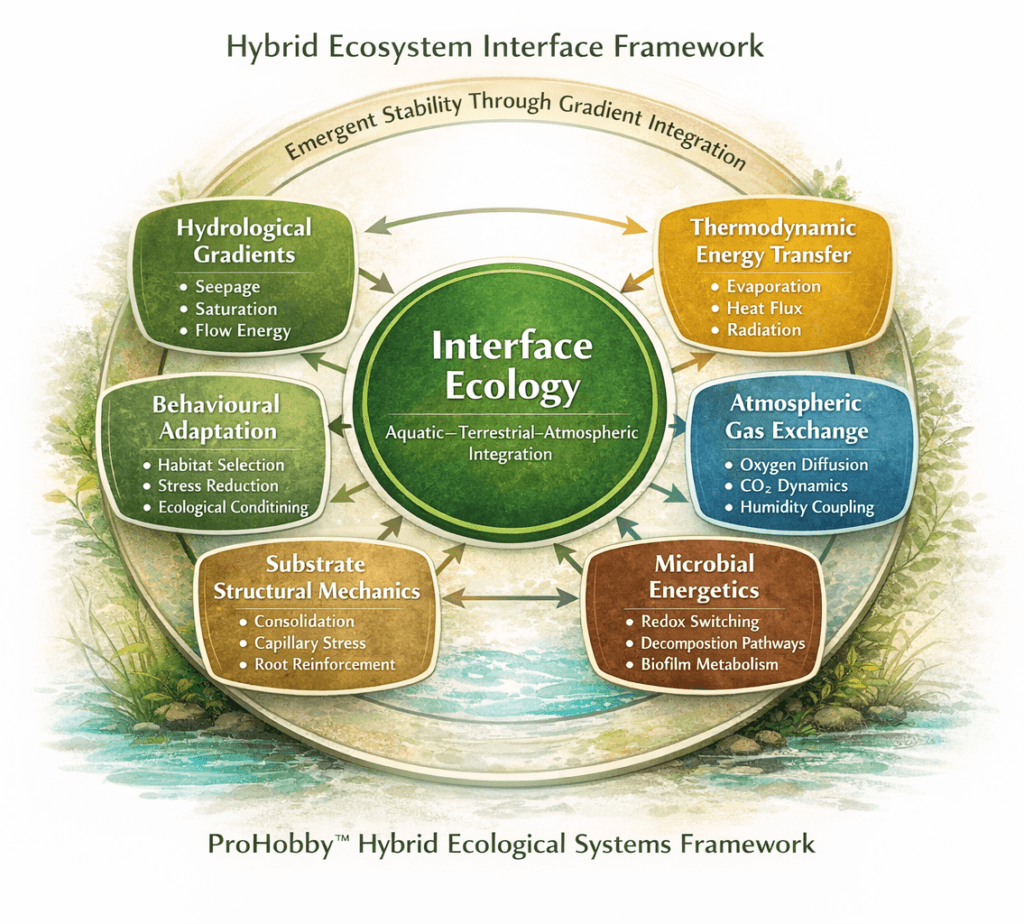
This ecological framework illustrates the systemic relationships governing hybrid aquatic–terrestrial environments such as paludariums and ripariums. It highlights how energy transfer, moisture distribution, gas exchange, microbial metabolism and substrate structure combine to produce emergent ecological balance.
Hybrid aquatic–terrestrial systems such as paludariums and ripariums operate through interface ecology, where environmental gradients rather than fixed parameters determine long-term ecosystem stability. Understanding this hybrid aquarium ecosystem behaviour requires examining how water movement, energy transfer and biological adaptation interact across habitat boundaries.
PART 2
Hydrology, Phase Boundaries and Energy Geometry
Hydrology in Confined Ecological Systems
Hybrid ecosystems operate under hydrological regimes that differ fundamentally from both open aquatic environments and terrestrial soils. In nature, the movement of water across landscapes is governed by large-scale processes such as watershed dynamics, seasonal rainfall variability and geomorphological structure. In controlled environments, these drivers are replaced by smaller yet highly influential mechanisms: evaporation gradients, capillary transport within substrates, directional flow patterns and periodic human intervention.
Water within hybrid systems rarely exists in a single stable state. Instead, it transitions continuously between phases and spatial locations. Liquid water occupying submerged zones may migrate upward through porous materials via capillary action, while surface films evaporate into the surrounding air, altering humidity and temperature distribution. These processes generate hydrological gradients that define the ecological architecture of the system.
Such gradients are not merely physical curiosities; they determine how nutrients are transported, how microbial communities are structured and how plants regulate gas exchange. Their study therefore forms a bridge between the conceptual framework of interface ecology and the systemic understanding of ecosystem stability explored in the pillar on aquarium ecosystem stability.
Capillary Transport and Moisture Stratification
At the microscopic level, the movement of water through substrate is governed by capillary forces arising from surface tension and pore geometry. Fine-grained sediments and organic soils can retain moisture above the visible waterline, creating semi-saturated zones that function neither as fully aquatic nor fully terrestrial habitats. These zones act as transitional environments where aerobic and anaerobic microbial processes coexist.
Moisture stratification influences oxygen diffusion, nutrient mobility and root physiology. Emergent plants, for instance, may draw water upward through vascular tissues while simultaneously releasing oxygen into the surrounding substrate. This interaction alters local redox conditions and shapes microbial metabolism. Over time, the substrate becomes a vertically structured system in which chemical reactions vary with depth and moisture content.
Such processes connect directly to the principles discussed in substrate biogeochemistry in aquariums, where sediment layers operate as dynamic interfaces rather than inert foundations. In hybrid ecosystems, however, the influence of capillary transport extends beyond submerged zones, affecting the stability of entire habitat gradients.
Evaporation as an Energy Transfer Mechanism
Evaporation is often treated in aquarium practice as a maintenance concern, primarily associated with water loss and mineral concentration. From an ecological perspective, it represents a powerful mechanism of energy redistribution. The phase change from liquid to vapour requires latent heat, which is drawn from surrounding surfaces. This cooling effect modifies microclimatic conditions across both aquatic and terrestrial zones.
In hybrid systems, evaporation rates vary spatially according to airflow patterns, lighting intensity and surface exposure. Open water areas may experience rapid heat exchange, while sheltered substrates retain moisture and warmth. These differences contribute to thermal gradients that influence metabolic rates in microorganisms and behavioural preferences in animals.
Moreover, evaporative flux interacts with humidity buffering within enclosed environments. Elevated humidity can reduce transpiration stress in emergent plants while simultaneously slowing oxygen exchange at the water surface. Understanding these coupled effects is essential for interpreting the energy geometry of hybrid ecosystems — a concept closely related to the hydrodynamic reasoning presented in flow and energy geometry in aquariums.
Boundary Layer Physics at Water Surfaces
Where water meets air, a thin boundary layer forms in which fluid motion and gas exchange occur under conditions distinct from those in the bulk environment. The thickness and stability of this layer depend on factors such as surface turbulence, temperature differentials and atmospheric circulation. In hybrid ecosystems, boundary layer behaviour influences oxygen dissolution, carbon dioxide release and the transport of volatile organic compounds.
Subtle changes in surface agitation can therefore alter biochemical processes throughout the system. A calm water surface may promote stratification and reduced gas exchange, while moderate directional flow enhances mixing and maintains oxygen availability. These dynamics illustrate the importance of residence time — the duration water remains in contact with reactive surfaces — a principle explored in residence time and biological filtration efficiency.
Boundary layers also affect the distribution of heat and moisture above the waterline. Warm, humid air rising from aquatic zones may condense on cooler structural surfaces, creating microhabitats for mosses and microbial films. Such feedback loops demonstrate how physical processes at interfaces propagate ecological consequences.
Convective Airflow and Microclimatic Circulation
In enclosed hybrid ecosystems, air movement is rarely uniform. Thermal gradients generated by lighting, evaporation and substrate moisture create convective currents that redistribute heat and humidity. Warm air tends to rise from illuminated or saturated areas, while cooler air descends along shaded surfaces. This circulation pattern establishes microclimates that influence plant growth orientation, fungal colonisation and animal behaviour.
Convective airflow can also modulate the effectiveness of gas exchange across both aquatic and terrestrial interfaces. Increased circulation enhances the diffusion of oxygen into water and facilitates the removal of excess carbon dioxide, thereby supporting metabolic stability. Conversely, stagnant air pockets may lead to localised hypoxia or condensation-induced substrate saturation.
These phenomena intersect with broader considerations of aquarium hydrodynamics and system equilibrium, reinforcing the idea that energy movement through air is as significant as water flow in shaping hybrid ecosystems.
Hydrological Variability and Controlled Fluctuation
Unlike purely aquatic systems, where water level changes are often minimised to maintain stability, hybrid ecosystems may benefit from moderate hydrological variability. Controlled fluctuations in water depth can expose new substrate surfaces to oxygen, stimulate microbial succession and alter nutrient availability. Periodic wetting and drying cycles mimic natural floodplain dynamics, encouraging ecological resilience.
However, variability must remain within tolerable bounds. Excessive or abrupt changes can disrupt established gradients, leading to substrate compaction, plant stress or microbial imbalance. The challenge lies in designing systems that accommodate fluctuation without destabilisation — an approach aligned with the broader theory of dynamic equilibrium in closed aquatic ecosystems.
Through such design strategies, hydrological processes become tools for ecological management rather than sources of unpredictability.
Integrating Hydrology with Biological Function
The physical movement of water and air ultimately acquires ecological significance through its impact on living organisms. Moisture gradients dictate root distribution in emergent plants, while flow patterns influence feeding zones for amphibious species. Microbial communities respond to shifts in oxygen availability and nutrient transport, adjusting their metabolic pathways accordingly.
In this way, hydrology acts as a mediator between energy transfer and biological organisation. Its effects are neither isolated nor purely mechanical; they form part of a network of feedback systems that determine the long-term behaviour of hybrid ecosystems. Recognising these connections prepares the ground for deeper examination of substrate chemistry and microbial interactions in the next phase of this monograph.
PART 3
Substrate Stratification & Biogeochemical Exchange
Substrate as a Multiphase Reaction Medium
In hybrid ecosystems, substrate cannot be understood simply as structural support or as a passive medium for plant anchorage. It functions instead as a multiphase reaction environment in which physical moisture regimes, chemical gradients and biological activity intersect continuously. Unlike fully submerged sediments, which often display relatively predictable vertical zonation, hybrid substrates are characterised by dynamic transitions between saturation, aeration and desiccation.
These transitions create spatially complex mosaics of microbial metabolism. At any given time, the same substrate volume may contain zones of active nitrification near oxygenated surfaces, denitrification within semi-anaerobic pockets and organic fermentation in deeper waterlogged layers. The coexistence of these processes transforms the substrate into an ecological processor capable of modulating nutrient availability and buffering environmental disturbance.
Understanding this behaviour extends principles explored in substrate ecology and nutrient cycling in aquariums, but introduces additional complexity due to the influence of atmospheric coupling and capillary transport discussed in earlier phases.
Vertical Chemical Gradients and Redox Architecture
Redox potential — the tendency of a chemical environment to gain or lose electrons — governs many biogeochemical reactions within substrate systems. In hybrid environments, redox gradients are rarely static. Oxygen penetration depth varies according to moisture content, organic loading and microbial respiration rates. Periodic drying events can introduce oxygen into previously reduced zones, altering the balance of chemical species such as ammonium, nitrate, sulphides and dissolved metals.
This dynamic redox architecture supports a broader diversity of metabolic pathways than typically observed in homogeneous aquatic sediments. For example, the re-oxidation of reduced compounds following partial drainage can release pulses of nutrients into adjacent water bodies, influencing algal growth and plant uptake. Conversely, sustained saturation may promote anaerobic processes that immobilise certain nutrients while generating gases such as methane.
The ecological significance of these transformations lies in their capacity to regulate nutrient flux without direct intervention. Hybrid substrates effectively operate as self-adjusting chemical landscapes, provided that their structural integrity and moisture gradients remain intact.
Organic Matter as Structural Catalyst
Organic detritus plays a central role in shaping substrate behaviour across hybrid ecosystems. Leaves, bark fragments, root exudates and microbial biomass contribute to the formation of porous matrices that retain moisture while permitting gas exchange. Over time, decomposition processes convert coarse organic inputs into finer particulate matter and humic compounds, altering both the physical texture and chemical reactivity of the substrate.
This transformation influences capillary dynamics, microbial colonisation patterns and nutrient adsorption capacity. In zones where organic accumulation is moderate, the substrate may develop a buffered microenvironment capable of stabilising pH and moderating nutrient fluctuations. Excessive accumulation, however, can lead to oxygen depletion and the formation of reduced compounds detrimental to plant roots or aquatic fauna.
The balance between organic enrichment and aeration is therefore critical. It reflects a broader ecological principle: substrates are not merely influenced by biological activity but are actively constructed by it. Hybrid ecosystems exemplify this reciprocal relationship, as plant growth, microbial metabolism and hydrological processes jointly determine substrate evolution.
Microbial Zonation and Functional Diversity
Hybrid substrates support microbial communities adapted to rapid environmental change. Aerobic bacteria dominate near exposed surfaces and root zones where oxygen is readily available. Facultative organisms capable of switching between metabolic modes occupy transitional layers, while obligate anaerobes thrive in persistently saturated micro-pockets. The spatial proximity of these groups facilitates sequential nutrient transformations that would otherwise require separate habitats.
For instance, organic nitrogen mineralised by heterotrophic bacteria may be oxidised to nitrate by nitrifiers in oxygenated zones, only to be reduced again by denitrifying microbes deeper within the substrate. This cyclical processing reduces the likelihood of nutrient accumulation in the water column, contributing to long-term system stability.
Such microbial diversity underpins the ecological buffering capacity described in biofilm development and microbial succession in aquariums, yet hybrid environments amplify these dynamics by introducing moisture-driven variability. Microbial communities become not only reactive but also anticipatory, capable of adjusting metabolic pathways in response to predictable environmental oscillations.
Root–Substrate Interactions and Rhizosphere Dynamics
Plant roots serve as conduits linking aquatic and terrestrial processes within hybrid ecosystems. Through respiration and nutrient uptake, they influence oxygen distribution, redox potential and chemical gradients in the surrounding substrate. Many emergent and amphibious species possess specialised tissues that transport atmospheric oxygen downward, creating localised aerobic zones even within saturated sediments.
These rhizosphere microenvironments support symbiotic microbial populations that enhance nutrient availability while protecting roots from toxic reduced compounds. The spatial arrangement of root systems therefore shapes substrate chemistry on both microscopic and macroscopic scales. Dense root networks may stabilise sediment structure, preventing compaction and maintaining pathways for water and gas movement.
At the same time, root exudates — organic compounds released into the substrate — stimulate microbial activity and contribute to the formation of biofilm matrices. This interplay exemplifies the concept of substrates as living interfaces, where plant physiology and microbial ecology converge to regulate ecosystem function.
Nutrient Adsorption, Release and Long-Term Cycling
Mineral components within hybrid substrates, including clays, silts and weathered rock fragments, provide surfaces for the adsorption of nutrients such as phosphate and trace metals. The strength of these interactions depends on pH, redox conditions and the presence of competing ions. Periodic shifts in moisture and oxygen availability can therefore trigger the release of previously bound nutrients, altering their distribution across the ecosystem.
Over extended timeframes, this cyclical adsorption–desorption process contributes to nutrient retention, reducing the frequency with which external supplementation is required. However, it also introduces complexity into system management. Sudden changes in hydrology or organic loading may disrupt established chemical equilibria, leading to transient nutrient imbalances.
Recognising these patterns aligns with the systemic reasoning explored in nutrient dynamics and chemical balance in planted aquariums, yet hybrid ecosystems demand a broader temporal perspective. Nutrient cycling must be understood not only in terms of immediate availability but also as part of a long-term ecological memory encoded within substrate structure.
Structural Consolidation and Sediment Maturation
As hybrid substrates age, physical and biological processes gradually transform their architecture. Fine particles settle into void spaces, organic matter decomposes into stable humic fractions and root networks reinforce structural cohesion. This maturation can enhance water retention and chemical buffering capacity, contributing to overall ecosystem resilience.
However, excessive consolidation may impede gas exchange and restrict root penetration, particularly in systems lacking periodic disturbance. In natural floodplain environments, seasonal flooding and sediment deposition counteract such compaction. Within controlled habitats, analogous effects may be achieved through careful design of hydrological variability or the introduction of detritivorous organisms that rework substrate layers.
Sediment maturation thus represents both a stabilising and potentially destabilising force. Its trajectory depends on the interplay between biological productivity, hydrological dynamics and management practices. Appreciating this complexity prepares the ground for subsequent analysis of how substrate processes influence broader ecosystem stability.
Substrate as a Temporal Archive
Beyond its immediate functional roles, substrate acts as a repository of ecological history. Layers of organic material, mineral deposits and microbial communities record past fluctuations in water level, nutrient input and biological activity. This temporal archive shapes future system responses by determining which metabolic pathways are primed for activation under changing conditions.
For example, a substrate previously exposed to periodic drying may harbour microbial populations capable of rapidly oxidising reduced compounds when oxygen becomes available. Conversely, persistently waterlogged sediments may accumulate chemical species that require extended recovery periods following disturbance. Such legacy effects illustrate the importance of viewing substrate not as a static medium but as a chronicle of ecological interactions.
Understanding this archival function enriches the interpretation of stability and collapse mechanisms addressed in broader ecosystem analyses. It emphasises that present conditions are always influenced by past processes, reinforcing the need for long-term perspective in hybrid ecosystem management.
Transition Toward Biological Integration
Having examined the physical and chemical dimensions of substrate stratification, the next phase of this monograph will explore how living organisms integrate these gradients into coherent ecological systems. Plant functional strategies, animal behaviour and microbial trophic networks collectively translate substrate processes into observable ecosystem dynamics.
The movement from biogeochemical mechanisms to biological organisation represents a critical step in understanding hybrid ecosystems as fully realised ecological entities rather than collections of interacting components.
Scaling Laws in Hybrid Ecosystems
Ecological processes expressed within hybrid habitats do not scale linearly with system size. Changes in spatial dimensions alter the relative dominance of physical forces, chemical gradients and biological interactions. Among the most important of these relationships is the surface-area-to-volume ratio, which governs how rapidly energy and matter are exchanged with the surrounding environment.
Smaller hybrid systems exhibit high surface-area exposure relative to their internal volume. This enhances evaporative cooling, accelerates gas exchange and increases sensitivity to external temperature fluctuations. Hydrological gradients may shift rapidly, and microbial communities must adapt to frequent oscillations in moisture and oxygen availability. Such environments often demonstrate dynamic but fragile stability, requiring continuous internal feedback to maintain functional coherence.
Larger systems, by contrast, possess greater volumetric inertia. Water bodies buffer thermal variation, and substrate layers develop deeper stratification. Energy transfer occurs more slowly, allowing biochemical processes to stabilise across extended temporal scales. However, increased size also introduces the potential for spatial heterogeneity beyond the range of natural feedback mechanisms. Zones of stagnation or excessive dryness may persist if structural design fails to distribute gradients effectively.
Scaling therefore influences not only physical behaviour but also ecological resilience. Designers must recognise that strategies successful in small hybrid habitats may not translate directly to larger installations. Effective ecological architecture emerges from understanding how geometric constraints shape the distribution of energy, moisture and biological activity throughout the system. As system dimensions change, ecosystem gradients within hybrid aquarium habitats reorganise, influencing how ecological aquarium design must adapt to maintain functional coherence.
PART 4
Biological Ecology Across Environmental Boundaries
Life at the Edge: Biological Organisation in Gradient-Dominated Systems
Biological communities inhabiting interface ecosystems are shaped not by uniform environmental conditions but by the persistent presence of gradients. Moisture, oxygen availability, temperature, nutrient concentration and structural complexity vary across relatively small spatial scales. Organisms respond to this variability through behavioural flexibility, physiological adaptation and ecological specialisation.
In hybrid systems, this leads to the formation of functional mosaics rather than homogeneous populations. Different species — and often different life stages of the same species — occupy distinct microhabitats within the broader system. Such spatial organisation reduces direct competition, increases resource utilisation efficiency and enhances the resilience of ecological processes.
This principle aligns with systemic stability theories explored in the context of ecosystem carrying capacity and environmental load, yet interface environments extend the concept by demonstrating how spatial heterogeneity can expand functional capacity without necessarily increasing overall resource input.
Amphibious Plant Strategies and Dual-Phase Physiology
Plants capable of inhabiting both submerged and emergent zones exhibit physiological traits that allow them to navigate fluctuating environmental constraints. Their root systems often function within oxygen-limited sediments while their foliage operates under atmospheric gas exchange regimes. This dual exposure necessitates adaptations in tissue structure, metabolic regulation and nutrient transport pathways.
Aerenchyma tissues — specialised air-filled channels — enable the internal movement of oxygen from leaves to roots, mitigating the effects of substrate hypoxia. At the same time, cuticular modifications and stomatal behaviour regulate transpiration in humid microclimates. The result is a coordinated physiological system capable of maintaining metabolic continuity across contrasting environmental domains.
Such adaptations influence ecosystem dynamics beyond individual plant survival. By oxygenating localised substrate zones, emergent plants facilitate microbial nitrification and organic matter decomposition. Their roots stabilise sediment structure and create physical refuges for invertebrates and small vertebrates. These processes connect directly to broader discussions of nutrient flux and plant–substrate interactions in ecological aquascaping systems, illustrating how biological function shapes chemical stability.
Epiphytes, Mosses and Surface-Dependent Communities
Interface ecosystems often support plant groups that rely less on traditional root–soil relationships and more on atmospheric moisture and structural support. Epiphytic species attach themselves to wood, rock or artificial surfaces, deriving nutrients from decomposing organic films and dissolved mineral deposits. Mosses, in particular, exhibit remarkable tolerance to alternating hydration and desiccation cycles, making them key colonisers of boundary microhabitats.
These organisms contribute to the development of biological skin layers across hardscape elements. Their growth modifies surface roughness, water retention capacity and light absorption patterns. Over time, they create microenvironments that foster microbial colonisation and detritus accumulation, effectively expanding the ecological footprint of structural features within the system.
The presence of such surface-dependent communities illustrates how interface ecosystems blur the distinction between living and non-living components. Hardscape ceases to function solely as inert design material and becomes an active participant in ecological processes.
Behavioural Ecology of Boundary-Dwelling Animals
Animal species inhabiting hybrid ecosystems often display behavioural patterns that reflect the spatial complexity of their environment. Amphibious organisms, for example, exploit thermal gradients between water and land to regulate body temperature. Some species utilise emergent vegetation as shelter during periods of heightened predation risk, while others forage along moisture transitions where detritus and invertebrate prey accumulate.
Even fully aquatic animals respond to the presence of interface zones. Shallow margins may serve as feeding grounds rich in organic input, while deeper water provides refuge from environmental fluctuations. Vertical habitat partitioning thus becomes an important mechanism for reducing interspecific competition and supporting diverse trophic interactions.
These dynamics echo themes explored in fish stress physiology and habitat design considerations, highlighting how behavioural normalcy often signals ecological alignment. In hybrid systems, the ability of organisms to move freely across environmental gradients contributes to their resilience and influences overall ecosystem stability.
Microbial Trophic Networks and Detritivore Pathways
Microbial communities within interface ecosystems form the foundation of nutrient cycling and energy transfer. Bacteria and fungi decompose organic matter, releasing dissolved compounds that support plant growth and secondary consumer populations. Detritivorous invertebrates, in turn, fragment coarse debris into finer particles, accelerating microbial processing and redistributing nutrients across substrate layers.
The coexistence of aquatic and terrestrial microbial assemblages enhances functional diversity. Moisture-dependent fungi may colonise partially saturated zones, while aquatic bacteria dominate submerged sediments. Their interactions create cross-phase trophic networks that enable the system to exploit a wider range of energy sources than purely aquatic habitats.
Such complexity reinforces the buffering mechanisms described in broader analyses of biofilm dynamics and microbial succession in maturing ecosystems. Interface environments, by hosting multiple overlapping trophic pathways, reduce the likelihood that disruptions in one domain will propagate uncontrollably through the entire system.
Reproductive Strategies and Lifecycle Synchronisation
Hybrid ecosystems influence not only daily behavioural patterns but also reproductive cycles and developmental trajectories. Some species utilise emergent zones as breeding grounds, depositing eggs in moist substrates or on vegetation above the waterline. Others rely on seasonal fluctuations in water level or humidity to trigger spawning or metamorphosis.
Lifecycle synchronisation with environmental gradients can enhance survival rates by aligning vulnerable developmental stages with favourable conditions. For instance, larvae emerging in shallow, nutrient-rich waters may benefit from abundant microbial food sources, while adults retreat to more stable habitats following metamorphosis.
In controlled environments, replicating such cues requires careful consideration of hydrological variability, temperature regimes and habitat structure. The absence of these signals may lead to suppressed reproductive behaviour or abnormal population dynamics, underscoring the importance of ecological authenticity in system design.
Competitive Interactions and Spatial Resource Partitioning
The presence of environmental gradients allows species to partition resources spatially rather than solely through temporal or behavioural differentiation. Plants occupying saturated substrates may specialise in nutrient uptake strategies distinct from those growing in drier zones. Aquatic invertebrates may exploit detritus accumulating at water margins, while terrestrial species focus on leaf litter decomposition above the waterline.
This spatial partitioning reduces direct competition and enhances the efficiency with which energy flows through the ecosystem. It also creates opportunities for mutualistic relationships, such as the exchange of nutrients between plant roots and microbial symbionts or the dispersal of organic matter by animal movement.
From a systems perspective, such interactions contribute to ecological redundancy, a key component of resilience discussed in analyses of dynamic equilibrium and long-term ecosystem maturation. Hybrid environments, by supporting multiple overlapping niches, may therefore maintain functional stability even when individual species populations fluctuate.
Boundary-Driven Behaviour as Indicator of System Integrity
Observing how organisms utilise environmental gradients provides valuable insights into the health of hybrid ecosystems. Natural patterns of station-holding, foraging and shelter selection suggest that physical and chemical conditions fall within tolerable ranges. Conversely, persistent avoidance of certain zones may indicate imbalances in moisture, temperature or substrate chemistry.
Behaviour thus becomes a diagnostic tool, complementing chemical testing and physical measurement. It reflects the integrated outcome of multiple ecological processes and can reveal emerging problems before they manifest as visible system failure.
Recognising these signals aligns with the diagnostic mindset advocated in broader discussions of system collapse pathways and environmental instability, reinforcing the importance of behavioural ecology in understanding interface ecosystems.
Integration of Biological and Physical Gradients
The interplay between biological organisation and physical processes defines the character of hybrid ecosystems. Plant growth patterns modify hydrological flow, while animal activity redistributes organic matter and influences substrate structure. Microbial metabolism alters chemical gradients that in turn affect plant physiology and behavioural responses.
This recursive relationship underscores the need to view hybrid systems as self-organising networks rather than static assemblies of components. Their stability arises from continuous feedback between living organisms and the environmental gradients they inhabit.
With this biological framework established, the next phase of the monograph will examine how these interactions contribute to overall system stability — and how disturbances at ecological boundaries can trigger cascading failures or, alternatively, reinforce resilience.
Evolutionary Behavioural Adaptation in Hybrid Systems
Organisms inhabiting interface ecosystems are subject to environmental conditions that differ markedly from those encountered in strictly aquatic or terrestrial habitats. Over extended periods, these conditions may influence behavioural expression, physiological tolerance and ecological interactions. While evolutionary change in controlled systems occurs slowly, behavioural plasticity allows species to adjust to novel gradients in moisture, oxygen and spatial structure.
Fish occupying shallow interface zones, for instance, may modify station-holding behaviour in response to variable flow regimes or intermittent exposure to atmospheric conditions. Amphibious invertebrates and emergent plants demonstrate adaptive strategies that balance aquatic feeding opportunities with terrestrial refuge. Even microorganisms exhibit selective pressures favouring metabolic flexibility in fluctuating redox environments.
Long-term conditioning within hybrid habitats can therefore produce communities whose behavioural norms diverge from textbook expectations derived from homogeneous ecosystems. Recognising this adaptive capacity encourages observers to evaluate ecological success through the lens of functional normalcy rather than strict replication of wild behaviour patterns. It also underscores the importance of designing gradients that remain within tolerable evolutionary envelopes for the species involved.
PART 5
Stability Theory of Hybrid Ecosystems
Stability Beyond Uniformity
In ecological systems, stability is often misunderstood as the maintenance of constant conditions. Within controlled aquatic environments this misconception frequently manifests as attempts to standardise water chemistry, homogenise flow patterns and minimise structural variability. Hybrid ecosystems challenge this paradigm by demonstrating that stability can arise from distributed complexity rather than environmental rigidity.
Because hybrid systems contain multiple interacting gradients — of moisture, oxygen, temperature and nutrient availability — they possess numerous pathways through which ecological processes can reorganise in response to disturbance. When one pathway becomes constrained, others may compensate. For example, a temporary reduction in dissolved oxygen within submerged zones may be offset by enhanced microbial processing in semi-aerated substrates or increased plant-mediated gas exchange in emergent areas.
This capacity for internal redistribution reflects principles associated with dynamic equilibrium in ecological systems, yet hybrid environments extend the concept by incorporating interactions between fundamentally different physical regimes. Stability emerges not from maintaining identical conditions everywhere, but from allowing the system to adjust its internal configuration while remaining within viable ecological bounds.
Buffering Depth and Ecological Redundancy
One of the defining features of hybrid ecosystems is their potential for increased buffering depth. In purely aquatic systems, disturbances such as nutrient surges or sudden temperature changes may propagate rapidly through the entire water column. In hybrid environments, structural complexity and substrate stratification introduce delays and attenuation mechanisms that can moderate the impact of such events.
Organic-rich substrates may temporarily absorb excess nutrients, while emergent vegetation can modify microclimatic conditions that influence metabolic rates. Microbial communities distributed across moisture gradients provide additional layers of processing capacity. This redundancy ensures that no single environmental variable exerts disproportionate control over system behaviour.
The concept parallels systemic analyses of environmental load and carrying capacity, but hybrid ecosystems often exhibit a more nuanced response to stress. Rather than approaching a fixed threshold beyond which collapse occurs, they may display gradual transitions as ecological functions shift between zones. Understanding these transitions is essential for anticipating long-term system trajectories.
Cross-Phase Feedback Mechanisms
Hybrid ecosystems are characterised by feedback loops that span environmental boundaries. Evaporation from aquatic zones influences humidity levels that affect plant transpiration and microbial activity in terrestrial substrates. Root oxygenation alters sediment chemistry, which in turn modifies nutrient availability for aquatic organisms. Airflow patterns redistribute thermal energy, shaping behavioural responses among animals occupying different habitat layers.
Such cross-phase feedback mechanisms create non-linear system dynamics. Small changes in one component may produce disproportionately large effects elsewhere, particularly when multiple gradients interact simultaneously. Conversely, certain disturbances may be absorbed with minimal visible impact if compensatory processes are activated in adjacent zones.
These interactions highlight the importance of integrated system monitoring. Chemical testing alone may not capture the full scope of ecological change, just as behavioural observations without contextual understanding can be misleading. Stability in hybrid ecosystems must therefore be assessed through a combination of physical, chemical and biological indicators.
Controlled Variability as a Stabilising Force
In many natural interface environments, periodic fluctuations — such as seasonal flooding or drying — play a critical role in maintaining ecological balance. Hybrid systems can benefit from analogous forms of controlled variability. Modest changes in water level, organic input or airflow may stimulate microbial succession, prevent substrate stagnation and encourage adaptive responses among plants and animals.
However, variability must be distinguished from instability. While gradual or predictable changes can enhance resilience, abrupt or poorly timed disturbances may disrupt established gradients and trigger cascading failures. The challenge lies in identifying the amplitude and frequency of variation that promote ecological renewal without exceeding the system’s capacity for reorganisation.
This perspective complements broader discussions of temporal dynamics and ecological memory, emphasising that long-term stability often depends on the system’s exposure to manageable forms of stress rather than on the elimination of all environmental change.
Failure Pathways Unique to Hybrid Systems
Despite their potential resilience, hybrid ecosystems possess vulnerabilities distinct from those of purely aquatic or terrestrial habitats. One such vulnerability arises from the collapse of moisture gradients. Excessive saturation across all substrate zones can lead to widespread oxygen depletion, accumulation of reduced compounds and root damage in emergent plants. Conversely, prolonged desiccation may impair microbial processing capacity and disrupt nutrient cycling.
Thermal imbalances represent another risk. Concentrated heat loads from lighting or insufficient airflow may create localised microclimates that exceed physiological tolerances for certain organisms. Because hybrid systems often depend on spatial differentiation, the loss of thermal gradients can reduce behavioural flexibility and increase stress levels.
Additionally, structural disturbances — such as compaction of substrate layers or removal of organic buffering material — may alter hydrological pathways in ways that are not immediately apparent. The resulting shifts in redox conditions and nutrient flux can initiate slow but progressive declines in ecosystem function.
Recognising these failure pathways reinforces the diagnostic framework developed in analyses of system collapse mechanisms in closed aquatic environments, while underscoring the need for habitat-specific considerations.
Long-Term Maturation and Ecological Memory
Over extended periods, hybrid ecosystems accumulate a form of ecological memory encoded in substrate composition, microbial diversity and structural configuration. This memory influences how the system responds to new disturbances. Mature substrates with well-established microbial networks may process nutrient fluctuations more efficiently than recently assembled environments. Root systems that have stabilised sediment layers can maintain hydrological gradients even under variable conditions.
However, maturation can also introduce rigidity. Excessive consolidation of substrate or overdominance of particular plant species may reduce ecological flexibility, making the system more susceptible to sudden shifts. Maintaining a balance between stability and adaptability requires ongoing observation and, in some cases, deliberate ecological intervention.
Understanding maturation as both an asset and a constraint aligns with broader theories of time-dependent ecosystem development, highlighting that stability is not a fixed endpoint but an evolving state shaped by cumulative processes.
Integrating Stability with Ecological Design
The stability characteristics of hybrid ecosystems are inseparable from their design. Structural layout determines how water moves, where organic matter accumulates and how organisms distribute themselves across environmental gradients. Lighting placement influences thermal regimes, while airflow patterns affect humidity buffering and gas exchange.
Design decisions therefore function as initial conditions in a complex system trajectory. Small adjustments at the outset can produce significant differences in long-term behaviour. Viewing design through the lens of stability theory encourages a shift from purely aesthetic considerations toward ecological functionality.
This integrative behaviour defines the aquatic–terrestrial interface habitat as a dynamic ecological system rather than a decorative aquarium format. This integrative perspective prepares the transition to the final phase of the monograph, which will synthesise conceptual insights into a coherent philosophy of hybrid ecosystem design and stewardship.
PART 6
Applied Synthesis & Ecological Design Philosophy
From Environmental Processes to Ecological Intention
Hybrid ecosystems challenge conventional approaches to aquarium design because they resist reduction to simple functional categories. They are neither aquatic systems augmented by terrestrial decoration nor terrestrial enclosures containing incidental water features. Instead, they represent deliberate attempts to construct environments in which multiple ecological regimes coexist and interact. The design of such systems therefore requires a shift in intention — from arranging components to facilitating processes.
Ecological intention begins with recognising that gradients, rather than static conditions, define system identity. Moisture variability, structural complexity and energy distribution patterns must be anticipated and accommodated rather than suppressed. Design becomes an act of creating conditions for interaction, allowing hydrological, chemical and biological dynamics to unfold in ways that approximate natural interface environments.
This perspective aligns with systemic reasoning found in broader analyses of ecosystem stability and collapse, yet hybrid systems demand a more nuanced understanding of how design decisions influence cross-phase feedback loops.
Paludariums as Riparian Microcosms
Among hybrid ecosystem forms, paludariums most clearly illustrate the concept of ecological continuity across environmental boundaries. By integrating submerged aquatic zones with emergent substrates and atmospheric plant growth, they replicate the structural logic of riparian landscapes. In such systems, water movement, organic matter deposition and vegetation development interact to produce layered habitat gradients.
The ecological value of paludariums lies not in their visual resemblance to riverbanks but in their capacity to reproduce functional relationships observed in natural floodplain environments. Periodic fluctuations in water level, subtle variations in substrate composition and the spatial distribution of light create opportunities for diverse biological processes to occur simultaneously.
Designing paludariums from this standpoint transforms them into experimental landscapes where ecological principles can be observed at manageable scales. Their success depends less on precise replication of natural scenes and more on the faithful reproduction of environmental constraints that shape organism behaviour and nutrient cycling.
Ripariums, Vivariums and the Spectrum of Interface Systems
Hybrid ecosystems exist along a continuum rather than as discrete categories. Ripariums emphasise emergent vegetation interacting with open water, often prioritising root–water relationships over extensive terrestrial structure. Vivariums may incorporate water bodies primarily as humidity regulators within predominantly terrestrial habitats. Each configuration represents a different balance between aquatic and atmospheric influences.
Understanding this spectrum allows designers to position systems according to ecological intention rather than aesthetic convention. A riparium designed to support extensive root oxygenation and nutrient uptake may require different hydrological dynamics than a vivarium focused on maintaining high humidity for epiphytic growth. Recognising these distinctions encourages a more flexible approach to system planning, one that prioritises functional outcomes over adherence to predefined formats.
This continuum perspective reinforces the integrative principles discussed in biotope ecosystem design and habitat fidelity, highlighting how ecological authenticity arises from process alignment rather than rigid categorisation.
Light Partitioning and Energy Distribution Strategies
Energy input in hybrid ecosystems is mediated not only through water but also through air and structural surfaces. Lighting regimes influence thermal gradients, photosynthetic activity and evaporation rates, thereby shaping both biological productivity and physical stability. Effective energy distribution requires consideration of how light intensity and spectral composition vary across vertical and horizontal axes.
Emergent plants may experience higher irradiance and temperature fluctuations than submerged vegetation, leading to differential growth rates and nutrient demand. Shaded substrate zones may retain moisture longer, fostering microbial processes distinct from those in illuminated areas. Designing lighting systems that support such diversity involves balancing uniform coverage with intentional variation.
These considerations intersect with broader discussions of flow patterns and energy geometry in ecological aquariums, emphasising that energy management extends beyond water movement to encompass atmospheric and radiative processes.
Organic Inputs and the Ethics of Ecological Intervention
Hybrid ecosystems rely on continuous inputs of organic matter to sustain microbial and detritivore pathways. Leaves, bark fragments and plant litter contribute to nutrient cycling while providing structural complexity. However, the introduction of organic material also raises questions about intervention thresholds — the point at which ecological stewardship becomes ecological manipulation.
Maintaining system integrity requires sensitivity to scale and timing. Excessive removal of detritus may disrupt established nutrient pathways, while unchecked accumulation can lead to substrate saturation and oxygen depletion. The role of the designer or caretaker thus evolves into that of a process moderator, guiding ecological succession without imposing rigid control.
This ethical dimension reflects a broader shift in aquarium philosophy, moving from the pursuit of visual perfection toward the cultivation of living systems capable of sustaining themselves over time.
Maintenance as Participation in Ecological Cycles
Routine maintenance practices in hybrid ecosystems differ fundamentally from those in purely aquatic systems. Tasks such as trimming vegetation, adjusting water levels or redistributing organic matter influence not only aesthetic presentation but also the trajectory of ecological development. Each intervention becomes part of the system’s history, shaping future responses to environmental change.
Viewing maintenance as participation in ecological cycles encourages a more reflective approach to system management. Rather than aiming to preserve a static design, caretakers engage with evolving processes, adapting strategies as gradients shift and biological communities mature. This perspective aligns with systemic theories of temporal ecosystem dynamics and maturation, highlighting the importance of long-term observation.
Aesthetic Naturalism and Functional Authenticity
The visual appeal of hybrid ecosystems often derives from their resemblance to natural landscapes. Yet aesthetic naturalism can diverge from functional authenticity if design choices prioritise appearance over ecological coherence. Smoothly contoured substrates, symmetrical plant arrangements or overly pristine surfaces may satisfy artistic expectations while undermining the environmental variability necessary for system stability.
Functional authenticity, by contrast, embraces irregularity and gradual transformation. It acknowledges that ecological processes generate patterns over time, rather than instantaneously. Allowing such patterns to emerge requires patience and a willingness to accept transitional states that may not conform to conventional aesthetic standards.
This distinction underscores the importance of aligning design philosophy with ecological intention, ensuring that visual outcomes remain secondary to systemic health.
Hybrid Ecosystems as Hypotheses in Ecological Alignment
At their most sophisticated, hybrid ecosystems function as hypotheses — structured experiments exploring how environmental constraints shape biological organisation. Each design decision represents an assumption about the relationships between water movement, substrate composition, energy distribution and organism behaviour. Over time, the system validates or refutes these assumptions through observable patterns of stability or decline.
Approaching hybrid habitats as hypotheses encourages continuous learning. Success is measured not solely by longevity but by the depth of insight gained into ecological processes. Such systems invite observers to reconsider the boundaries between controlled environments and natural landscapes, revealing the extent to which ecological principles remain consistent across scales.
PART 7
The Thermodynamics of Interface Ecosystems
Energy as the Hidden Architect of Ecological Form
All ecosystems, whether aquatic, terrestrial or hybrid, are ultimately governed by the movement and transformation of energy. While nutrient cycles and biological interactions are often emphasised in ecological discussions, these processes operate within constraints imposed by thermodynamic realities. Energy determines which chemical reactions proceed, how organisms regulate metabolism and how physical structures evolve over time.
In hybrid ecosystems, thermodynamic processes acquire additional complexity because energy flows simultaneously through multiple environmental media. Water, air and substrate each possess distinct thermal properties, heat capacities and conductive behaviours. The interfaces between them become zones where energy gradients intensify, creating localised conditions that influence biological organisation and chemical stability.
In paludarium ecosystem science, thermal gradients influence evaporative flux, plant transpiration and microbial energy balance across emergent plant ecosystems. Understanding this energetic architecture provides deeper insight into system behaviour than purely chemical or structural analysis. It reveals why certain gradients persist, why microclimates emerge and why hybrid ecosystems may display resilience under conditions that would destabilise more uniform habitats. These principles complement the systemic reasoning explored in discussions of hydrodynamic energy distribution in ecological aquariums, extending it into the domain of atmospheric and substrate thermodynamics.
Latent Heat Flux and Evaporative Energy Transport
One of the most significant thermodynamic processes in hybrid ecosystems is the transfer of latent heat associated with evaporation. When liquid water transitions into vapour, it absorbs a substantial quantity of energy from its surroundings. This energy does not manifest as a temperature increase but is instead stored within the molecular structure of the vapour phase. As a result, evaporation acts as an efficient cooling mechanism capable of reshaping thermal gradients across the system.
In confined ecological habitats, evaporative flux is influenced by factors such as surface area exposure, airflow velocity and vapour pressure differences between water surfaces and the surrounding atmosphere. Regions experiencing rapid evaporation may exhibit reduced substrate temperatures, altering microbial metabolic rates and plant physiological responses. Conversely, areas shielded from airflow may retain warmth and moisture, fostering distinct ecological niches.
The spatial variability of latent heat exchange introduces a form of energetic heterogeneity that interacts with hydrological gradients discussed earlier. It also influences behavioural ecology, as organisms respond to subtle temperature differentials when selecting feeding zones or refuges. These dynamics illustrate how thermodynamic processes underpin the stability mechanisms often attributed solely to chemical buffering or biological diversity.
Thermal Stratification in Multiphase Environments
Hybrid ecosystems rarely maintain uniform temperature profiles. Water bodies, substrate layers and atmospheric volumes each respond differently to external heat inputs such as lighting systems or ambient room conditions. Because water possesses a higher specific heat capacity than air, it tends to warm and cool more slowly. Substrates composed of organic material or mineral sediments may exhibit intermediate thermal responses depending on moisture content and density.
This disparity creates vertical and horizontal temperature gradients that influence energy flow throughout the system. Warm air rising from illuminated zones can generate convective currents that redistribute heat and humidity, while cooler substrate layers may act as thermal sinks. Such stratification affects not only biological metabolism but also chemical reaction kinetics, as many biochemical processes are temperature-dependent.
Understanding thermal layering therefore contributes to interpreting phenomena associated with residence time and metabolic throughput in ecological filtration contexts, even though the mechanisms extend beyond purely aquatic considerations. In hybrid systems, thermal stratification becomes a driver of ecological differentiation, shaping patterns of growth, decomposition and behavioural activity.
Radiative Energy Absorption and Surface Geometry
The distribution of radiative energy within hybrid ecosystems depends strongly on surface geometry and material properties. Dark organic substrates absorb and retain heat differently from reflective mineral surfaces. Dense vegetation intercepts light, altering both the intensity and spectral composition reaching lower layers. Water surfaces may reflect a portion of incoming radiation while transmitting the remainder into deeper zones.
These interactions influence the overall energy budget of the system. Areas receiving concentrated irradiance may experience enhanced photosynthetic productivity but also increased evaporation and thermal stress. Shaded microhabitats, by contrast, may maintain more stable moisture and temperature regimes conducive to microbial processing and detritus accumulation.
Designing hybrid ecosystems with awareness of radiative energy dynamics allows for intentional creation of ecological gradients. It supports the broader principle that structural arrangement can modulate energy distribution — a concept closely related to the reasoning presented in analyses of flow geometry and spatial energy partitioning in aquarium ecosystems.
Vapour Pressure Deficit and Plant Transpiration Dynamics
The exchange of water vapour between plant tissues and the surrounding atmosphere is governed by vapour pressure deficit (VPD), a measure of the difference between the moisture content of the air and the saturation point at a given temperature. In hybrid ecosystems, VPD varies spatially due to humidity gradients created by evaporation, airflow and substrate moisture release.
Plants exposed to high VPD conditions may increase transpiration rates, drawing more water from their roots and potentially influencing substrate hydrology. This can enhance oxygenation in rhizosphere zones but may also accelerate nutrient transport and alter chemical equilibria. Conversely, low VPD environments reduce transpiration stress but may limit gas exchange, affecting photosynthetic efficiency and microbial interactions.
These physiological responses highlight the interconnectedness of atmospheric thermodynamics and substrate chemistry. They demonstrate how plant function serves as a mediator between energy transfer and ecological stability, reinforcing concepts explored in broader discussions of nutrient demand and plant growth dynamics in complex aquascapes.
Convective Energy Circulation and System-Level Feedback
Thermal gradients within hybrid ecosystems generate convective flows that redistribute both heat and moisture. Warm air rising from illuminated or evaporative surfaces creates pressure differentials that drive circulation patterns. These patterns influence condensation, gas exchange and the dispersal of volatile organic compounds.
Convective energy circulation can either stabilise or destabilise ecological processes depending on its intensity and spatial distribution. Moderate airflow promotes uniform gas exchange and prevents the formation of stagnant microclimates. Excessive turbulence, however, may disrupt humidity buffering and increase evaporative stress. The balance between these effects determines how effectively the system maintains functional gradients.
Such feedback mechanisms illustrate the importance of viewing thermodynamics not as an abstract physical concept but as a practical determinant of ecological outcomes. They also underscore the need to integrate energy considerations into broader stability frameworks linking physical design with biological performance.
Energy Budget Modelling in Confined Ecosystems
A comprehensive understanding of hybrid system behaviour requires consideration of the overall energy budget — the balance between energy inputs, internal transformations and losses to the external environment. Lighting systems, ambient temperature and biological metabolism constitute primary sources of energy influx. Evaporation, radiation emission and convective heat transfer represent pathways of energy dissipation.
By conceptualising hybrid ecosystems in terms of energy budgets, it becomes possible to anticipate long-term trends in temperature regulation, moisture distribution and metabolic activity. Systems with excessive energy input relative to dissipation capacity may experience chronic thermal stress, while those with insufficient input may struggle to sustain biological productivity.
This modelling perspective connects thermodynamics to the broader systemic analyses of environmental load and ecological capacity limits, demonstrating that energy constraints operate alongside chemical and biological factors in shaping ecosystem trajectories.
Thermodynamic Gradients as Drivers of Emergence
Ultimately, thermodynamic processes contribute to the emergent characteristics that distinguish hybrid ecosystems from simpler habitat constructs. Temperature differences influence species distribution, metabolic rates and behavioural patterns. Evaporative cooling shapes microclimates that support specialised plant and microbial communities. Radiative energy absorption alters growth dynamics and nutrient cycling pathways.
These gradients are not static. They evolve as structural elements mature, organic matter accumulates and biological communities reorganise. The resulting feedback loops reinforce the concept that stability in hybrid ecosystems arises from continuous energetic negotiation across environmental boundaries rather than from fixed equilibrium states.
Understanding this negotiation prepares the transition to further exploration of atmospheric coupling and gas exchange complexity in subsequent expansion chapters, where the interaction between thermodynamics and chemical diffusion will be examined in greater detail.
PART 8
Atmospheric Coupling & Gas Exchange Complexity
The Atmosphere as an Active Ecological Medium
In many controlled aquatic environments, air is treated as a passive background condition — a medium through which light passes and from which oxygen diffuses into water. Hybrid ecosystems require a different perspective. Here, the atmosphere becomes an active ecological participant, influencing moisture transport, energy exchange and biochemical regulation across both aquatic and terrestrial domains.
Atmospheric coupling refers to the continuous interaction between internal habitat conditions and the surrounding air mass. Temperature gradients, vapour pressure differences and structural enclosure determine how rapidly gases move across environmental boundaries. These exchanges shape microbial metabolism, plant physiology and the stability of chemical equilibria within water bodies and substrate layers.
Recognising the atmosphere as a dynamic component aligns hybrid ecosystem analysis with broader systemic thinking about whole-system equilibrium and environmental interdependence, rather than limiting interpretation to processes occurring within water alone.
Boundary Layer Resistance and Diffusion Constraints
At every interface where gas exchange occurs — water surfaces, moist substrates, plant foliage — a thin boundary layer of relatively still air forms. This layer acts as a diffusion barrier, slowing the movement of oxygen, carbon dioxide and water vapour. Its thickness depends on airflow velocity, temperature gradients and surface roughness.
In hybrid ecosystems, variations in boundary layer resistance create spatial heterogeneity in gas exchange efficiency. Smooth water surfaces under low airflow conditions may develop thick diffusion barriers, reducing oxygen replenishment and increasing the risk of stratification. Conversely, textured plant canopies or irregular hardscape features can disrupt boundary layers, enhancing local gas transfer rates.
Understanding these dynamics connects to principles discussed in hydrodynamic mixing and oxygen transport in ecological filtration contexts, yet expands the focus to include atmospheric processes. Gas exchange limitations in hybrid systems may arise not from insufficient water movement alone but from the interplay between air circulation and surface geometry.
Vapour Pressure Gradients and Moisture Redistribution
The distribution of water vapour within hybrid ecosystems is governed by gradients in vapour pressure. Regions with high evaporation rates contribute moisture to the air column, while cooler surfaces or shaded zones may promote condensation. This cyclical movement of vapour redistributes latent energy and influences substrate hydration patterns.
Moisture condensation on structural elements can create microhabitats that support mosses, fungi and microbial films. These communities, in turn, modify surface permeability and alter the trajectory of subsequent vapour transport. Over time, atmospheric moisture pathways become integrated into the ecological architecture of the system.
Such feedback loops illustrate how atmospheric processes intersect with substrate moisture stratification and capillary dynamics, reinforcing the concept that hybrid ecosystems function through continuous coupling between phases rather than through isolated environmental compartments.
Oxygen Discontinuities and Cross-Phase Metabolic Implications
Gas exchange complexity becomes particularly evident when considering oxygen availability across environmental gradients. In submerged zones, oxygen diffusion is constrained by the relatively low solubility and mobility of gases in water. In atmospheric zones, oxygen is abundant but may be partially restricted by boundary layer resistance or high humidity conditions.
Hybrid ecosystems therefore exhibit discontinuities in oxygen concentration that influence metabolic pathways among microorganisms and plants. Facultative bacteria occupying transitional moisture zones may shift between aerobic and anaerobic respiration depending on local conditions. Plant roots extending into saturated sediments may rely on internal oxygen transport mechanisms to maintain cellular function.
These processes highlight the importance of integrating atmospheric coupling into analyses of microbial succession and biochemical energy utilisation, as metabolic flexibility often determines the resilience of interface ecosystems under fluctuating environmental conditions.
Carbon Dioxide Exchange and Photosynthetic Microclimates
The distribution of carbon dioxide within hybrid habitats is shaped by a combination of biological consumption, respiratory production and atmospheric diffusion. Dense plant growth in enclosed systems can create localised depletion zones during periods of intense photosynthesis, particularly when airflow is limited. Conversely, microbial respiration in organic-rich substrates may elevate CO₂ concentrations near the ground surface.
Such spatial variation affects photosynthetic efficiency and growth patterns among emergent vegetation. Microclimates with elevated humidity and moderate CO₂ availability may promote rapid leaf expansion and biomass accumulation, while poorly ventilated zones risk metabolic imbalance. Understanding these interactions aligns with broader discussions of nutrient demand regulation and carbon dynamics in planted ecological systems, yet hybrid environments introduce additional complexity due to vertical gas gradients.
Condensation Microhabitats and Fungal Ecology
In systems where humidity approaches saturation, condensation becomes a recurring phenomenon. Water vapour deposited on cooler surfaces forms films that may persist long enough to support microbial colonisation. Fungal hyphae, in particular, exploit these transient moisture sources, contributing to decomposition pathways and nutrient recycling.
While fungal activity can enhance ecological processing, excessive condensation may also signal imbalances in airflow or thermal distribution. Persistent dampness across structural surfaces can lead to substrate saturation or inhibit gas exchange at critical interfaces. Monitoring condensation patterns therefore provides insight into atmospheric coupling efficiency and system-level stability.
These considerations intersect with systemic frameworks addressing environmental stress indicators and early warning signals in ecological habitats, reinforcing the diagnostic value of atmospheric observations.
Airflow Regimes and Gas Exchange Optimisation
Air movement within hybrid ecosystems is rarely uniform. Natural convection driven by temperature differentials interacts with external ventilation patterns to create complex airflow regimes. These regimes determine how effectively oxygen is replenished, how rapidly moisture is redistributed and how thermal gradients evolve over time.
Optimising gas exchange requires balancing airflow intensity with humidity retention. Gentle circulation promotes diffusion without excessively increasing evaporative stress, while stagnation can lead to hypoxic microzones and condensation accumulation. Structural design elements — such as ventilation openings, canopy density and water surface exposure — play a decisive role in shaping these dynamics.
This interplay between physical design and atmospheric function mirrors principles explored in energy geometry and spatial flow distribution, emphasising that stability in hybrid ecosystems depends on coordinated management of both water and air movement.
Atmospheric Coupling as a Stability Determinant
Ultimately, the effectiveness of gas exchange processes influences the long-term trajectory of hybrid ecosystems. Adequate atmospheric coupling supports balanced microbial metabolism, consistent plant growth and behavioural normalcy among animals. Conversely, disruptions in airflow or humidity gradients can initiate cascading effects, altering substrate chemistry and energy distribution.
By framing the atmosphere as an integral ecological component rather than an external constant, designers and observers gain a more comprehensive understanding of system behaviour. This perspective prepares the transition to deeper exploration of biochemical energetics in subsequent expansion chapters, where the interaction between microbial metabolism and environmental gradients will be examined in greater detail.
These processes help explain why riparium ecological stability depends not only on water chemistry but also on atmospheric gas exchange and humidity buffering.
PART 9
Advanced Microbial Energetics & Biochemical Pathways
Microorganisms as Energetic Mediators of Interface Systems
Within hybrid ecosystems, microorganisms do not merely recycle nutrients; they act as energetic mediators linking physical gradients to biological organisation. Their metabolic pathways determine how chemical potential energy stored in organic matter, dissolved compounds and reduced minerals is transformed into forms usable by higher trophic levels. Because hybrid habitats contain simultaneous zones of aeration, saturation and partial desiccation, microbial communities must operate across fluctuating energetic constraints.
This variability fosters metabolic diversity. Microbial populations capable of shifting between aerobic respiration, anaerobic fermentation and alternative electron-acceptor pathways gain a competitive advantage. Over time, such flexibility contributes to ecological buffering, enabling the system to maintain functional continuity despite environmental oscillations. These dynamics expand upon principles discussed in biofilm succession and microbial maturity in ecological aquariums, illustrating how energetic adaptability underpins long-term stability.
Facultative Metabolism and Redox Switching
A defining feature of interface microbial ecology is the prevalence of facultative metabolic strategies. Facultative organisms can utilise oxygen when available but switch to nitrate, sulphate or organic compounds as terminal electron acceptors under reduced conditions. This ability allows them to inhabit transitional zones where redox potential varies with moisture gradients and hydrological fluctuations.
In hybrid substrates, redox switching often occurs over short spatial scales. A microbial colony located near a root oxygenation zone may experience alternating periods of aerobic and anaerobic metabolism as water levels change or organic loading shifts. Each metabolic mode yields different energetic returns, influencing growth rates and community composition. The resulting mosaic of metabolic activity creates a dynamic biochemical landscape that regulates nutrient availability across the system.
Understanding such switching behaviour provides insight into the resilience mechanisms associated with dynamic equilibrium in complex aquatic ecosystems, where stability emerges from the capacity of organisms to adapt energetically to changing conditions rather than from static environmental control.
Sulphur Cycling and Semi-Wet Sediment Chemistry
In partially saturated substrates, sulphur compounds play a significant role in microbial energetics. Sulphate-reducing bacteria may dominate in anoxic microzones, converting sulphate into hydrogen sulphide during organic matter decomposition. While excessive accumulation of sulphide can be toxic to plant roots and aquatic organisms, its subsequent oxidation in oxygenated zones contributes to nutrient regeneration and energy redistribution.
Hybrid ecosystems often support cyclical sulphur pathways, as fluctuating moisture levels alternately favour reduction and oxidation processes. This cyclical behaviour enhances the system’s capacity to process organic inputs without accumulating persistent toxic intermediates. It also demonstrates how microbial energetics intersect with physical hydrology and substrate stratification, reinforcing the interconnected nature of interface ecology.
Methane Production and Oxidation Interfaces
Where organic material accumulates under prolonged saturation, methanogenic archaea may generate methane as a by-product of anaerobic metabolism. In hybrid systems, methane does not necessarily accumulate unchecked. Transitional zones with intermittent oxygen exposure can support methanotrophic bacteria capable of oxidising methane into carbon dioxide, thereby recovering energy and reducing greenhouse gas emissions at micro scales.
This coupling between methanogenesis and methane oxidation illustrates how biochemical pathways align with environmental gradients to maintain energetic balance. It also highlights the importance of substrate porosity and airflow in facilitating gas diffusion. Systems lacking sufficient interface zones may experience reduced methane processing capacity, leading to altered nutrient dynamics and potential destabilisation.
Heterotrophic and Autotrophic Energy Budgets
Microbial communities within hybrid ecosystems operate under complex energy budgets influenced by both organic and inorganic substrates. Heterotrophic organisms derive energy from the breakdown of detrital material, while autotrophic microbes utilise chemical gradients — such as reduced nitrogen or sulphur compounds — to fix carbon and contribute to primary productivity.
The coexistence of these metabolic strategies expands the ecological versatility of hybrid systems. During periods of high organic input, heterotrophic pathways dominate, accelerating decomposition and nutrient release. When organic resources decline, chemolithoautotrophic organisms may sustain baseline metabolic activity, ensuring continuity of biochemical processes.
This energetic diversity aligns with systemic analyses of nutrient flux regulation and ecosystem load distribution, demonstrating that stability often depends on maintaining multiple metabolic pathways capable of compensating for fluctuations in resource availability.
Biofilm Energetics at Environmental Boundaries
Biofilms formed on submerged surfaces, moist substrates and emergent structures represent concentrated centres of microbial activity. Within these matrices, gradients in oxygen, nutrients and metabolic by-products create stratified microenvironments where diverse biochemical reactions occur simultaneously. Energy transfer within biofilms is mediated not only through diffusion but also through direct microbial interactions, including syntrophic relationships in which the metabolic output of one species becomes the substrate for another.
At environmental boundaries, biofilm energetics acquire additional significance. The interface between air and water, for instance, supports communities adapted to rapid fluctuations in moisture and gas availability. These organisms often exhibit accelerated metabolic turnover, contributing disproportionately to nutrient cycling relative to their biomass.
Such boundary-driven energetic processes reinforce the concept that hybrid ecosystems derive stability from distributed biochemical activity, rather than from reliance on a single dominant pathway.
Microbial Competition, Cooperation and Energetic Efficiency
Energetic constraints shape not only metabolic strategies but also the social dynamics of microbial populations. Competition for electron acceptors, carbon sources and spatial niches can influence community composition and functional performance. At the same time, cooperative interactions — such as cross-feeding and shared biofilm matrices — enhance overall energetic efficiency.
Hybrid ecosystems, with their spatially complex gradients, encourage both forms of interaction. Zones of high resource availability may foster competitive exclusion, while transitional areas promote coexistence through niche differentiation. The resulting balance between competition and cooperation contributes to ecological redundancy, reducing the risk that disturbances will eliminate critical metabolic functions.
This interplay parallels broader ecological themes explored in carrying capacity theory and resilience modelling, underscoring the importance of energetic diversity in sustaining long-term system performance.
Energetic Thresholds and Microbial Collapse Mechanisms
Despite their adaptability, microbial communities are subject to energetic thresholds beyond which functional collapse may occur. Prolonged oxygen deprivation, extreme desiccation or excessive accumulation of metabolic waste products can disrupt biochemical pathways and reduce overall processing capacity. In hybrid ecosystems, such thresholds are often linked to structural changes in substrate or alterations in atmospheric coupling.
Recognising early signs of microbial energetic stress — such as reduced decomposition rates or shifts in biofilm composition — allows for timely ecological intervention. Failure to address these signals may lead to cascading effects on plant growth, nutrient cycling and animal behaviour, ultimately compromising system stability.
These considerations reinforce diagnostic frameworks associated with environmental failure chains in closed ecological systems, highlighting the central role of microbial energetics in maintaining functional integrity.
Transition Toward Structural Mechanics and Long-Term Habitat Evolution
Having examined the biochemical pathways that govern energy transformation at environmental boundaries, the next expansion chapter will focus on the physical mechanics of hybrid substrates. Structural consolidation, load distribution and capillary stress influence not only hydrology but also the energetic conditions under which microbial and plant communities operate.
Understanding these mechanical dimensions completes the multidimensional analysis required for a comprehensive theory of interface ecosystems.
PART 10
Structural Mechanics of Hybrid Substrates
Substrate as Load-Bearing Ecological Infrastructure
In hybrid ecosystems, substrate performs a dual role that extends beyond chemical mediation and biological support. It functions as load-bearing ecological infrastructure, determining how structural elements, hydrological gradients and biological communities interact over time. The mechanical properties of substrate influence water retention, gas diffusion pathways, root penetration and the stability of hardscape features. These properties evolve as organic matter accumulates, sediments consolidate and biological activity alters particle cohesion.
Unlike purely aquatic systems where buoyancy reduces the mechanical significance of substrate structure, hybrid habitats operate under gravitational constraints similar to terrestrial soils. Emergent plants exert downward pressure through root systems, while overlying hardscape elements create localised stress distributions. Understanding how substrates respond to these forces is essential for anticipating long-term habitat dynamics.
This mechanical perspective complements analyses of sediment biogeochemistry and ecological buffering, illustrating that physical stability and chemical functionality are inseparable dimensions of interface ecosystem performance.
Sediment Consolidation and Porosity Evolution
Over time, hybrid substrates undergo consolidation as fine particles settle into void spaces and organic material decomposes into denser humic fractions. This process reduces overall porosity, altering the pathways through which water and gases move. In early system stages, high porosity promotes rapid drainage and oxygen penetration. As consolidation progresses, moisture retention increases, potentially enhancing nutrient buffering but also raising the risk of anaerobic microzones.
The rate and extent of consolidation depend on factors such as particle size distribution, organic input levels and hydrological variability. Periodic wetting and drying cycles may slow compaction by creating microfractures within sediment layers, while continuous saturation accelerates structural densification. These dynamics influence not only substrate chemistry but also the energetic conditions explored in previous chapters, as reduced gas exchange capacity can constrain microbial metabolism.
Recognising consolidation as a temporal process encourages designers to anticipate structural changes rather than treating substrate properties as static design parameters.
Capillary Stress and Shrink–Swell Behaviour
Moisture gradients within hybrid substrates generate capillary stresses that affect particle cohesion and volume stability. As water evaporates from surface layers, tension forces develop within pore spaces, drawing particles closer together. This shrinkage can create cracks that alter hydrological pathways and expose deeper layers to oxygen infiltration. Subsequent rehydration causes swelling, which may close fractures but also redistribute sediments unevenly.
Such shrink–swell cycles are common in natural floodplain soils and contribute to the formation of complex structural mosaics. In controlled environments, these processes influence root anchorage, microbial habitat distribution and the stability of structural elements such as rocks or wood. Excessive capillary stress may lead to subsidence or displacement of hardscape features, while insufficient variability can result in overly compacted substrates lacking ecological flexibility.
Understanding these mechanical oscillations adds depth to systemic interpretations of dynamic equilibrium and environmental adaptability, demonstrating how physical processes support long-term resilience.
Root Reinforcement and Biotic Structural Engineering
Plant root systems act as natural reinforcement networks within hybrid substrates. By penetrating sediment layers and binding particles together, roots enhance shear strength and reduce susceptibility to erosion or collapse. This phenomenon parallels soil stabilisation observed in riparian vegetation zones, where root density correlates with slope stability and sediment retention.
In hybrid ecosystems, root reinforcement contributes to the maintenance of hydrological gradients by preserving pore structure and preventing excessive compaction. It also creates microchannels that facilitate gas diffusion and water redistribution. Over extended periods, the decomposition of older roots leaves behind organic matrices that further influence substrate architecture.
Such biotic structural engineering underscores the importance of integrating plant ecology with mechanical considerations. It reveals how biological processes can modify physical constraints, reinforcing the interconnectedness of ecological subsystems.
Load Distribution and Structural Interaction with Hardscape
The placement and configuration of hardscape elements — rocks, driftwood, artificial terraces — introduce additional mechanical complexity. These structures impose point loads and pressure gradients that affect sediment compression and water flow patterns. Uneven load distribution may lead to differential settlement, altering the intended topography of the habitat and potentially disrupting established ecological gradients.
Design strategies that account for load dispersion, such as layering substrates with varying particle sizes or incorporating supportive frameworks, can mitigate these risks. Over time, biological activity may further stabilise hardscape through root anchorage or microbial binding. However, excessive structural rigidity can limit natural substrate movement, reducing the capacity for ecological self-organisation.
Balancing mechanical stability with adaptive flexibility aligns with broader design philosophies emphasising process-oriented habitat construction rather than static arrangement.
Erosion, Sediment Migration and Micro-Geomorphic Change
Hybrid ecosystems experience continuous micro-geomorphic evolution as water flow, animal activity and gravity redistribute sediment particles. Minor erosional processes may carve shallow channels or expose buried organic matter, while deposition in low-energy zones gradually reshapes substrate contours. These subtle changes influence moisture gradients, nutrient concentration patterns and habitat accessibility.
Although such transformations are often perceived as aesthetic imperfections, they represent natural expressions of ecological dynamics. Allowing limited sediment migration can enhance structural diversity and promote the formation of new microhabitats. Conversely, attempts to immobilise substrate entirely may hinder the development of functional gradients essential for long-term stability.
This perspective integrates mechanical reasoning with ecological succession theory, highlighting how physical landscape evolution contributes to system resilience.
Structural Thresholds and Collapse Scenarios
Despite their adaptive capacity, hybrid substrates may reach structural thresholds beyond which recovery becomes difficult. Excessive compaction can restrict root growth and impede gas exchange, leading to widespread metabolic stress. Saturation-induced slumping or hardscape displacement may disrupt hydrological pathways, triggering cascading chemical imbalances. Conversely, severe desiccation can fragment sediment layers and destabilise plant anchorage.
Identifying early indicators of structural stress — such as uneven settlement, persistent surface cracking or altered water distribution patterns — enables timely intervention. Addressing these issues requires understanding both mechanical and ecological dimensions, reinforcing diagnostic frameworks associated with failure chains in complex ecosystem systems.
Long-Term Habitat Evolution and Geomorphic Memory
Over extended timescales, hybrid ecosystems develop geomorphic memory encoded in substrate layering, root networks and structural rearrangements. This memory influences how the system responds to future disturbances. Mature substrates with established reinforcement patterns may resist erosion more effectively, while consolidated layers may limit the capacity for gradient reformation following major changes.
Designers and caretakers must therefore consider habitat evolution as an ongoing process rather than a completed state. Periodic reassessment of substrate mechanics ensures that ecological functionality remains aligned with system maturity. Such long-term thinking complements systemic analyses of time-dependent ecosystem development and resilience, completing the multidimensional framework required to understand interface habitats.
Toward Integrated Structural–Energetic–Biological Systems
With the examination of substrate mechanics, the cornerstone monograph now encompasses physical, chemical, biological and energetic dimensions of hybrid ecosystems. Structural stability interacts with thermodynamic gradients, microbial energetics and behavioural ecology to produce the emergent characteristics that define interface habitats.
This integrated perspective reinforces the central thesis of the monograph: hybrid ecosystems are not merely combinations of environmental features but self-organising systems governed by interactions at ecological boundaries.
Integrated Systems Thinking at Ecological Boundaries
Interface ecosystems demonstrate that ecological processes cannot be meaningfully separated into isolated disciplinary categories. Hydrological gradients influence thermodynamic energy transfer. Thermal regimes shape microbial metabolic pathways. Substrate mechanics determine oxygen diffusion and nutrient retention. Plant physiology modifies atmospheric humidity and sediment structure. Each domain both constrains and amplifies the others.
Understanding hybrid habitats therefore requires a mode of reasoning that is inherently integrative. Rather than analysing individual parameters in abstraction, observers must consider the relational architecture through which environmental forces interact. Stability is produced not by optimising single variables but by allowing system components to establish functional alignment across spatial and temporal scales.
This integrative perspective also reshapes how disturbance is interpreted. A fluctuation in water level may alter evaporation dynamics, which in turn modifies atmospheric humidity and microbial respiration rates. The resulting chain of responses may either destabilise the system or reinforce resilience depending on the existing configuration of gradients. Cause and effect become distributed rather than linear.
Such distributed causality mirrors ecological processes observed in large natural interface landscapes. Floodplains respond to seasonal inundation not through immediate equilibrium restoration but through gradual reorganisation of sediment structure, vegetation patterns and trophic interactions. Hybrid ecosystems reproduce this principle in miniature, offering insight into how complex habitats maintain functional continuity despite persistent variability.
From a design perspective, integrated systems thinking encourages the creation of environments that support multiple feedback pathways. Structural diversity, moderated hydrological fluctuation and atmospheric coupling are not aesthetic luxuries but mechanisms through which ecological redundancy is achieved. When gradients are permitted to interact constructively, biological communities gain the flexibility required to adapt to changing conditions.
Ultimately, hybrid ecosystems illustrate a broader ecological truth: stability is rarely the product of control alone. It emerges from the capacity of systems to distribute energy, matter and biological function across interconnected domains. Recognising this interconnectedness provides the intellectual foundation for approaching interface habitats as living systems rather than as engineered displays.
Ecological Entropy and Structural Order
All ecosystems exist within a tension between order and disorder. Energy flows through biological systems drive the organisation of matter into structured forms — plant tissues, microbial colonies, sediment layers — yet the same processes inevitably generate entropy as heat loss, chemical dispersion and physical degradation. Hybrid ecosystems, with their intersecting environmental regimes, provide a vivid illustration of this balance.
Structural order in such systems is expressed through the persistence of functional gradients: stable moisture zones, coherent airflow pathways and predictable nutrient cycling patterns. These features represent local reductions in entropy achieved through continuous energy input from light, organic matter and biological metabolism. However, disturbances such as excessive drying, uncontrolled flooding or mechanical collapse can accelerate entropic processes, dissolving established gradients and redistributing resources chaotically.
Resilient hybrid habitats do not eliminate entropy; they manage its expression. By maintaining structural diversity and enabling adaptive feedback, they channel disorder into pathways that support ecological renewal rather than systemic failure. Understanding this thermodynamic perspective deepens appreciation of why long-term stability depends not on rigid control but on the capacity of systems to reorganise while preserving functional integrity.
Closing Perspective: Ecological Quietness at the Boundaries of Systems
As hybrid ecosystems mature, their defining gradients become less visually dramatic yet more functionally significant. Water movement slows into subtle seepage patterns. Substrate layers stabilise while retaining the capacity for transformation. Atmospheric humidity fluctuates within narrow ranges that support plant vitality and microbial processing. Biological behaviour settles into rhythms that appear ordinary precisely because they are ecologically appropriate.
This condition may be described as ecological quietness — a state in which complexity persists without spectacle. It reflects the successful alignment of hydrological, thermodynamic and biological processes across environmental boundaries. Rather than requiring constant intervention, the system begins to regulate itself through distributed feedback mechanisms.
Interface ecosystems achieve this quietness not by eliminating variability but by integrating it. Moisture gradients, temperature differentials and structural irregularities remain present, yet they no longer generate instability. Instead, they function as organising forces that guide energy flow and ecological succession. The system becomes resilient not because it is static, but because it is coherently dynamic.
Viewing hybrid habitats through this lens invites a reconsideration of how controlled ecological environments are valued. Their significance lies not only in aesthetic expression or technical achievement but in their capacity to reveal fundamental principles governing the natural world. They demonstrate that boundaries are not merely points of separation; they are zones of interaction where new forms of stability can emerge.
In this sense, the study and cultivation of hybrid ecosystems represent an exploration of ecological alignment at manageable scales. They challenge observers to move beyond the pursuit of visual perfection toward a deeper engagement with environmental processes. Success is measured not by immediate appearance but by the gradual establishment of functional harmony across water, air and substrate.
When such harmony is achieved, hybrid ecosystems cease to feel constructed. They become quietly self-evident — living systems whose behaviour confirms the validity of the ecological relationships on which they are founded.
SUGGESTED FURTHER READING
Readers interested in deeper understanding of hybrid aquarium ecosystems, paludarium design science and interface ecology frameworks may explore the following reference guides:
- Aquarium Ecosystem Stability & Collapse
- Dynamic Equilibrium in Aquatic Systems
- Flow & Energy Geometry in Aquariums
- Substrate Biogeochemistry and Sediment Ecology
- Biofilms — The Invisible Engine of Aquariums
- Carrying Capacity & Environmental Load
- Biotope Aquariums and Ecological Fidelity
These readings expand on the systemic principles that underpin interface ecosystem behaviour.