
By ProHobby™ | Ecological Systems Authority
Algae keeps coming back because the conditions that caused it have not been corrected. Scrubbing it off the glass, running a blackout, adding algae-eating fish — these suppress algae temporarily or remove the current growth. They change nothing about the light, nutrients, CO₂, flow, and biological maturity that allowed the algae to establish in the first place. Three days later, it is back.
The approach most hobbyists take treats algae as an organism to be killed. The approach that actually works treats it as an indicator to be diagnosed. Different algae types have different causes. Correcting the wrong cause does not stop the right algae. Before any intervention, the first step is identifying which algae you have — because the appearance tells you almost everything about what is wrong.
Algae growth is fundamentally a nutrient and energy management problem. The Nutrient Cycles in Nature and Captivity cornerstone article explains the complete framework of how nutrients enter, cycle through, and are exported from aquatic systems — and where algae fits in that cycle. The Ecological Lighting and Energy Systems cornerstone article explains how light energy drives biological activity in aquariums and why light is the primary lever in algae management. Both are foundational to understanding why the interventions in this guide work.
Table of Contents
- Identify Your Algae First — Type-by-Type Visual Guide
- The Limiting Factor Principle — Why Algae Always Wins in Imbalanced Systems
- Algae in Planted Tanks — Cause and Resolution
- 3a. Too Much Light for Current Plant Density
- 3b. CO₂ Deficiency or Fluctuation
- 3c. Nutrient Imbalance
- 3d. Flow Dead Zones
- Algae in Fish-Only Tanks
- The New Tank Ugly Phase — Why It Appears and Why It Passes
- Specific Algae Types — Cause, Diagnosis, and Fix
- 6a. Brown Algae / Diatoms
- 6b. Green Spot Algae (GSA)
- 6c. Green Dust Algae (GDA)
- 6d. Hair Algae and Thread Algae
- 6e. Black Beard Algae (BBA)
- 6f. Staghorn Algae
- 6g. Cyanobacteria — the One That Isn’t Algae
- 6h. Green Water (Phytoplankton Bloom)
- What Works and What Doesn’t — Honest Assessment
- India-Specific Algae Drivers
- Frequently Asked Questions
1. Identify Your Algae First — Type-by-Type Visual Guide
Before attempting any intervention, identify what you are dealing with. Each algae type has a distinctive appearance.
Brown or tan coating on glass, substrate, and decor → Diatoms (brown algae). Soft, easily wiped off. Appears in new tanks.
Hard green spots on glass → Green Spot Algae (GSA). Circular, discrete, firmly attached. Cannot be wiped with a soft cloth — requires a scraper.
Fine green powder dusting on glass → Green Dust Algae (GDA). Looks like the glass has been lightly frosted green. Smears when wiped rather than coming off cleanly.
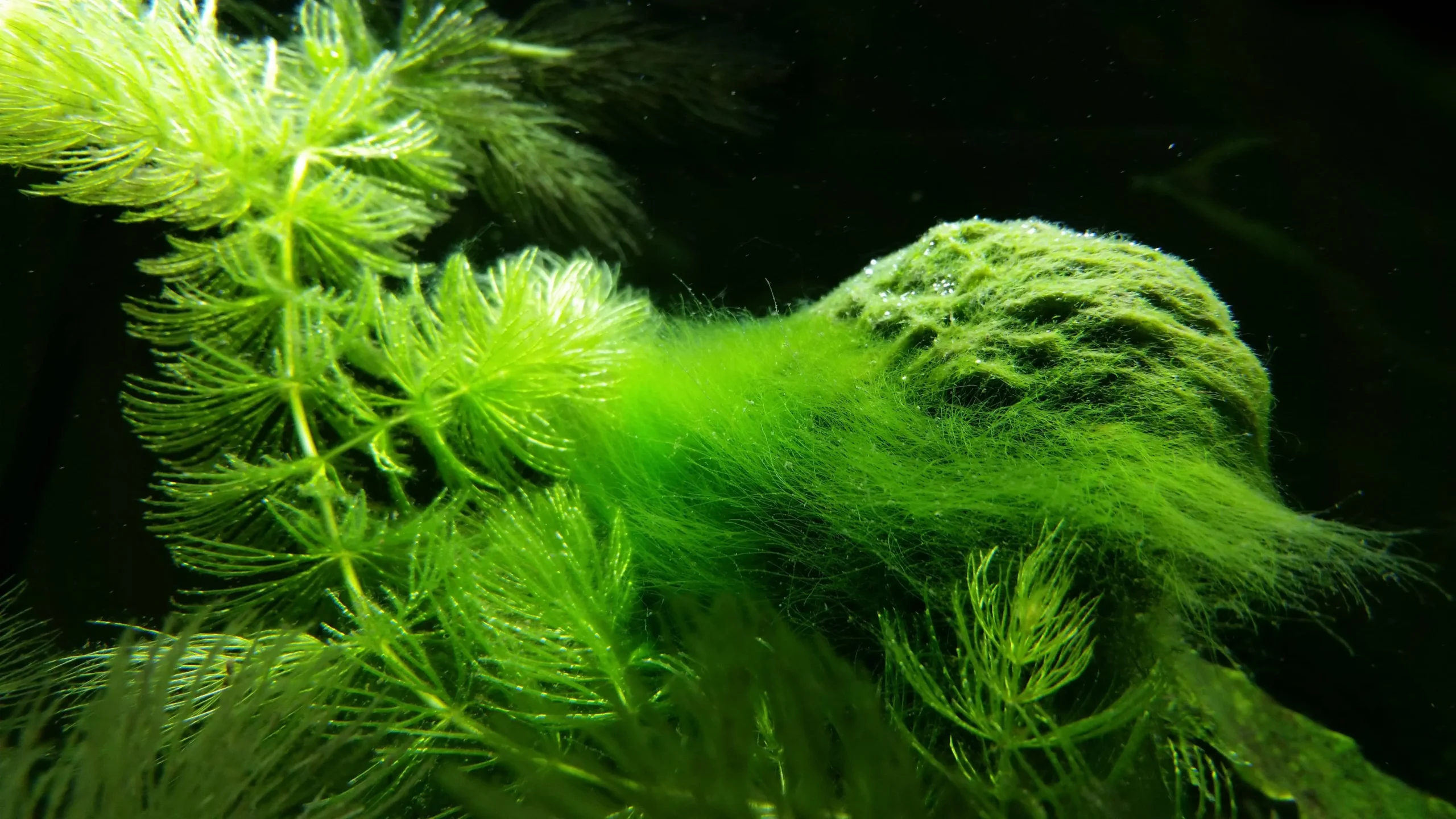
Green filaments, short to medium length, growing from substrate or plants → Hair Algae or Thread Algae. Tangles on fingers and plant leaves. Multiple possible species with different causes.
Dark green to black tufts at plant leaf edges, filter intake, hardscape edges → Black Beard Algae (BBA), also called Red Algae. Feels rough to touch. Very resistant to removal.
Short grey-green or black bristles growing in fast-flow areas → Staghorn Algae. Resembles tiny antlers or deer velvet. Usually found near filter outputs.
Blue-green, purple, or dark brown slime coating surfaces, strong unpleasant smell → Cyanobacteria. NOT true algae — a photosynthetic bacterium. Peels off in sheets. The smell distinguishes it from every other type.
Water itself turning green → Free-floating phytoplankton bloom. Covered in full in the Cloudy Aquarium Water guide — different mechanism and management from surface-growing algae.
Identification matters because the same intervention that resolves diatoms can worsen BBA, and the solution for GDA can make GSA worse. Every type below receives its own cause-and-fix section.
2. The Limiting Factor Principle — Why Algae Always Wins in Imbalanced Systems
Understanding this principle makes every algae decision logical rather than arbitrary.
In a planted aquarium, plant growth requires three primary inputs simultaneously: light, carbon (CO₂), and nutrients (primarily nitrate, phosphate, iron, and micronutrients). Plants can only grow as fast as their scarcest resource allows. If any one of the three is limiting, adding more of the other two does not increase plant growth — it creates excess of those resources.
Algae is far more metabolically flexible than plants. It can grow at lower light intensities, lower CO₂ concentrations, and across a wider nutrient range. It reproduces faster. It tolerates instability better. In any imbalanced system — too much light for available CO₂, too many nutrients for available light — algae accesses the excess first.
The fundamental principle: algae grows on whatever is left over.
If light exceeds what plants can use given available CO₂ → excess light energy becomes algae energy. If nutrients exceed what plants can assimilate given available light and CO₂ → excess nutrients become algae nutrients. If CO₂ is intermittent or insufficient → plants struggle, reducing their uptake, leaving light and nutrients available for algae.
This principle predicts every intervention:
- Reducing light helps only if light is the excess variable
- Adding CO₂ helps only in high-light tanks where CO₂ is limiting
- Reducing fertiliser helps only if nutrients are the excess variable
- Adding plants helps by increasing uptake across all three variables
It also explains why common interventions fail:
- Adding CO₂ to a low-light tank with excess nutrients does not help — plants cannot use more CO₂ because light is limiting; the CO₂ serves no purpose
- Adding fertiliser to a CO₂-limited planted tank increases algae, not plant growth
- Reducing nutrients in a high-light planted tank causes deficiency without reducing algae, because light is still the excess variable
3. Algae in Planted Tanks — Cause and Resolution
3a. Too Much Light for Current Plant Density
The most common cause of algae in new planted tanks and in tanks that have recently lost significant plant mass.
The mechanism: Plants in a tank absorb light proportionally to their total leaf area and growth rate. A tank with small, newly planted specimens has very limited light uptake capacity. The same photoperiod that will be appropriate once the plants are established is far too much light in the first weeks — the excess falls on substrate and hardscape rather than plant leaves, and algae colonises these surfaces.
Similarly, after a significant trim or plant die-off, the remaining plant mass absorbs less light than before. If the photoperiod is not adjusted downward, algae benefits from the temporarily reduced plant uptake.
Practical assessment: Is there significant unshaded glass, substrate, and hardscape visible? Do the plants currently cover less than 50% of the substrate surface area? Has the tank recently been heavily trimmed? If yes, light is likely the excess variable.
The fix:
- Reduce the photoperiod to 6 hours for new planted tanks, increasing to 8–9 hours as plant growth fills the tank
- In established tanks after heavy trimming, reduce the photoperiod by 2 hours for two to four weeks until plant mass recovers
- Add fast-growing stem plants to rapidly increase light uptake capacity in new or sparse tanks — species like hornwort, water sprite, and fast-growing hygrophila take up light and nutrients quickly, providing biological competition against algae while slower-growing species establish
3b. CO₂ Deficiency or Fluctuation
The most important and most commonly misunderstood variable in planted tank algae management.
CO₂ deficiency: In high-light planted tanks, CO₂ is almost always the limiting factor for plant growth. The amount of CO₂ naturally present in aquarium water from fish respiration and biological decomposition is typically insufficient for plants under high or even moderate lighting to grow at their potential rate. The result: plants grow slowly and absorb light and nutrients slowly, while algae — which is more efficient at low CO₂ — uses what the plants cannot.
Adding CO₂ injection to a high-light tank often produces a dramatic algae reduction not because CO₂ directly inhibits algae but because it removes the limitation on plant growth, plants start growing faster, and they outcompete algae for light and nutrients.
CO₂ fluctuation — the specific cause of Black Beard Algae:
This is subtle and important. BBA is not primarily caused by low CO₂ — it is caused by unstable CO₂. A tank where CO₂ fluctuates significantly between day and night, or spikes and crashes due to injection equipment inconsistencies, creates conditions that BBA exploits even in otherwise well-managed planted tanks.
The reason is that CO₂ fluctuation stresses plants. A plant under fluctuating CO₂ cannot maintain consistent uptake — it slows photosynthesis when CO₂ drops and accelerates when it rises, but the biochemical machinery for photosynthesis cannot respond instantaneously. During the stress of CO₂ fluctuation, plants produce less of certain allelopathic compounds and are less effective competitors. BBA fills the gap.
The fix for CO₂ deficiency:
- For low-to-medium light tanks without injection: liquid carbon supplements (glutaraldehyde-based products) can provide modest carbon supplementation. Realistic for soft-lighting setups
- For medium-to-high light tanks: CO₂ injection is the proper solution. Liquid carbon cannot keep pace with the photosynthesis demand of a well-lit planted tank
The fix for CO₂ fluctuation (BBA specifically):
- Use a pH/CO₂ controller or drop checker to maintain consistent CO₂ concentration
- Ensure the CO₂ diffuser is clean and consistent — partial blockage causes irregular delivery
- Time the CO₂ to turn on approximately one hour before lights-on and off one hour before lights-off — this prevents CO₂ spikes during inactive plant hours
- In Delhi’s hard water, high KH reduces CO₂ injection effectiveness by buffering against pH change — check actual CO₂ concentration rather than relying on pH alone as a proxy
3c. Nutrient Imbalance
Nutrients are often incorrectly identified as the primary algae cause when they are frequently the secondary variable. Plants need light and CO₂ to use nutrients. Nutrients alone, in a low-light tank without CO₂ limitation, are not the primary driver. However, specific nutrient imbalances do drive specific algae types.
Phosphate excess → promotes green algae and green water Phosphate is the nutrient most specifically associated with algae promotion. It enters the tank through overfeeding (all commercial fish foods contain phosphate), fish waste, and some tap water supplies. Plants use phosphate but inefficiently at low light or low CO₂. Excess phosphate accumulates and fertilises opportunistic algae.
Nitrate excess → promotes most green algae, particularly in low-light and unplanted tanks Nitrate at low concentrations is not a significant algae driver in planted tanks. At very high concentrations (above 50–100 ppm) it becomes a more significant driver, particularly in unplanted tanks. In planted tanks, the more important variable is whether plants are taking up nitrate efficiently — which depends on light and CO₂ availability.
Iron excess → promotes hair algae and thread algae Iron is an essential plant micronutrient but algae can use it as well. Over-dosing iron fertilisers in a tank where plant uptake is limited by CO₂ or light provides excess iron for algae. Hair algae in particular is associated with excess iron in combination with moderate light.
Low phosphate → can trigger GSA Counter-intuitively, green spot algae often appears in tanks with low phosphate. Plants under phosphate deficiency slow their growth, reducing their competitive ability, and GSA — which requires less phosphate than most plants — exploits the gap. If GSA persists despite good light and CO₂, test for phosphate deficiency before assuming excess.
3d. Flow Dead Zones
Poor water circulation creates areas in the tank where water moves slowly or not at all. These dead zones accumulate detritus, have reduced CO₂ exchange, and develop elevated nutrient concentrations — all of which favour algae over plants.
BBA specifically tends to appear first in dead zones — behind decorations, in the lower corners of tanks, and at the intake filter where flow is low. Staghorn algae appears near filter outputs where flow is erratic.
Improving circulation by adding a powerhead, adjusting filter placement, or using a wavemaker eliminates many of the physical conditions that algae exploits regardless of what nutrients or CO₂ levels are doing. Good flow distributes CO₂ and nutrients evenly, removes waste from plant leaf surfaces, and prevents the localised nutrient hotspots that algae colonises.
4. Algae in Fish-Only Tanks
The cause profile for algae in unplanted or lightly planted fish-only tanks is entirely different from planted tank algae.
The primary causes in fish-only tanks:
Excess light. Fish do not need significant light — their welfare needs are met by the natural light cycle in the room. A fish-only tank with a full photoperiod of 8–10 hours of direct aquarium lighting is providing far more light energy than any fish requires. This light is absorbed by algae on glass and surfaces. Reduce the photoperiod to 6 hours or use a timer to create a midday break in the light period. Move the tank away from windows if natural light is supplementing the artificial photoperiod.
Overfeeding. The primary nutrient input in a fish-only tank is food. Every piece of food contains phosphate, nitrogen, and organic carbon. Uneaten food that decomposes adds all of these directly to the water column. Regular overfeeding is the most common cause of chronic algae in fish-only tanks. For the complete framework on feeding quantities and their relationship to water quality, see How Often to Feed Fish.
Infrequent water changes. Without plants taking up nitrate and phosphate, these accumulate entirely between water changes. An infrequently changed fish-only tank develops elevated nutrient levels that become progressively more algae-hospitable over time.
Biological immaturity. New fish-only tanks go through a period of biological immaturity where protozoan grazers and other microorganisms that naturally suppress algae on surfaces have not yet established. Diatoms during this period are virtually universal — see Section 6a.
The fix for fish-only tank algae:
- Reduce photoperiod to 6 hours maximum
- Reduce feeding by 20–30%
- Increase water change frequency or volume
- Add appropriate algae grazers — nerite snails (highly effective on glass), bristlenose pleco (hardscape and glass), otocinclus (soft algae and biofilm)
- Wait through the new tank ugly phase
5. The New Tank Ugly Phase — Why It Appears and Why It Passes
Virtually every new aquarium goes through a period — typically the first 4–12 weeks — where algae appears on virtually every surface regardless of how carefully the tank is maintained. This is normal. It is not a sign of failure or error.
The mechanism: A new tank has several concurrent imbalances that all favour algae:
- Silicate levels are elevated from new substrate and hardscape — silicates are a primary nutrient for diatoms
- The microbial community is in its earliest stages — the protozoan grazers, microcrustaceans, and other organisms that naturally suppress algae on surfaces in a mature tank are absent
- Plant root systems are minimal, plant growth rate is low, and plant uptake capacity is correspondingly low
- Bacterial blooms consume oxygen and create nutrient gradients that algae exploits
The tank’s microbial ecology matures over weeks and months. As it does — as the biofilm communities diversify, as protozoan populations establish, as silicate is gradually consumed — algae levels naturally decline without any specific intervention. This process is described in detail in The Role of Time in Aquariums and the biofilm succession science is in Biofilms — The Invisible Engine of Every Aquarium.
What to do during the ugly phase:
- Maintain good water changes to export silicate and nutrients
- Keep the photoperiod short (6 hours) — the biological immaturity means the tank cannot effectively compete with algae for light energy
- Do not over-fertilise — plant mass is not yet large enough to use significant nutrient inputs
- Allow otocinclus and/or nerite snails to manage surface diatoms
- Wait — the ugly phase passes on its own
What not to do: treat the ugly phase as a permanent problem requiring chemical intervention. Algaecides kill algae briefly and also damage the developing microbial community, potentially extending the unstable phase.
6. Specific Algae Types — Cause, Diagnosis, and Fix
6a. Brown Algae / Diatoms
Appearance: Soft, brown, silky coating on glass, substrate, hardscape, and plant leaves. Easily wiped off — does not require a scraper. Reappears within days of removal during the new tank phase.
Cause: Elevated silicate concentrations, low light relative to the aquarium, and biological immaturity. Silicates leach from new substrate (particularly sand), new hardscape, and tap water in some areas. Diatoms are silicate-dependent — they build their cell walls from silicate and colonise extensively when it is available in excess.
Who gets it: Almost universal in new tanks. Nearly always disappears within 4–8 weeks as silicate is consumed and the broader microbial community matures.
The fix:
- Allow the maturation process to proceed — diatoms almost always resolve without intervention
- Otocinclus and nerite snails graze diatoms effectively and can control appearance during the maturation period
- In established tanks where diatoms persist: investigate silicate source (certain substrate and rock types continue releasing silicate for months), ensure adequate light for the photosynthetic community, and check water source for high silicate
What NOT to do: Large water changes to combat diatoms. Tap water often contains silicate — the water change may introduce more silicate than it removes.
6b. Green Spot Algae (GSA)
Appearance: Discrete, circular, hard green spots on glass. Firmly attached — requires a razor blade or hard algae scraper to remove. Commonly appears on the glass facing the light source.
Cause: Two possible and opposite causes — which is unusual and important. GSA can indicate either:
- Low CO₂ in a planted tank: plants are growing slowly, their competitive pressure is weak, and GSA exploits available light on bare glass
- Low phosphate: counter-intuitive, but phosphate-deficient plants slow their growth, GSA tolerates low phosphate better than most plants and fills the gap
Diagnosis: Test phosphate. If phosphate reads near zero (<0.05 mg/L) in a planted tank, phosphate deficiency is likely. If phosphate is in range (0.1–1.0 mg/L), CO₂ deficiency or fluctuation is more likely.
The fix for CO₂-driven GSA: Introduce or improve CO₂ injection. Increase plant density to reduce the available glass area for colonisation.
The fix for phosphate-driven GSA: Increase phosphate dosing slightly. Many fertiliser regimes underdose phosphate from an excess concern that is not supported by research in properly managed planted tanks.
Long-term control: Maintain consistent CO₂, adequate phosphate, and high plant density. Nerite snails are effective at controlling existing GSA on glass.
6c. Green Dust Algae (GDA)
Appearance: Fine green powder coating the glass, particularly the front pane. Smears when wiped rather than coming off cleanly. Appears like the glass has been lightly dusted with green chalk.
Cause: New tank immaturity, moderate-high light with insufficient plant competition, and often resolves on its own as the tank establishes. Unlike BBA or GSA, GDA is relatively weak algae that cannot maintain itself against a well-established plant community.
A notable property of GDA: Wiping it off typically makes it worse in the short term — the individual cells spread across the glass and re-establish. Waiting 3–4 weeks without wiping and then performing a large water change (which removes the free-swimming reproductive spores) is sometimes more effective than constant removal.
The fix: Reduce photoperiod during early tank establishment. Increase plant density. Improve CO₂ consistency. In established tanks, GDA persistence suggests the plant community is not strongly competitive — investigate CO₂, nutrients, and light balance.
6d. Hair Algae and Thread Algae
Appearance: Green filaments ranging from a few millimetres to several centimetres long, growing from substrate, plant leaves, and hardscape. Tangles on fingers and plant stems. Can form dense mats in severe infestations.
Causes: Multiple possible — the appearance alone does not fully determine the cause.
- New tank establishment — common in the first weeks before plant competition is strong. Usually resolves with maturation.
- CO₂ deficiency or fluctuation — in planted tanks, inconsistent CO₂ is a common hair algae trigger
- Iron excess — over-dosing iron-containing fertilisers in a tank where plant uptake is CO₂-limited leaves excess iron for algae
- High light with insufficient plant competition — particularly in low-CO₂ planted tanks
The fix:
- In new tanks: wait; reduce photoperiod; add fast-growing plants
- In CO₂-injected tanks: stabilise CO₂ concentration (check drop checker, ensure consistent injection)
- Reduce iron dosing and assess whether the full fertiliser regime is appropriate for current plant density
- Manual removal is effective for controlling current growth while addressing the underlying cause
- Amano shrimp and certain fish (rosy barbs, Florida flagfish) eat hair algae actively
6e. Black Beard Algae (BBA)
Appearance: Dark green to black tufts or filaments growing at plant leaf edges (particularly slow-growing species like anubias and java fern), filter intake mesh, hardscape edges, and in areas of low flow. Feels rough to the touch, unlike the soft feel of hair algae. Very resistant to manual removal.
The primary cause: CO₂ fluctuation, not CO₂ deficiency.
This is the most important and most misunderstood fact about BBA. Tanks with zero CO₂ injection often have very little BBA. Tanks with CO₂ injection that fluctuates — turning on and off inconsistently, delivering variable amounts, or creating pH swings — are extremely prone to BBA. BBA thrives in the instability created by inconsistent carbon supply.
Secondary causes include low-flow dead zones in the tank — BBA consistently establishes first in areas of low water movement before spreading to higher-flow areas.
Diagnosis:
- Does BBA appear specifically near filter intakes, in corners, or behind decorations? → Low flow is contributing
- Did BBA appear after adding or adjusting CO₂ injection? → CO₂ fluctuation is the primary cause
- Does BBA appear on slow-growing species (anubias, java fern) but not on fast-growers? → Classic CO₂-fluctuation pattern — slow growers are more vulnerable
The fix:
- Stabilise CO₂ delivery: use a drop checker and pH controller, clean the diffuser regularly, time CO₂ to lights-on/off schedule, and avoid switching CO₂ on and off intermittently
- Improve flow in dead zones: add a powerhead, adjust filter return, ensure circulation reaches all tank corners
- Spot treatment with Excel (glutaraldehyde) or hydrogen peroxide directly applied to BBA during a brief water-off period is effective at killing existing colonies — this creates a visible dieback within a week
- Remove and trim affected plant leaves (particularly anubias) where BBA is heavily established
- Amano shrimp eat BBA, particularly when it is dying back after spot treatment
6f. Staghorn Algae
Appearance: Short, branching grey-green filaments resembling tiny antlers or velvet. Usually appears near filter outputs and other high-flow areas. Often confused with BBA but is lighter in colour and has a distinct branching structure.
Cause: Ammonia fluctuations are specifically associated with staghorn algae. In tanks where ammonia occasionally spikes — from overfeeding, a dying fish, CO₂ injection at excessive rates causing pH fluctuation that affects the nitrogen cycle — staghorn appears as the first algae response. CO₂ excess (paradoxically) can drive staghorn by crashing pH so rapidly that the biofilm community is temporarily disrupted, releasing a brief ammonia pulse.
The fix:
- Investigate the ammonia source: overfeeding, organic accumulation, or CO₂ overinjection affecting pH/biofilm stability
- Reduce CO₂ injection rate if staghorn appeared after injection was introduced or increased
- Spot treat existing growth with hydrogen peroxide or glutaraldehyde
- Amano shrimp and certain nerite species consume staghorn
6g. Cyanobacteria — the One That Isn’t Algae
Appearance: Blue-green, purple, or dark brown-black slime coating substrate, plant leaves, and hardscape. Peels off in sheets. Distinctive strong, unpleasant smell — earthy, musty, sometimes described as muddy or petroleum-like. This smell is the primary distinguishing characteristic.
Critical distinction: Cyanobacteria is NOT algae. It is a photosynthetic bacterium — the oldest photosynthesising organism on Earth. This distinction matters because algaecides designed for plant-based algae are often ineffective against cyanobacteria, and the causes and fixes are entirely different.
Causes:
- Low flow — cyanobacteria thrives in areas of stagnant water. It is almost always present first in dead zones before spreading
- Low nitrate — cyanobacteria can fix atmospheric nitrogen, meaning it can grow in a tank where nitrate is very low. This is counter-intuitive: adding nitrate fertiliser to a tank with cyanobacteria often reduces it rather than making it worse
- High organic load — excess detritus in the substrate and low water changes provide the nutrient base
- Immature or disrupted tank biology — cyanobacteria is more competitive when the broader microbial community that would otherwise outcompete it is absent or disrupted
The fix:
- Improve flow — add a powerhead, adjust circulation to reach affected areas. This is usually the most effective single intervention
- Increase water changes to reduce organic load
- If nitrate is near zero, increase nitrate levels (potassium nitrate dosing or increased feeding) — this sounds wrong but removes cyanobacteria’s competitive nitrogen-fixing advantage
- Manual removal combined with improved flow and a 3-day blackout can break severe infestations
- Erythromycin (an antibiotic) is effective against cyanobacteria and is sometimes used as a treatment of last resort — however it also damages the nitrifying biofilm community, potentially triggering a cycle disruption. Correcting the flow and nutrient imbalance is preferable to antibiotic treatment where possible
6h. Green Water — Phytoplankton Bloom
Appearance: The water itself turns green, ranging from pale green-tinted to opaque emerald. Not surface algae — free-floating single-celled algae suspended in the water column.
This type is fully covered — including UV steriliser treatment, blackout method, and the light-nutrient balance fix — in the Cloudy Aquarium Water guide linked in the identification section above. The mechanisms and interventions are covered there because it is fundamentally a water clarity problem as much as an algae problem.
7. What Works and What Doesn’t — Honest Assessment
What reliably works:
Reducing photoperiod. For almost all algae types in planted and unplanted tanks, reducing light hours reduces algae growth rate. 6–8 hours is appropriate for most setups. A midday break (2 hours on, 4 hours off, 4 hours on) can further reduce algae without significantly affecting plants.
Stabilising CO₂ in planted tanks. Specifically for BBA, hair algae, and staghorn. Consistency matters more than concentration. A stable 15 mg/L is better for the planted tank than fluctuating between 5 and 30 mg/L.
Adding fast-growing plants. Plants are the most effective long-term algae suppressors available. They compete for light, CO₂, and nutrients simultaneously. In a new tank with algae problems, adding floating plants or fast-growing stem plants directly reduces available resources for algae.
Improving flow. Eliminates the dead zones that BBA, cyanobacteria, and staghorn preferentially colonise.
Consistent water changes. Export excess nutrients, remove algae spores, and reduce the organic load that algae feeds on.
Appropriate grazers. Nerite snails (glass algae, diatoms, GSA), Amano shrimp (hair algae, BBA), otocinclus (soft surface algae, diatoms), bristlenose pleco (hardscape and glass algae). These do not solve the underlying imbalance but effectively manage algae levels in a balanced system.
What does not work:
Algaecides. Kill algae briefly while damaging the broader microbial community. The underlying imbalance remains; the algae returns within days. The microbial damage may prolong the problem.
Continual manual removal without addressing the cause. Removes current growth but changes nothing about conditions. Results in the same algae in the same places within days.
Adding more CO₂ without addressing light. Adding CO₂ to a low-light tank does not increase plant growth — light is limiting, not CO₂. The CO₂ does not help.
Reducing fertilisers in a CO₂-limited planted tank. Reduces plant growth further (they were already nutrient-limited by CO₂ deficiency), weakening plant competition while not addressing the actual excess variable.
Frequent large water changes alone. Reduces nutrient levels temporarily but does not address the light or CO₂ imbalance. Algae regrows from the remaining nutrients and spores within days.
8. India-Specific Algae Drivers
Summer light duration and intensity. From March through June in North India, daylight hours lengthen and light intensity increases significantly. A tank positioned where indirect natural light supplements the artificial photoperiod can receive significantly more total light in summer than in winter. Algae blooms in March and April often coincide with this increasing natural light rather than any change in tank management. Seasonal assessment of light entering the tank from windows is part of good Indian aquarium management — the tank’s position relative to natural light that was appropriate in winter may require adjustment in summer.
Temperature effects on plant vs algae metabolism. At elevated summer temperatures (30–34°C), the metabolic rate of most aquarium plants is supressed relative to their optimal range. Plants from tropical origins typically prefer 24–28°C and grow progressively less efficiently above this. Many algae types, by contrast, are more temperature-tolerant and can maintain growth rates at temperatures that reduce plant efficiency. The competitive balance shifts toward algae in summer not just because of light changes but because plant metabolic capacity is reduced by heat stress. The complete temperature management framework is in Aquarium Water Temperature in Indian Summer.
Hard water and CO₂ injection. Tap water in most parts of india has very high KH (carbonate hardness), typically 8–15 dKH. High KH buffers pH very strongly, meaning that CO₂ injection must achieve significantly higher concentrations to produce the pH drop that planted tank hobbyists use as a proxy for CO₂ levels. A hobbyist in Delhi NCR area using the standard “pH should drop by 1 unit with CO₂ injection” rule may be severely underinjecting CO₂ because their high-KH water resists the pH change. The result: CO₂ deficiency despite running injection, and algae that appears to be unresponsive to CO₂ adjustment. The Hard Water Aquariums in Delhi NCR guide covers how to interpret CO₂ in high-KH water.
Power cuts affecting CO₂ injection consistency. In load-shedding states, power cuts interrupt CO₂ solenoids, creating exactly the kind of CO₂ fluctuation that drives BBA. A CO₂ injection system in a city with regular power cuts will produce CO₂ fluctuation patterns regardless of how well-calibrated the injection rate is. BBA in Indian planted tanks during summer often traces to this cause — the injector cycling on and off with the power supply. Battery-backed CO₂ solenoids or manual adjustment protocols during power cuts are the mitigation.
The underlying principle connecting algae management to aquarium ecology — why imbalanced systems always produce algae and why stable, mature systems naturally suppress it — is the subject of the Aquarium Stability Is Not Balance cornerstone article.
9. Frequently Asked Questions
Why does algae come back after I remove it? Because removing algae changes nothing about the conditions that allowed it to grow. Algae is reproductive and opportunistic — a few remaining cells or spores in the same conditions will re-establish the same growth within days. Permanent algae reduction requires changing the conditions: reducing excess light, stabilising CO₂, improving flow, or increasing plant competition. Once the conditions no longer favour algae over plants or an established microbial community, algae stops recurring.
Which algae is hardest to get rid of? Black beard algae (BBA) is generally considered the most persistent because its cause — CO₂ fluctuation — is difficult to eliminate completely, and its physical structure is resistant to manual removal. Cyanobacteria in established infestations is also stubborn because it can regrow from very small remnants and fixes its own nitrogen supply. Green spot algae on glass, while physically hard to remove, is manageable with a razor blade and appropriate phosphate management. Diatoms are the easiest — they are temporary and naturally resolve.
Is some algae normal in an established tank? Yes. A completely algae-free aquarium is not a biological ecosystem — it is a chemically sterilised one. Some biofilm and algae growth on substrate and hardscape surfaces is part of the normal biological community of a mature tank. The target is not zero algae but managed algae that stays within accepted bounds. An established tank with healthy plant competition typically maintains low algae levels naturally, with occasional spot cleaning of glass rather than a chronic battle against spreading growth.
I have algae but no plants. What do I do? In a fish-only tank, the algae management levers are: reduce photoperiod to 6 hours maximum, reduce feeding by 20–30%, increase water change frequency, improve flow to eliminate dead zones, and add appropriate algae grazers (nerite snails, bristlenose pleco). Without plants competing for light and nutrients, these four adjustments are the primary tools.
My CO₂ is good, my light is balanced, nutrients are dosed correctly — why do I still have algae? Ensure flow is reaching all tank areas — dead zones are the most common cause of localised algae in otherwise well-managed planted tanks. Check whether the tank is mature enough — biological maturity develops over 6–12 months and the algae competition from the full microbial community is not present in newer tanks regardless of how well-calibrated the chemistry is. Check for Indian-specific factors: natural light supplementing the artificial photoperiod, power cuts causing CO₂ fluctuation, or hard water causing underestimation of actual CO₂ concentration.
Do algae-eating fish solve algae problems? They control algae levels — they do not solve algae problems. An algae eater in a tank with too much light and insufficient plants will keep surfaces cleaner than the same tank without one, but it will not eliminate the imbalance. Appropriate grazers are a useful tool in an overall balanced approach, not a standalone solution. They are also often misused — common plecos sold as “algae eaters” grow to 40–50cm and are inappropriate for most community tanks. Nerite snails, otocinclus, and Amano shrimp are the most effective and appropriate grazers for standard planted aquariums.
I added CO₂ injection and the algae got worse. Why? Two possibilities. First: if you increased light when adding CO₂ (a common response to the improved plant growth it enables), you may have increased light before plant mass expanded enough to use it, temporarily increasing algae energy availability. Keep light stable and allow plant growth to catch up to the new CO₂ level first. Second: if CO₂ is being introduced inconsistently — the solenoid turning on late, inconsistent bubble rate, or a new injection system being calibrated — the fluctuation may be driving BBA even as overall CO₂ levels improve. Stability of delivery is as important as the CO₂ level itself.
How long does it take for algae to go away after I fix the cause? Existing algae does not disappear when the underlying cause is corrected — it starves and dies gradually, which can take 2–4 weeks. Manual removal of the bulk of existing growth combined with correcting the cause produces the fastest visible improvement. If algae continues growing rather than declining 4 weeks after correcting what appeared to be the cause, a secondary cause has been missed — reassess using the type-by-type guide in Section 6.