
by ProHobby™ | Ecological Systems Authority
This article is the engineering companion to Aquarium Filtration: The Complete Science and Practice Guide. That guide covers the complete biology and practice of aquarium filtration — how biofilm communities work, how to size and maintain a filter, seeding methods, sensitive species, and troubleshooting. If you have not read it, start there.
This article goes one layer deeper. It takes the same subject and approaches it the way aquaculture engineers do: with actual numbers, worked calculations, and quantitative frameworks for evaluating whether a filtration system has genuine capacity for a given bioload. Biological filtration is the processing component of the nutrient cycle in a closed aquatic system — the point where ammonia, the entry compound of the nitrogen cycle, is converted into progressively less harmful forms. The Nutrient Cycles in Nature and Captivity cornerstone article covers that cycle in full; this article covers how to engineer the filter that drives it. The Aquarium Stability Is Not Balance cornerstone article explains why filtration capacity is one of the primary determinants of system stability in a closed aquatic ecosystem. The concepts here — ammonia throughput, oxygen diffusion, residence time, flow geometry, colonised surface area vs total surface area — are the variables that determine whether a filter performs as its marketing claims or as its biology allows.
You do not need this level of analysis for every tank. You do need it when you are designing a high-bioload system, troubleshooting a tank that keeps failing despite apparently adequate filtration, or evaluating competing filter and media options using criteria more rigorous than turnover rate specifications.
Table of Contents
- Ammonia Production: The Biological Load in Numbers
- Nitrification Capacity: What a Filter Can Actually Process
- 2a. The Baseline Processing Rate
- 2b. Colonised Surface Area vs Total Surface Area
- 2c. The Worked Calculation
- Residence Time: The Engineering Variable Most Guides Ignore
- 3a. The Formula and What It Means
- 3b. Optimal Residence Time Ranges
- 3c. Why Increasing Flow Can Decrease Biological Efficiency
- Oxygen: The True Limiting Variable
- 4a. DO Requirements for Nitrification
- 4b. Oxygen Diffusion in Porous Media
- 4c. The Oxygen-Residence Time Trade-Off
- Biomedia: Engineering Analysis of Real-World Performance
- 5a. Why Quoted Surface Area Is Misleading
- 5b. The Accessibility Coefficient
- 5c. Media Comparison with Performance Reasoning
- Flow Geometry Inside the Filter Chamber
- 6a. Plug Flow vs Mixed Flow
- 6b. Channelling: The Silent Capacity Killer
- 6c. Practical Media Configuration for Maximum Efficiency
- Sizing a Filter: Two Worked Examples
- 7a. 100-Litre Planted Community Tank
- 7b. 200-Litre Heavily Stocked Cichlid Tank
- System-Specific Engineering Considerations
- 8a. Planted Tanks: The DO-CO₂ Trade-Off
- 8b. Marine and Reef Systems
- 8c. High-Bioload Freshwater: When Wet-Dry Outperforms Canister
- Using the Aquarium Flow and Filtration Calculator
- Frequently Asked Questions
1. Ammonia Production: The Biological Load in Numbers
Every sizing calculation starts here. You cannot evaluate whether a filter has sufficient capacity without knowing the ammonia load it needs to process. The two most important inputs are fish mass and species-specific excretion rate.
Ammonia production rates by fish type (approximate, at 26°C):
| Fish type | Approximate ammonia production |
|---|---|
| Small community fish (neons, rasboras, small tetras) | 5–15 mg NH₃/fish/day |
| Medium community fish (danios, barbs, live-bearers) | 15–30 mg NH₃/fish/day |
| Large community fish (angels, gouramis, medium cichlids) | 30–60 mg NH₃/fish/day |
| Large predatory fish (oscars, large cichlids) | 80–150 mg NH₃/fish/day |
| Goldfish (per adult fish) | 80–120 mg NH₃/fish/day |
| Discus (adult) | 20–40 mg NH₃/fish/day |
| Marine fish (medium community) | 20–50 mg NH₃/fish/day |
These are production rates under normal feeding conditions. At higher temperatures, production increases proportionally with metabolic rate. At 30°C, expect approximately 15–20% higher production than at 26°C. At 32°C, approximately 25–30% higher.
Feeding multiplier: The figures above assume once-daily feeding at moderate quantity. Heavy twice-daily feeding increases ammonia production by 30–50% above baseline. This is why filter sizing must account for intended maintenance practice, not just stocking.
The total daily ammonia load is the sum of individual fish production across your stocking. This is the number your filter needs to process entirely, every 24 hours, to maintain zero ammonia in the water column.
Example — a 100-litre community tank:
- 10 neon tetras × 10 mg/day = 100 mg/day
- 6 harlequin rasboras × 12 mg/day = 72 mg/day
- 4 Corydoras × 20 mg/day = 80 mg/day
- 1 bristlenose pleco × 25 mg/day = 25 mg/day
- Total: approximately 277 mg NH₃/day
This number feeds directly into the capacity calculation in Section 2.
2. Nitrification Capacity: What a Filter Can Actually Process
2a. The Baseline Processing Rate
Mature nitrifying biofilm — primarily Nitrospira in aquarium systems — processes ammonia at a rate that depends on available oxygen, temperature, and biofilm density. The conservative aquaculture standard for a mature, well-oxygenated biofilm is:
~0.4 mg NH₃ per cm² of colonised surface area per hour
This is the number used in aquaculture systems design. It represents a mature biofilm community under good conditions — adequate dissolved oxygen, temperature in the 24–28°C range, pH above 7.0.
Converting to daily: 0.4 × 24 = 9.6 mg NH₃ per cm² per day
So the calculation is straightforward in theory: divide your daily ammonia load by 9.6 to find the minimum colonised surface area your filter needs in cm².
Using our example: 277 ÷ 9.6 = ~29 cm² of active colonised surface area needed
That seems very small. And it would be — if 100% of media surface area were actually colonised and active. The problem is that it isn’t.
2b. Colonised Surface Area vs Total Surface Area
This is the gap that marketing specifications exploit and that most hobbyists never account for.
Media products quote total surface area — the theoretical maximum calculated from the geometry of the media structure. A ceramic ring with 300 m² per litre of total surface area sounds impressive. What matters is how much of that 300 m² is:
- Physically accessible to water flow (not in micropores too small for water circulation)
- Adequately supplied with dissolved oxygen (not in oxygen-depleted zones deep in the media structure)
- Colonised with active biofilm (which takes months to fully develop)
The realistic colonisation efficiency of most hobby aquarium media is determined by the same biofilm ecology principles covered in Biofilms — The Invisible Engine of Every Aquarium:
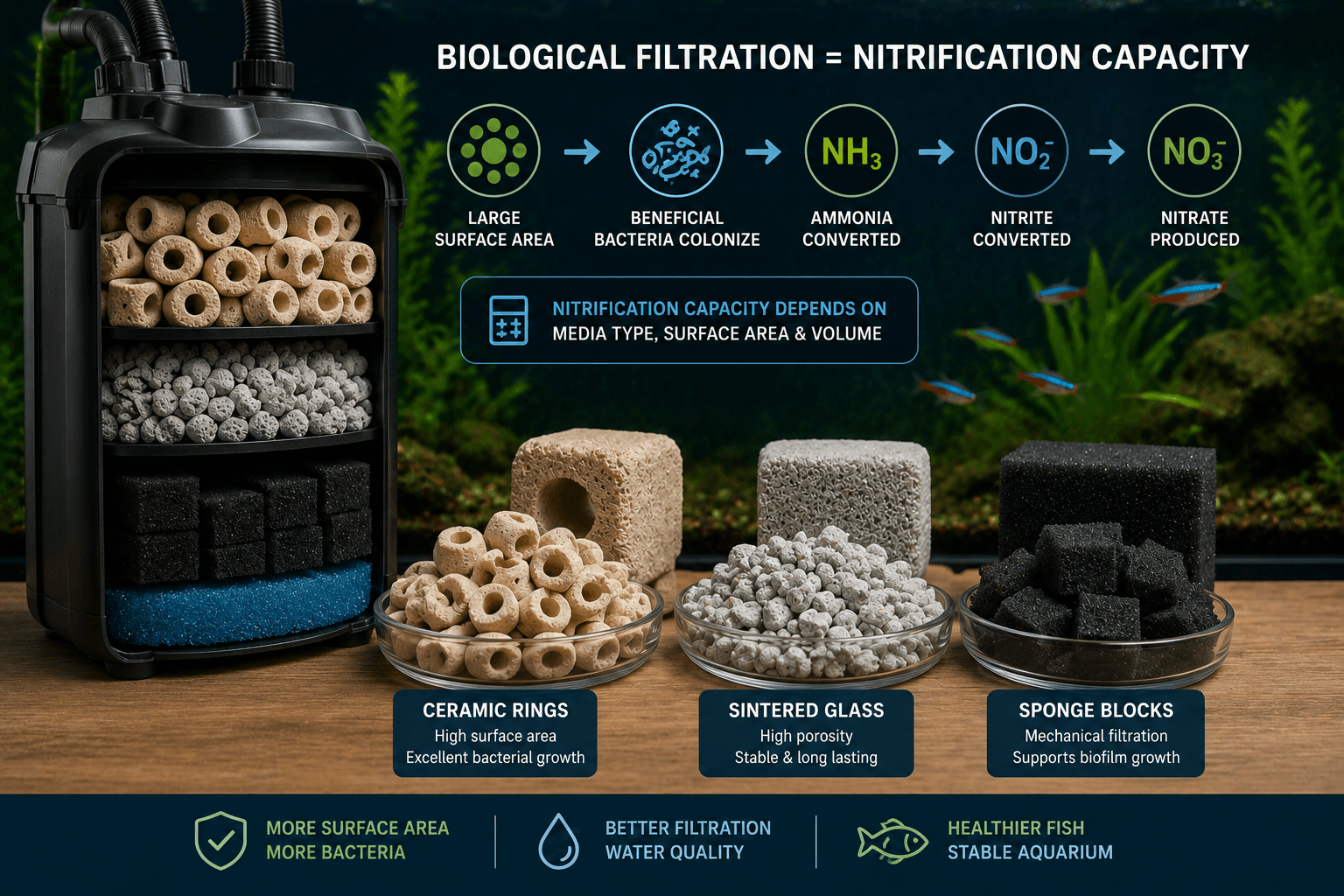
- High-quality sintered glass (Seachem Matrix, quality equivalents): 30–45% effective colonisation
- Standard ceramic rings (budget): 10–25% effective colonisation
- High-quality sponge media: 60–80% effective colonisation (lower total surface area but far higher accessibility)
- Lava rock: 25–40% effective colonisation
A product quoting 300 m² per litre with 15% actual colonisation efficiency provides 45 m² per litre of active biofilm surface — the same as a product quoting 70 m² per litre at 65% efficiency.
This is why expensive media with impressive surface area specifications often fails to outperform simpler media with better oxygen accessibility — and why sponge filters consistently outperform their surface area numbers in practice.
2c. The Worked Calculation
Using our 100-litre community tank example (277 mg NH₃/day):
Required active surface area: 277 ÷ 9.6 = ~29 cm² active surface area
Converting to media volume: If we use quality ceramic rings with 200 m² quoted surface area per litre (200,000 cm² per litre) at 20% colonisation efficiency:
- Active surface area per litre = 200,000 × 0.20 = 40,000 cm²/litre
- Media volume required = 29 ÷ 40,000 = 0.00073 litres = 0.73 ml
That number is tiny. So why do filters fail with small amounts of media?
The answer: this calculation represents steady-state processing in ideal conditions. Real-world performance is degraded by:
- Immature biofilm (months 1–6 significantly below mature rate)
- Oxygen limitation inside the media (reduces active fraction)
- Residence time limitations (water passes through too fast for full processing)
- Temperature variation (summer heat and winter cold both reduce efficiency)
- Chloramine exposure in Indian tap water degrading biofilm over time
Apply a practical safety factor of 10–20× to the theoretical minimum to account for real-world conditions. Our 100-litre community tank therefore needs 10–15 ml of quality media at theoretical minimum — but practically should run 200–500 ml of quality biological media with adequate flow and oxygen supply.
The value of this calculation is not to produce a precise sizing answer but to demonstrate that in most cases, biological capacity is not the primary limiting factor in a properly maintained filter — oxygen supply, residence time, and biofilm maturity are more commonly the constraints.
3. Residence Time: The Engineering Variable Most Guides Ignore
3a. The Formula and What It Means
Residence time is the average duration that water spends inside the filter chamber in contact with biological media. It is the time the bacteria have to process the ammonia in each volume of water that passes through.
Residence Time (hours) = Volume of biological media chamber (litres) ÷ Flow rate (litres/hour)
Worked example with a typical canister filter:
- Biological media chamber volume: 1.5 litres
- Pump flow rate: 600 L/hr
- Residence time = 1.5 ÷ 600 = 0.0025 hours = 9 seconds
Nine seconds is the contact time available for ammonia processing in each pass. In a mature, well-oxygenated filter this is sufficient because not all ammonia is processed in a single pass — the water circulates through the filter many times per hour, and the cumulative processing across multiple passes removes ammonia to zero.
But this only works if: the filter is turning the tank over frequently enough (multiple passes per hour), and each pass achieves genuine contact with active biofilm rather than channelling through a low-resistance path.
3b. Optimal Residence Time Ranges
There is no single optimal residence time number — it depends on biofilm maturity, temperature, oxygen supply, and ammonia load. However, practical ranges derived from aquaculture applications:
| Residence time | Biological processing efficiency |
|---|---|
| Under 5 seconds | Very low — insufficient contact time |
| 5–15 seconds | Moderate — adequate for established filter with multiple daily passes |
| 15–60 seconds | Good — high contact time, approaching maximum processing per pass |
| Above 60 seconds | Risk of oxygen depletion in deep media beds |
For hobby aquariums with typical flow rates, 8–15 seconds is the most common range. This is sufficient for a healthy established filter. The issue arises not with the residence time itself but with what happens to oxygen during those seconds.
3c. Why Increasing Flow Can Decrease Biological Efficiency
Counter-intuitive but important: increasing filter flow rate past a certain point reduces biological efficiency per unit of water processed, even though the total water volume processed per hour increases.
The mechanism: the ammonia processing reaction by nitrifying bacteria is not instantaneous. If water moves too rapidly through the media bed, each volume of water interacts with bacteria for too short a time to be fully processed in that pass. More passes per hour compensate for less processing per pass — but only up to the point where oxygen depletion within the media bed becomes the limiting factor.
At very high flow rates through a dense media bed, the water flowing at the front face of the media is well-oxygenated. Water that has penetrated deeper into the bed has had oxygen consumed by the bacteria it already passed, and may be oxygen-depleted before it exits. The inner bacteria are not processing ammonia at full rate because they are oxygen-limited, not time-limited.
For the complete treatment of how residence time interacts with flow geometry and biological capacity across different aquarium types, see Residence Time in Aquariums and Flow and Energy Geometry in Closed Aquatic Systems.
The practical consequence: for a given media volume, there is an optimal flow rate range that maximises ammonia processing per litre of media. Below this range, residence time is excessive and oxygen depletion is possible. Above it, contact time is insufficient. Within it, both oxygen supply and contact time are adequate.
This optimal range varies by media type — higher for open-structure media like sponge, lower for densely packed ceramic — which is why matching flow rate to media type is as important as matching flow rate to tank volume.
4. Oxygen: The True Limiting Variable
4a. DO Requirements for Nitrification
Nitrifying bacteria are obligate aerobes. They cannot perform ammonia or nitrite oxidation without oxygen. The minimum dissolved oxygen concentration for nitrification is approximately 2 mg/L; optimal performance requires 5–7 mg/L. Below 2 mg/L, nitrification stops. Between 2 and 5 mg/L, it is rate-limited.
The practical aquarium target is DO above 6 mg/L throughout the filter media bed — not just in the tank water, but specifically in the water reaching all sections of the biological media.
Why this matters: The filter motor draws water from the tank into the filter inlet at tank DO levels — typically 7–8 mg/L in a well-aerated tank at 26°C. As this water flows through the media bed, the bacteria consume oxygen. Each gram of ammonia oxidised consumes approximately 3.5 grams of dissolved oxygen. In a heavily loaded filter with slow flow, the water exiting the biological media may be significantly oxygen-depleted compared to the inlet water.
4b. Oxygen Diffusion in Porous Media
This is where the gap between quoted and actual surface area becomes most significant.
In a porous ceramic ring with 300 m² per litre of surface area, most of that surface is inside the structure — in micro and nanopores too small for convective water flow. Oxygen reaches these surfaces only by molecular diffusion, which is orders of magnitude slower than convective transport.
In practice: the oxygen-accessible layer of biological media is typically the outer 100–500 micrometres of the structure for conventional ceramic media. The deep interior may have bacteria physically present but operating at greatly reduced rates due to oxygen limitation.
This is why densely microporous media with very high theoretical surface areas frequently underperforms simpler, more open-structured media in real-world aquariums. The biofilm living in the oxygen-accessible outer layer does the work. The impressive internal structure contributes less than it appears to.
The design implication: media with large macropores that allow convective flow into the interior — alongside sufficient mesopores for bacterial attachment — achieves higher real-world performance than media optimised purely for maximum total surface area. This is why products like Seachem Matrix are designed with specifically sized pore structures rather than simply maximising total porosity.
4c. The Oxygen-Residence Time Trade-Off
The two variables work against each other. Increasing residence time improves ammonia processing per pass but increases the risk of oxygen depletion in the media bed. Decreasing residence time (increasing flow) improves oxygen supply to the media but reduces contact time.
The optimal operating point is a function of:
- The oxygen consumption rate of the biofilm (proportional to ammonia load and biofilm density)
- The oxygen supply rate (proportional to flow rate and inlet DO)
- The media structure (how readily oxygen penetrates)
For most hobby aquariums, the constraint is not residence time but oxygen supply. A filter with adequate flow (reasonable residence time) but poor surface agitation upstream — meaning the water entering the filter is oxygen-depleted — will nitrify poorly regardless of how much media it contains.
This explains why improving surface agitation often improves parameter stability even when the filter size is unchanged. Better upstream DO → better DO at media → higher nitrification rate per cm² of media → the same media volume processes more ammonia.
5. Biomedia: Engineering Analysis of Real-World Performance
5a. Why Quoted Surface Area Is Misleading
The aquarium market has converged on total surface area as the primary media marketing specification. This is largely meaningless without additional information about:
- Pore size distribution — ratio of macro, meso, and micropores
- Tortuosity — how convoluted the internal pathways are, which affects both diffusion distance and flow resistance
- Material density — harder materials resist compression and structural collapse over time
- Hydrophilicity — how readily the material develops a water-stable biofilm (some materials are initially hydrophobic and resist biofilm colonisation)
A media with 1,500 m² per litre of total surface area and 95% of that surface in diffusion-limited micropores is functionally inferior to a media with 300 m² per litre and 70% in convectively accessible macropores, despite a 5× surface area advantage on paper.
5b. The Accessibility Coefficient
A useful practical concept for comparing media: the accessibility coefficient is the fraction of total surface area that is genuinely oxygen-accessible under typical filter operating conditions.
| Media type | Typical accessibility coefficient | Effective surface area at 300 m²/L quoted |
|---|---|---|
| Quality sintered glass (Matrix-class) | 0.35–0.50 | 105–150 m²/L effective |
| Budget ceramic rings | 0.10–0.20 | 30–60 m²/L effective |
| Lava rock | 0.25–0.40 | 75–120 m²/L effective |
| High-quality open-cell sponge | 0.65–0.80 | 195–240 m²/L effective (at ~300 m²/L total) |
| Plastic bio-balls | 0.85–0.95 | Low total, very high accessibility |
The accessible surface area determines actual ammonia processing potential. By this metric, a well-chosen sponge block frequently outperforms budget ceramic media despite a significant disadvantage in quoted surface area.
5c. Media Comparison: Engineering Reasoning
High-quality sintered glass (Seachem Matrix, quality equivalents): Engineered with both macro and mesopore structure to balance flow penetration and surface area. The best available option for maximising biological capacity per unit volume in high-bioload systems. The pore structure genuinely allows deep convective flow. Cost-justified for large systems or where filter chamber volume is the constraint.
Budget ceramic rings: Wide quality range. Poor examples have very fine microporous structure that fires well for surface area measurement but is diffusion-limited in real use. Better examples have larger visible pores that allow some convective flow. Generally adequate for low-to-moderate bioloads. Risky for high-bioload systems where the gap between quoted and actual performance is most consequential.
Lava rock: The effective budget alternative to quality sintered glass. Natural vesicular structure creates irregular but genuinely accessible pore networks. Colonises readily. Very long service life. Variable density and pore size between sources — source quality matters. Excellent value for cost.
Sponge media: Open cell structure provides near-complete oxygen accessibility. Lower total surface area than ceramics but colonised surface area often comparable. Ideal for low-to-moderate bioloads. Self-compressing under high flow, which reduces effective pore size over time. Replace when physical structure has degraded. Best for shrimp tanks, breeding tanks, and systems where gentle flow is a requirement.
A common failure pattern: Activated carbon placed in the biological media chamber and left permanently. Carbon in the biological zone restricts water flow to the actual biological media, reduces residence time for the media that matters, and once saturated (typically after four to six weeks) stops providing any chemical benefit while continuing to restrict flow. Carbon belongs in the final chamber position and on a scheduled replacement cycle — or not at all in systems that do not need it. It is not a substitute for biological media and its presence in a biological media position is a capacity reduction, not an enhancement. Appropriate for the specific application of wet-dry trickle filtration where the media is exposed to air rather than submerged — the air-water interface maximises oxygen supply regardless of structure. Not suitable for submerged filtration where the low surface area becomes the constraint.
6. Flow Geometry Inside the Filter Chamber
6a. Plug Flow vs Mixed Flow
Two idealised flow models describe how water moves through a filter chamber:
Plug flow: Water moves through the chamber as a uniform “plug” — all water entering spends exactly the same residence time in the chamber before exiting. Every volume of water gets the same contact time with media. This is the ideal for maximum ammonia processing per pass.
Mixed flow (fully mixed): Water entering the chamber is instantly and completely mixed with the existing chamber water. Some water exits immediately upon entry (short-circuit); some remains for very long periods. Average residence time equals chamber volume divided by flow rate, but individual volumes vary widely.
Real filters operate between these extremes. The closer to plug flow, the more efficiently residence time translates to ammonia processing. The closer to mixed flow, the more variable the contact time — with some water short-circuiting and some over-dwelling.
6b. Channelling: The Silent Capacity Killer
Channelling occurs when water finds a low-resistance path through the media bed and preferentially flows through that path rather than distributing evenly. The result: a fraction of the media bed receives most of the flow (and processes ammonia at high rate), while the rest receives minimal flow (and processes ammonia slowly or barely at all).
Causes of channelling:
- Uneven media packing — looser sections carry more flow
- Media of different particle sizes creating a gradient of permeability
- Gas bubbles trapped in the media bed (particularly relevant in canister filters that have been re-sealed after maintenance)
- Media compression over time creating dense, low-permeability zones alongside less compressed zones
Signs of channelling: A filter that tests poorly (measurable ammonia despite seemingly adequate size) but shows no mechanical failure. The media looks fine; the biofilm appears healthy in accessible areas. The problem is internal flow distribution, not biology.
Prevention: Use media of consistent particle size and pack it uniformly. Avoid mixing very fine and very coarse media in the same chamber. When repacking a canister after maintenance, distribute media evenly and compact gently. Run the filter briefly on its side after sealing to redistribute any trapped air.
A related India-specific point: Long hose runs between canister filter and aquarium reduce actual flow rate below the pump’s rated output. Every metre of hose and every elbow fitting adds resistance — a canister rated at 800 L/hr with two metres of tubing and four elbows may deliver only 550–650 L/hr at the outlet. If your filter is not producing the expected flow, measure the actual output by timing how long it takes to fill a known volume before assuming the filter or media is the problem. Keep hose runs as short and straight as practical.
6c. Practical Media Configuration for Maximum Efficiency
For canister filters and sump systems, the media sequence matters for both mechanical protection of biological media and flow distribution:
Optimal sequence (water flow direction):
- Coarse pre-filter sponge — intercepts large particles, protects downstream media from rapid clogging, easy to clean without disturbing biological layers
- Fine mechanical media or filter floss — polishes water, removes fine particles before they reach biological media
- Biological media (ceramic, sintered glass, lava rock) — sized and packed for uniform flow distribution, approximately 1–2 litres for most systems
- Optional: second biological layer with different media structure (e.g., quality sponge following ceramic) to capture any ammonia not processed in the first layer
- Optional: chemical media last (activated carbon, Purigen) — placed last so it polishes water after biological processing, on scheduled replacement cycle
Packing density: Biological media should fill its chamber without excessive compression. Over-packed media creates high flow resistance, forcing channelling through low-resistance paths. A slight looseness is preferable to compression.
7. Sizing a Filter: Two Worked Examples
7a. 100-Litre Planted Community Tank
Stocking:
- 12 neon tetras
- 8 harlequin rasboras
- 6 bronze Corydoras
- 1 bristlenose pleco
Daily ammonia production (from Section 1):
- 12 × 10 mg = 120 mg
- 8 × 12 mg = 96 mg
- 6 × 20 mg = 120 mg
- 1 × 25 mg = 25 mg
- Total: ~361 mg NH₃/day
Required active surface area: 361 ÷ 9.6 = ~38 cm²
With 20× safety factor for real-world conditions: ~760 cm²
Media volume to achieve this (quality ceramic, 20% colonisation of 200,000 cm²/L): 760 ÷ 40,000 = 0.019 litres = 19 ml of quality ceramic
Practical recommendation with all safety factors: 250–400 ml of quality biological media minimum.
Filter selection: A canister rated at 300–500 L/hr with 0.5–1L biological media chamber is adequate. Flow rate at approximately 4–5× tank volume per hour — appropriate for a planted tank to minimise CO₂ stripping. Use a spray bar return to distribute flow without surface turbulence.
Note: The plants in this tank provide supplementary ammonia processing. In a dense, well-lit planted tank this can reduce effective ammonia load by 20–40%, allowing the filter to be sized more conservatively than a fish-only equivalent.
7b. 200-Litre Heavily Stocked Cichlid Tank
Stocking (example — large South American cichlid community):
- 2 Geophagus sveni (medium) × 50 mg/day = 100 mg
- 2 Satanoperca leucosticta (medium) × 50 mg/day = 100 mg
- 1 large pleco × 40 mg/day = 40 mg
- 1 adult oscar × 120 mg/day = 120 mg
- Total: ~360 mg NH₃/day
Comparable total to the community tank above, but at half the species count and in a 200-litre tank — and fed twice daily at higher quantities, so add 40% feeding multiplier:
Adjusted total: ~504 mg NH₃/day
Required active surface area: 504 ÷ 9.6 = ~53 cm²
With 20× safety factor: ~1,060 cm²
Media volume (quality ceramic at 20% colonisation): 1,060 ÷ 40,000 = 0.027 litres = 27 ml minimum
Practical recommendation: 1–1.5 litres of quality biological media with safety factor of 15–20× applied, run in a large canister or dual-canister setup.
Filter selection: Dual canisters totalling 1,800–2,500 L/hr with combined 1.5–2 litres of quality biological media. Alternatively, a sump filter with equivalent media volume allows easier maintenance without disturbing the display tank.
Note on safety factor for high-bioload predatory fish: The 20× safety factor is particularly important for tanks with large predatory fish because ammonia production can spike dramatically from a single large meal, and a filter crash in a heavily stocked predatory tank produces fish deaths much faster than in a lightly stocked community tank. For the complete four-constraint framework for evaluating how filtration capacity interacts with stocking, temperature, dissolved oxygen, and territory, see Carrying Capacity in Aquariums.
8. System-Specific Engineering Considerations
8a. Planted Tanks: The DO-CO₂ Trade-Off
The fundamental planted tank filtration engineering challenge is that the two most important gases have competing optimal management at the water surface:
- Dissolved oxygen increases with surface agitation (gas exchange)
- Dissolved CO₂ decreases with surface agitation (CO₂ is stripped)
High surface agitation maximises DO for fish and filter bacteria but strips CO₂ that plants need. Low surface agitation maintains CO₂ for plants but risks oxygen depletion for fish and biofilm.
The engineering resolution:
Daytime: Minimal surface agitation. Plants are photosynthesising — producing DO and consuming CO₂. Filter return positioned to create lateral circulation without surface turbulence. Spray bar or lily pipe return rather than a nozzle directed upward.
Nighttime: Increased surface agitation. Photosynthesis stops — all organisms consume DO and produce CO₂. The added CO₂ from respiration is not a concern (lights are off, plants cannot use it) but the lost DO is critical. An airstone on a timer, switching on at lights-off, provides overnight oxygen exchange without interfering with CO₂ during the photosynthetic period.
Flow rate target for planted tanks: 3–5× tank volume per hour — lower than fish-only to minimise CO₂ stripping. In a high-tech CO₂-injected tank, the flow rate must be calibrated carefully: enough to distribute CO₂ throughout the tank (too slow creates CO₂ gradients) while not stripping it at the surface (too fast defeats the injection). Drop checker measurement in multiple tank locations is the calibration tool.
8b. Marine and Reef Systems
Marine systems have biological filtration requirements that differ in several engineering dimensions:
Higher ammonia toxicity at marine pH. Seawater pH of 8.1–8.3 means a higher proportion of any total ammonia exists in the toxic un-ionised form, making the effective toxic threshold lower. Marine biofilms must maintain closer-to-zero ammonia than freshwater.
Protein skimmers as supplementary biological processing. Protein skimmers remove dissolved organic compounds (DOC) before they enter the nitrogen cycle. By removing organic material upstream of the ammonia production step, skimmers reduce the ammonia load that the biological filter needs to process. In a well-run reef system with an effective skimmer, the biological filter may process 40–60% less ammonia than an equivalent non-skimmed system.
Refugium and macroalgae. Growing macroalgae (typically Chaetomorpha) in a refugium section of the sump processes ammonia and nitrate directly through plant uptake and can significantly reduce the biological filter load. A well-grown chaeto refugium with strong lighting can export a meaningful fraction of the system’s nitrogen load.
8c. High-Bioload Freshwater: When Wet-Dry Outperforms Canister
For tanks with very high ammonia loads — large oscar tanks, koi ponds, heavily stocked goldfish systems — wet-dry trickle filtration has engineering advantages over submerged canister filtration:
Oxygen availability. Media in a wet-dry filter is exposed to air above the water surface. Oxygen diffusion from air into the biofilm surface is orders of magnitude faster than from water. The nitrifying bacteria on wet-dry media operate at much higher oxygen availability than those in any submerged system. This allows wet-dry media to support higher biofilm densities and process more ammonia per unit surface area.
The specific use case: When ammonia load per unit filter volume is the binding constraint — typically large predatory fish or very dense stocking — wet-dry filtration provides significantly more ammonia processing per litre of media than canister filtration, at the cost of CO₂ stripping (which makes it inappropriate for planted tanks) and greater system complexity.
For the same reason, hang-on-back filters with weir returns that expose water to air briefly as it falls perform better biologically than their size suggests — the oxygen supplementation from the weir fall is meaningful.
9. Using the Aquarium Flow and Filtration Calculator
The Aquarium Flow and Filtration Calculator takes the calculations in this guide and applies them to your specific tank setup. Input your tank volume, stocking list, and current filter specification to:
- Calculate total daily ammonia load from your stocking
- Estimate theoretical and practical nitrification capacity from your current media volume
- Calculate residence time for your filter configuration
- Identify whether flow rate, media volume, or oxygen supply is the binding constraint
- Generate specific recommendations for filter size, media type, and configuration adjustments
Use it alongside this guide: the guide provides the conceptual framework for interpreting the calculator’s outputs; the calculator applies the maths to your specific numbers.
10. Frequently Asked Questions
What is the most important factor in biological filtration — media volume, flow rate, or oxygen? In most hobby aquariums with adequate surface agitation, the binding constraint is typically biofilm maturity rather than any of these physical variables. A well-established mature filter processes ammonia far more efficiently than a new filter with twice the media volume. Among the three physical variables, oxygen availability is most often the practical limit in dense media configurations. Flow rate and media volume matter most in high-bioload systems where the biofilm is mature and operating at capacity.
Why does my well-sized filter still test positive for ammonia? Most commonly: the biofilm is not yet fully mature (tanks under 6 months old), channelling is reducing the fraction of media in active contact with flow, or the oxygen supply to media is limiting nitrification. A mature filter in an appropriately sized, well-oxygenated system with good flow distribution should maintain zero ammonia continuously. If yours does not, investigate these three variables before concluding the filter is undersized.
How much media do I actually need? The theoretical minimum from the calculations in Section 2 is surprisingly small — often less than 50 ml of quality media for a typical community tank. In practice, apply a 15–20× safety factor to account for biofilm immaturity, real-world oxygen limitations, and system disruption events. A well-designed 100-litre community tank should run 250–500 ml of quality biological media; a 200-litre high-bioload system should run 1–1.5 litres.
Does expensive media make a meaningful difference? For low-to-moderate bioload systems — the majority of home aquariums — the practical difference between quality lava rock and premium sintered glass media is small. The biofilm will colonise both; the effective surface area difference does not determine success or failure at these loads. The difference becomes more meaningful in high-bioload systems where maximising biological capacity per litre of filter volume is a genuine constraint, or in systems where long-term structural stability (resistance to crumbling) matters.
Should I match media type to fish type? The relevant match is bioload to media accessibility. For gentle-flow systems (shrimp, bettas, nano tanks), high-quality sponge provides excellent biological capacity alongside appropriate flow characteristics. For high-bioload systems (oscars, goldfish, heavily stocked cichlid tanks), dense quality sintered glass or lava rock maximises capacity in the available chamber volume. Most community tanks are served adequately by any quality biological media — the differences matter at the extremes of bioload.
What happens to nitrification during Indian summer? Above approximately 30°C, nitrifying bacteria experience heat stress and their efficiency declines progressively. At 32–34°C, processing rate can fall 20–30% below optimal while fish metabolisms are simultaneously elevated — producing more ammonia while the filter processes it less efficiently. The compound effect is why summer is the peak period for ammonia events in Indian tanks. Increasing surface agitation (to maintain DO for the stressed biofilm), reducing feeding, and — where possible — cooling the tank are the engineering responses. The flow and temperature management framework is in Aquarium Water Temperature in Indian Summer.
How do I know if my filter is limited by oxygen, residence time, or media volume? Test ammonia at the filter inlet (tank water) and measure DO simultaneously. If DO in the tank is above 6 mg/L and ammonia is elevated, oxygen supply is not the primary limit at the tank level — investigate residence time and media volume. If DO is below 5 mg/L, oxygen supply is limiting both fish health and filter performance: improve surface agitation first. If you can increase surface agitation significantly without improving ammonia control, media volume or biofilm maturity is the constraint.