
by ProHobby™ | Delhi NCR’s Ecological Systems Authority
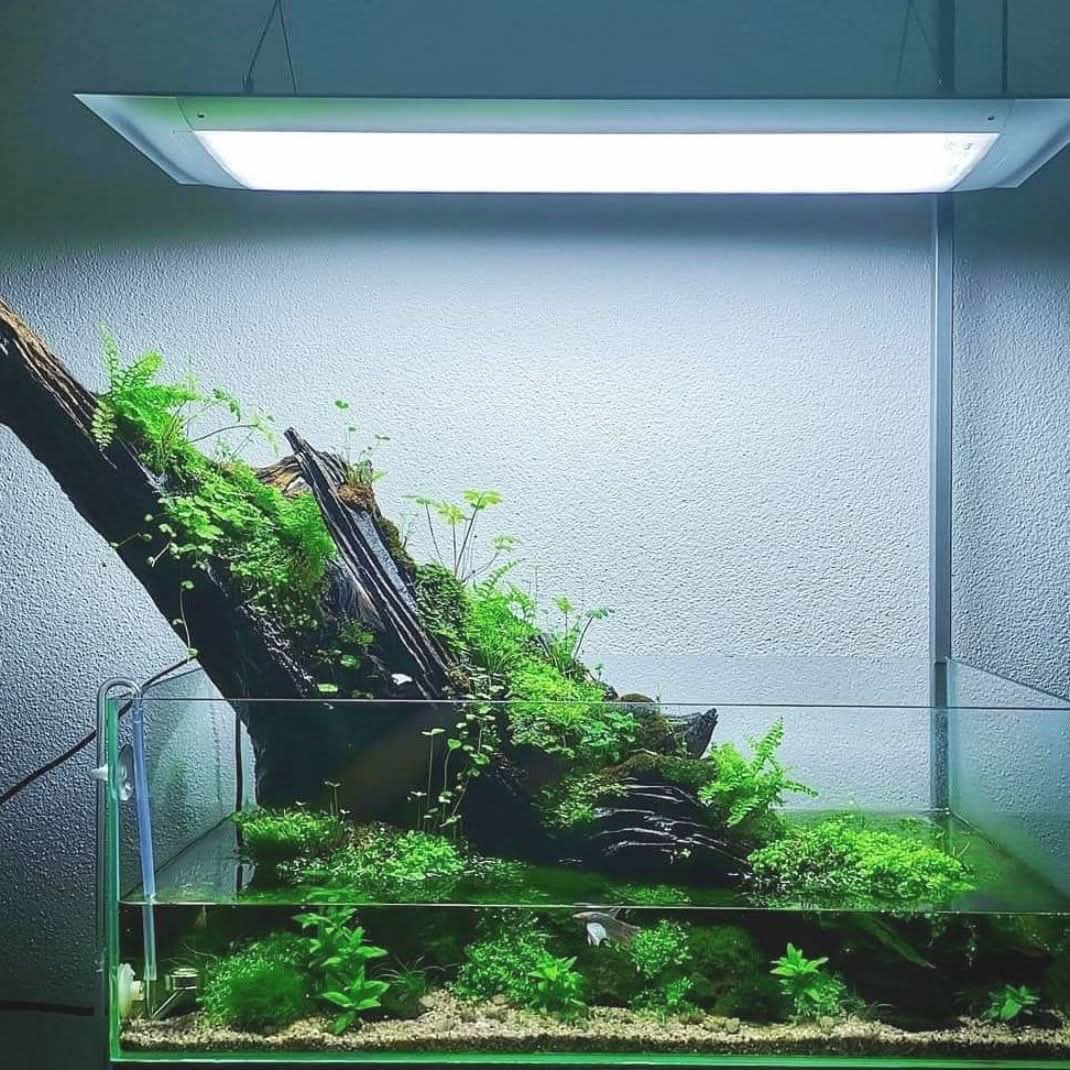
Hybrid aquarium ecosystems exist at the boundary between land and water, where aquatic and terrestrial processes interact within a single enclosed system.
Most aquariums are fully aquatic systems. Most terrariums are fully terrestrial. Hybrid ecosystems exist in between — at the ecological interfaces where water, land, and air interact continuously.
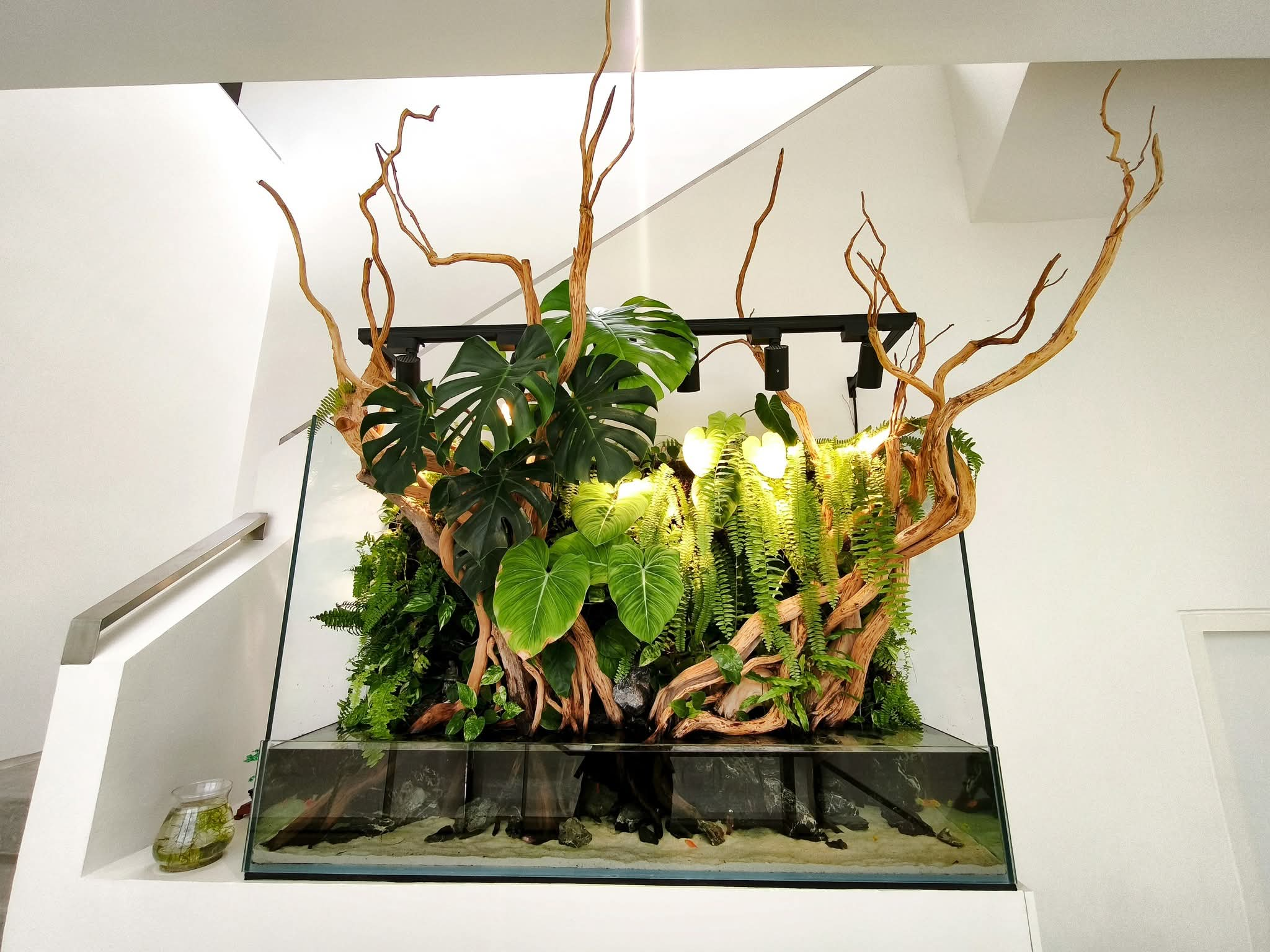
Paludariums, ripariums, vivariums, and other hybrid systems are not simply aquariums with plants growing above the waterline. They function under a different ecological logic, where stability depends less on fixed parameters and more on how well environmental boundaries are designed and managed.
What Makes a System “Hybrid”?
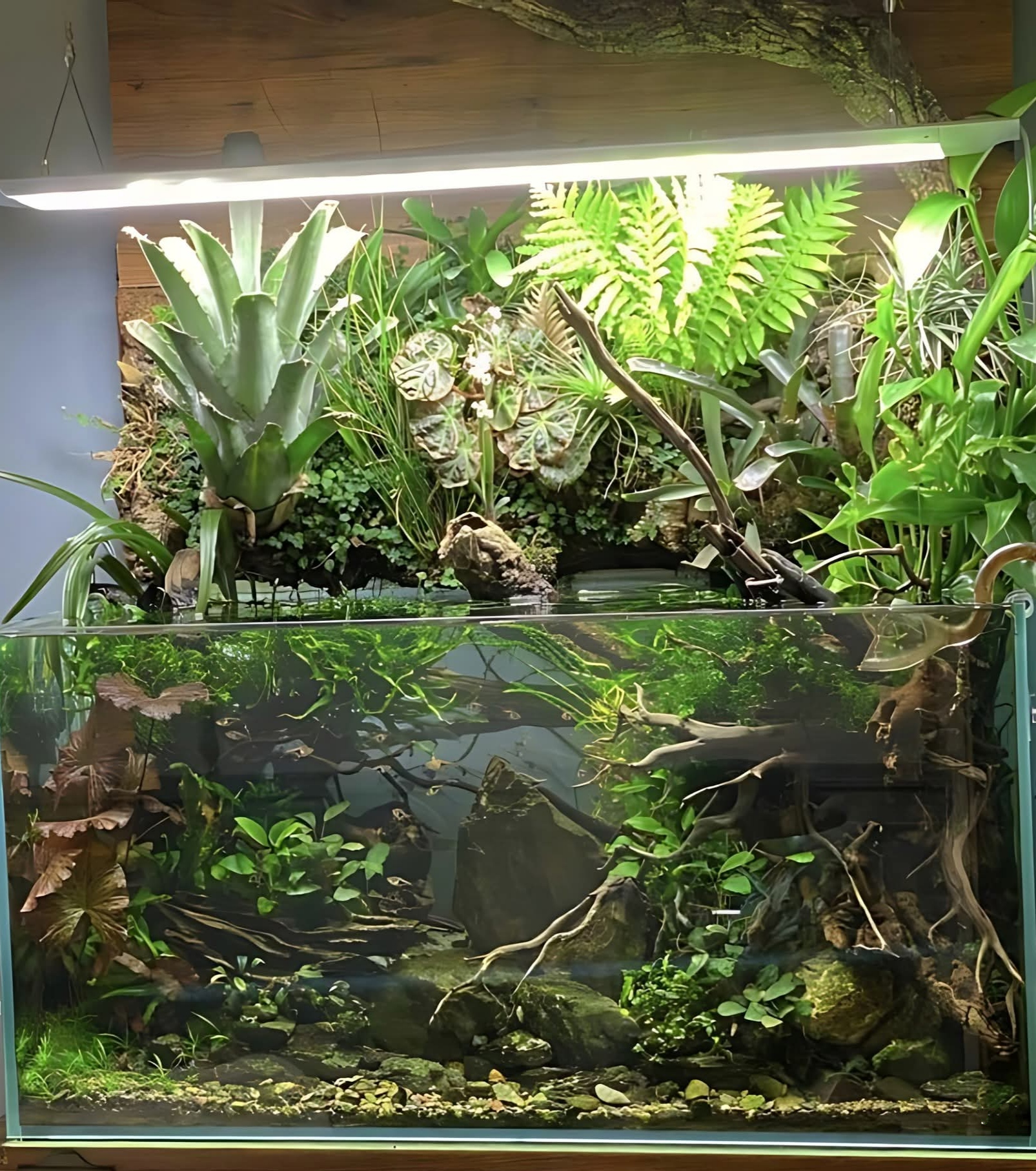
A hybrid ecosystem contains multiple interacting environmental zones within a single enclosure:
- A submerged aquatic zone
- A terrestrial or semi-terrestrial zone
- A shared atmospheric space
Each zone follows different rules. Water buffers temperature and chemistry. Land responds quickly to moisture, microbial activity, and organic decay. Air becomes the connecting medium through which heat, humidity, gases, and microorganisms move.
The success of a hybrid system depends not on perfect control of each zone, but on how smoothly energy, water, and organic matter move across their boundaries.
Why Hybrid Ecosystems Are More Demanding Than Aquariums
Many hybrid systems fail because they are designed as decorative layouts, not ecological systems. Sharp boundaries, sealed substrates, and overly sterile materials prevent natural regulation.
Common failure points include:
- Water quality problems caused by terrestrial runoff
- Mold and fungal growth due to stagnant air
- Root rot from poorly drained land zones
- Livestock stress caused by unstable microclimates
These issues are rarely equipment-related.
These failures are rarely equipment-related. They are interface problems, where land and water are not allowed to interact in controlled, functional ways and reflect the same patterns seen in why aquariums fail despite doing everything right, where systems collapse due to misaligned constraints rather than lack of effort.
Water Chemistry Behaves Differently in Hybrid Systems
In hybrid ecosystems, water chemistry is strongly influenced by land design. Organic material enters the water continuously, not in isolated events. Evaporation concentrates dissolved compounds more quickly. Drainage quality determines whether decomposition stabilises the system or overwhelms it.
As a result, chemistry in hybrid systems is best understood as a consequence of structure, not something to be corrected independently. Attempting to manage chemistry without addressing land–water interactions usually increases instability.
This idea connects directly to ProHobby™’s reference articles on water chemistry as a system outcome rather than a target.
Livestock Selection: Adaptation Over Parameters
Hybrid ecosystems favour species adapted to environmental variability. Amphibious fish, riparian plants, semi-aquatic reptiles, and organisms accustomed to fluctuating water levels perform best.
Species that require rigid parameters often show chronic stress in hybrid setups, even when test results appear acceptable. Behaviour becomes the most reliable indicator of system alignment.
When hybrid systems are correctly designed, behaviour becomes subdued and predictable — not suppressed, but unremarkable.
This constraint-first thinking is also fundamental to biotope aquariums, where geography and ecology dictate what the system is allowed to become.
Maintenance Shifts From Control to Observation
Successful hybrid ecosystems do not rely on rigid schedules. Instead, maintenance responds to visible processes:
- Organic accumulation
- Drainage efficiency
- Air movement and humidity
- Root and microbial health
As systems mature, intervention decreases. Maintenance becomes observational rather than corrective — a pattern shared by stable biotope and ecosystem-aligned aquariums.
Why Hybrid Ecosystems Matter
Hybrid ecosystems represent a shift away from isolated techniques and toward ecosystem thinking. They reward patience, restraint, and respect for natural constraints.
For aquarists ready to move beyond standard aquariums, hybrid systems offer one of the most challenging — and most rewarding — paths forward.
Go Deeper
This article introduces the concept of hybrid ecosystems. ProHobby™ explores the underlying science in greater depth in:
- Biotope Aquariums: Constraint, Emergence & System Fidelity
- Dynamic Equilibrium in Closed Aquatic Systems
- Why Aquariums Fail Despite Doing Everything Right
Hybrid ecosystems do not succeed through control.
They succeed through alignment.